LNG, Natural Gas
August 04, 2025
INTERVIEW: JERA eyes long-term LNG supply deal with Qatar by March 2026

HIGHLIGHTS
Focusing on Qatar after securing US Gulf Coast LNG
Looks at Qatar for emergency response capability
'Definitely want to revive long-term contract with Qatar': Tsugaru
Japan's JERA sees Qatar as a potential "base" supply source into the 2030s due to its "absolutely stable supply" capability, as the largest Japanese power generation company aims to "revive" a long-term LNG supply contract by signing a deal by the end of March 2026, its chief low carbon fuel officer told Platts, part of S&P Global Energy.
The move by JERA, which is among the world's largest LNG buyers, comes as it intends to focus as a "top priority" on working toward a potential long-term contract with Qatar, Ryosuke Tsugaru, who is also a senior managing executive officer, said in an interview at the company headquarters in Tokyo on Aug. 1.
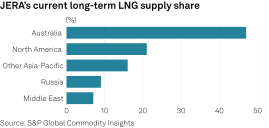
JERA's latest move follows its securing of up to 5.5 million mt/year of LNG from four US Gulf Coast export developers, bringing the share of US LNG in its long-term supply portfolio to about 30% from the current level of 10%.
"Since the bulk of LNG from the [US] Gulf Coast has been secured, I hope to proceed with negotiations with Qatar as a top priority moving forward, honestly speaking," said Tsugaru, who joined JERA in April 2024 after an over 30-year career at Mitsubishi, where he was senior vice president and division COO of the Asia-Pacific Division.
"To be honest, I personally believe that the absence of a long-term contract with Qatar in JERA's overall portfolio of 30 million mt[/year] is a significant issue since I joined the company," Tsugaru said.
"The reason is that Qatar currently produces about 20% of the world's LNG, but JERA is only buying 700,000 mt[/year] from the producer," he added.
Why Qatar
During the interview, Tsugaru explained why JERA is pursuing a long-term LNG contract with Qatar, which it categorizes differently from the US.
In the case of the US, Tsugaru said, "To put it simply, we are buying LNG, but what we are really buying from the Gulf Coast is its competitiveness, flexibility and stable supply."
"So, what are we buying from Qatar? First, as I mentioned earlier, stable supply; but to add one more thing, it is absolutely stable supply and the ability to respond to supply disruptions -- in other words, emergency response," he said, referring to Japan's frequent energy contingencies.
With its "overwhelming reserves, production capacity and large fleet capacity," Tsugaru said Qatar has "flexibility and emergency response systems built into its supply system."
"Our company currently holds about 25 million mt[/year] of long-term LNG contracts and also procures from the spot market," Tsugaru said.
"Depending on the year, our [domestic LNG] demand volume fluctuates around 30 million mt[/year]. Ultimately, without a variety of supply sources with different attributes in this portfolio, we cannot achieve a stable or flexible supply," he added.
"If Japan does not engage with countries that have some of the world's most stable and potentially flexible supply systems, I believe we will fall into a trap," Tsugaru said.
"Therefore, I definitely want to revive the long-term contract with Qatar," he added.
Supply role
JERA is currently looking at placing a potential long-term LNG supply from Qatar as the "base" for its LNG supply portfolio, while US LNG will be used to respond to LNG demand fluctuations caused by weather, industry and renewable energy, Tsugaru said.
"That is where we will rely on America," he said about the LNG demand fluctuations. "We will place Qatar at the base."
When asked about the potential size of additional Qatari LNG supplies, Tsugaru said, "We don't currently have a specific percentage target for Qatar."
"Rather, we want to revive the long-term contract at a scale comfortable for both parties," he said.
"By reviving the long-term contract at a comfortable scale for both parties, I believe we will begin to see the general outline of our portfolio around 2030," he added.
Asked about the timeline for the potential LNG supply deal with Qatar, Tsugaru said, "I personally hope to reach a conditions agreement within the calendar year [2025], and that a binding SPA [sale and purchase agreement] can be concluded within the fiscal year [ending March 2026]."

Editor: