LNG, Maritime & Shipping
June 23, 2025
Asia weighs LNG supply contingency amid focus on Strait of Hormuz security
HIGHLIGHTS
Platts JKM up 16% since Israel's June 13 attack on Iran
India, China buyers do not expect further escalation
Enhanced shipping safety measures create congestion
Asia's key buyers of Middle Eastern LNG are considering alternative supply sources following the US' strikes on Iran's nuclear sites over the weekend, which has shifted focus to shipping security in the vital the Strait of Hormuz delivery route, sources told Platts June 23.
The move by importers in India, China, South Korea and Japan comes as Tehran strengthens its rhetoric surrounding a potential blockage of the Strait of Hormuz, a vital chokepoint through which about 20% of the world's oil and LNG transit daily.
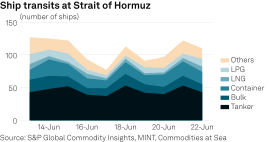
Shipping companies have started to take a more cautious approach to transiting the Strait of Hormuz, which has created large areas of congestion outside the key waterway, a crucial passage for LNG exports from Qatar and the UAE to Asia, according to shipping sources.
Platts, part of S&P Global Energy, assessed the JKM -- the benchmark price reflecting LNG delivered to Northeast Asia -- up 16% from $12.758/MMBtu on June 12, to $14.815/MMBtu on June 23, driven by supply concerns as market participants consider the potential closure of the Strait of Hormuz.
India, China
India and China have the largest exposure to Qatari LNG imports in Asia. India's share of Qatari LNG imports stood at 42.6% in 2024, according to Energy data, while China's Qatari LNG imports accounted for 24% of the total last year, according to the country's General Administration of Customs.

A Chinese LNG importer echoed the assessment of the situation, saying: "Even if the Strait of Hormuz were to be closed, I believe such a situation would not persist for long, especially considering that China is likely to intervene."
However, some Chinese national oil companies have been discussing contingency measures for the potential closure of the Strait of Hormuz since last week, according to one Chinese importer.
Commenting on the current situation, a source in the Middle East said: "So far it should be ok but the situation can change dramatically."
"In any case, demand in China is subdued, they won't mind deferring deliveries to other periods of the year or later," the Middle East source added.
The source, however, warned that "the situation can change quickly. A wounded tiger is unpredictable."
S Korea, Japan
In South Korea, the Ministry of Trade, Industry and Energy held an emergency meeting with local oil and LNG importers on June 23, following the US' bombing attacks on key Iranian nuclear facilities over the weekend.
"There have been no disruptions in imports of oil and LNG, and that all oil tankers and LNG carriers passing the Strait of Hormuz for South Korea are under normal operation," the MOTIE said in a statement at the end of the meeting.
The government and state-run Korea Gas Corp. said they are not seeking alternative Qatari LNG supply for the peak summer season at the moment, but indicated the country may raise shipments from Australia and the US.
"South Korea has already reduced shipments from Qatar, while raising imports from Australia and the US," a MOTIE official said.
For the first five months of the year, imports of Qatari LNG declined almost 15% year on year to 3.154 million mt, while shipments from Australia climbed 25% during the period.
Japan's exposure to Middle East LNG supply is relatively limited, with its Qatari LNG imports accounting for just 4.4% of total deliveries in 2024, according to Ministry of Finance data.
"Our loading of Qatar cargoes finished before the conflict happened, and we don't have any scheduled to load from Qatar for a while," said one Japanese buyer.
Another Japanese buyer said: "We are closely monitoring the situation in Hormuz, and in the case of supply disruptions, we will only consider spot procurement."
Shipping risk
LNG exporters and lifters of term cargoes in the Persian Gulf have asked their fleet operators to keep their ships outside an area considered to be of higher risk, to reduce insurance costs and avoid congestion.
The additional war risk premium, or AWRP, for a seven-day transit through the Persian Gulf is hovering between 0.125%-0.25% of the Hull and Machinery value. This pushes up the costs for shippers in a big way, an LNG shipping broker said.
Typically, LNG ships are positioned around Qatar and Abu Dhabi for several days, or even a few weeks, until their loading plan is finalized, another broker said.
Now, LNG ships will enter the high-risk area only when they have to load a cargo, which they can do in just 24 hours, thereby saving on insurance costs.
However, LNG shipping sources said that the current congestion in the Persian Gulf will impact movement of cargoes out of the region, even if the Strait of Hormuz is not closed. This will support freight rates, which had witnessed a slump even before the latest Israel-Iran conflict began. Asia-Pacific TFDE LNG freight rates were assessed by Platts at $17,500/day on June 20, up $2,500 on the day.
Safety measures
Japan's NYK Line, among the world's largest ship operators, has introduced a standby measure of up to several days for its vessels waiting before entering the Strait of Hormuz to limit their time in the Persian Gulf, where flexibility in schedules allows, a company spokesperson told Platts June 23.
The move comes as part of a precautionary measure following the escalation of the Israel and Iran conflicts since June 13, the spokesperson said.
"At this point, we have not implemented a complete navigation halt in the Strait of Hormuz," the spokesperson said. "However, decisions regarding the passage or entry of each vessel in the future will be made by our management while assessing the latest safety conditions."
Similarly, Japan's Mitsui OSK Lines, the world's largest operator of LNG carriers, has cautiously kept sailing in the Persian Gulf as of June 22, albeit with enhanced safety monitoring, a company spokesperson told Platts.
"We are continuing operations in the Persian Gulf with the utmost attention, prioritizing the safety of crew, vessels, and cargo," the spokesperson said.
MOL's Safety Operation Supporting Center is now monitoring the safety of its sailings in the Persian Gulf in 24-hour operations, the spokesperson added.

Editor: