LNG
April 01, 2026
Market upheaval drives reversal in Singapore-Rotterdam LNG bunker spread
By Megan Gildea and Atsuko Kawasaki
Editor:
HIGHLIGHTS
Singapore holds $1.55/MMBtu premium over Rotterdam
LNG bunker prices reversed from earlier discount
LNG bunker fuel prices in Singapore held a premium to Rotterdam on March 31, underscoring a sharp reversal from the discount structure seen earlier this year, as geopolitical tensions and regional supply-demand shifts reshape market dynamics.
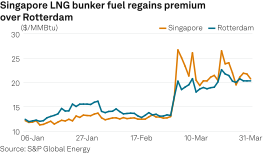
Platts, part of S&P Global Energy, assessed the price of LNG bunker fuel in Rotterdam at $19.20/MMBtu on March 31, while Singapore was assessed higher at $20.749/MMBtu, placing the Asian hub at a $1.55/MMBtu premium to the Dutch port.
The current premium marks a significant turnaround from the trend observed at the start of 2026. Between Jan. 1 and Feb. 27, Singapore LNG bunker prices averaged a $1.86/MMBtu discount to Rotterdam, reflecting relatively softer demand in Asia and ample regional supply.
The spread began to narrow at the start of March as global gas markets reacted to the US and Israeli strikes on Iran. On March 2, the discount had compressed to just 17 cents/MMBtu, following a sharp rally in both hubs. Singapore prices climbed more than 21% on the day, while Rotterdam surged more than 28%.
A decisive shift occurred on March 3, when the spread flipped into premium territory, with Singapore commanding a steep $6.42/MMBtu premium over Rotterdam -- the widest differential recorded during the period under review.
Although the premium eased in subsequent sessions, falling to as low as 73 cents/MMBtu on March 11, it remained largely positive through most of the month. The spread briefly reverted to a discount on March 25, at 50 cents/MMBtu, before flipping back in the following sessions, reaching a premium of 32 cents/MMBtu.
Overall, from March 2 through March 27, Singapore LNG bunker fuel averaged a premium of $2.27/MMBtu to Rotterdam, highlighting a sustained shift in regional pricing dynamics.
Market participants attributed the volatility to a combination of supply concerns, shifting arbitrage flows and stronger bunker demand in Asia relative to Europe. The evolving spread continues to influence vessel routing decisions and LNG bunkering economics across key global shipping corridors.
For Singapore in particular, the rallying JKM -- the benchmark for LNG cargoes delivered into Northeast Asia -- was a key driver behind the reversal of the spread.
QatarEnergy on March 4 declared force majeure on its LNG supplies to affected buyers, having halted LNG production on March 2. JKM surged as Asia sought to compete with the European market to secure US and West African cargoes in the absence of Qatari volumes.
JKM rose to $25.412/MMBtu on March 19, the highest since Dec. 30, 2022, according to Platts data.
Singapore LNG bunker prices fell below VLSFO on a GJ basis on March 9, Platts data showed, boosting demand in the bunkering hub.
Singapore has been seeing spot demand from tankers and car carriers, an LNG bunker buyer said. "LNG bunker buyers maximized their buying volumes from term contracts for March delivery because prices were lower than VLSFO," an LNG bunker trader based in Singapore said.
Rotterdam LNG bunker prices have also shown improved price competitiveness since the onset of the war. The spread to VLSFO on a Gj basis remains narrower than levels prior to the conflict. Between Jan. 1 and Feb. 27, LNG averaged a premium of $2.25/Gj to VLSFO. Since March 2, it has averaged 70 cents/Gj.
