LNG, Natural Gas
April 01, 2026
Europe enters gas summer cycle under fragile supply outlook
By Megan Gildea and Eniayo Adeniji
Editor:
HIGHLIGHTS
Summer prices hit premium to winter levels
Storage target of 90% faces feasibility risk
Europe's gas market entered the summer injection season April 1 under an unusually complex and fragile supply outlook, as geopolitical shocks and structural shifts reshaped expectations for storage refilling and price formation in the LNG and gas complex.
The combined impact of Iranian strikes on Qatari infrastructure and the stalling of ship traffic through the Strait of Hormuz has removed a significant portion of flexible LNG supply from the global system.
Qatar, the world's second-largest LNG exporter after the US, shipped 82.44 million metric tons of LNG in 2025, with 8.9% of this total directed towards European terminals, according to S&P Global Energy CERA data. With these volumes curtailed, the market has been anticipating tighter balances for the summer injection season.
Although the injection period typically begins around April, market uncertainty and unattractive regasification economics are prompting the region to shift injections further into the summer months, from June onwards, sources said.
Market expectations for summer prices have accordingly moved higher. Platts, part of S&P Global Energy, assessed Northwest Europe at an average of $16.428/million British thermal unit for May-September 2026, while Winter 2026 was at $16.275/MMBtu March 31.
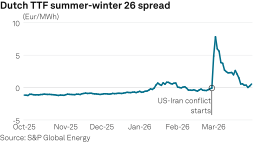
Similarly, Platts assessed the Dutch TTF Summer 26 contract at Eur50.345/megawatt-hour March 31, at a 53.5-euro-cent/MWh premium to its winter equivalent.
This inversion reflects growing concerns over the refilling challenge and marks a significant reversal from the start of the gas winter, when Platts assessed the TTF Summer 26 instrument at a Eur1.165/MWh discount to the winter Oct. 1.
EU member states have been tasked with meeting a 90% storage fill target at any point over Oct. 1-Dec. 1, with this figure adjustable downward by 10 percentage points in the event of difficult conditions.
However, the feasibility of such targets has come under scrutiny, with the Energy Commission calling for further reductions in late March.
CERA's latest base-case scenario projects inventories to replenish to about 82% at the start of the next heating season, a level similar to that seen at the start of winter 2025-26.
"I think as long as JKM-TTF spreads continue to remain favored to Asian deliveries, we are likely to see European injections trend below the rate required to reach comfortable levels next winter," a Europe-based analyst said.
East vs. West competition
Asian demand has so far been relatively muted, allowing Europe to attract cargoes without competitive bidding.
However, expectations have been building that stronger cooling demand in key Asian markets would increase procurement in the coming months.
"I think the view is that Europe doesn't need the cargoes right now, but April is injection season ... but we're getting into dangerous territory now," an Atlantic-based trader said.
Should that Asian demand materialize, Europe would be forced to compete more directly on price to secure marginal cargoes. Market participants said this dynamic has not fully emerged in spot pricing, but forward curves have begun to reflect a tighter balance into the peak summer period.
"Even if storage targets are relaxed, the risk just gets pushed to winter, so Europe will be competing in the third and fourth quarters for the extra cargoes," a second Atlantic-based trader said.
Market participants were in consensus that, due to unattractive economics, the injection risk is being pushed further down the curve, and the market will be seeking to inject later in the summer than is typically the case.
"The squeeze or shortage will likely appear in Q4, but we could see [a] price rally this month if timelines for the war's conclusion continue to shift," the Europe-based analyst said.
"Before the war, the task of getting storages back to 80% would have already required a record amount of flows into Europe," a second Europe-based analyst said. "If the conflict does continue into summer, TTF will have to bid higher. I wouldn't be surprised if we go above [Eur]80[/MWh]. It's either the higher bid, or we don't secure the record amount of cargoes needed."
Aggregated gas storage inventory data showed EU gas stocks at 28.11% full as of March 29, following a net injection of 0.01% on the day. While modest, the build marked only the second net injection recorded this year.
