08 Mar 2022 | 07:46 UTC
LNG buyers, traders cut exposure to spot Russian LNG trade

By Eric Yep
Highlights
Importers avoiding direct procurement of Russia-origin spot LNG
Suppliers asked not to nominate Russian cargo from their portfolio
Contractual clause allows buyers to reject Russia-origin nominations
LNG market participants are actively reducing exposure to Russian-origin spot LNG cargoes as the global backlash against Moscow escalates and increasingly envelopes the energy trade, several sources from LNG importing companies, portfolio majors and trading houses told S&P Global Commodity Insights.
Companies are avoiding direct procurement of spot LNG originating from Russia, in addition to informing suppliers not to nominate a Russian cargo from their portfolio or inserting a contractual clause in spot transactions that allows buyers to reject Russia-origin nominations, sources said.
The growing pushback is likely to affect LNG trade flows, resulting in a tiered LNG marketplace where benchmark prices surge due to tighter supply, while Russian LNG spot cargoes become heavily discounted due to a lack of buying interest.
Even though there isn't a trade embargo on Russian LNG currently, the potential for future sanctions has made payment channels more difficult, and logistical difficulties, such as shipping arrangements, in trading such spot volumes have increased significantly, according to these market sources.
Chinese national oil companies are not considering buying spot LNG cargoes now, as the price is too high, but are likely to take a wait-and-see stance on buying Russian LNG cargoes or trade with Russia at present, a source with an NOC said.
One international oil and gas company has already issued directives to its trading desk to avoid Russian spot LNG due to growing reputational risk, although payment channels for Russian commodities were still open.
A lot of caution in the LNG community is purely from the perspective of managing risk, more so from the trade finance and shipping side of the business.
Suppliers loading from Russian LNG terminals were being asked to include "subject to buyer's acceptance" clauses, which means much higher risk in transit, as the end-user can decline to accept the shipment if financial sanctions tighten further or if ports decline to accept Russian cargoes or vessels.
Last week, Malaysia's transport ministry said the country's operator Kuala Linggi had denied entry to Russia-flagged Aframax tanker Linda 2, which was due to dock March 5. The 115,418 dwt crude oil tanker was named under the specially designated list of the Office of Foreign Assets Control of the US Department of the Treasury.
However, even non sanctioned Russian vessels have been affected recently. Two Cyprus-flagged LNG tankers bound for the UK's Isle of Grain terminal had to be diverted after port workers declined to process Russian cargoes, even though a UK ban on Russia-linked vessels did not include Russian cargoes.
Besides, in a tiered market, high-risk trades also carry large margins. Traders said there were inquiries about distressed Russian LNG cargoes available at discounted prices, with a few Chinese and Indian buyers still willing to import Russian LNG.
These trades can be lucrative especially as Asian spot LNG prices hit record highs.
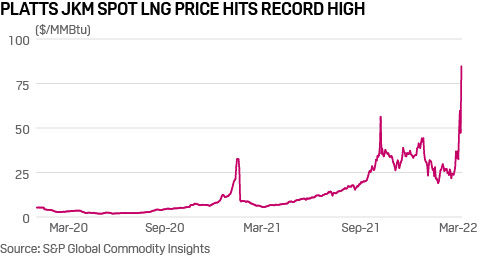
Spot Asian LNG prices hit a record high twice within a span of a week. The Platts JKM for April deliveries touched $59.672/MMBtu March 3. Platts JKM rose 79.21% from a day earlier to $84.762/MMBtu March 7, registering the single largest daily jump in the price assessment, according to S&P Global data.
Related Factbox: Key China-Russia oil and gas deals, joint projects and energy investments
Editor: