Fertilizers, Chemicals, Energy Transition, Renewables
November 17, 2025
Market digests Trump's exemption of nitrogen fertilizers from US tariffs
HIGHLIGHTS
Market reactions mixed amid uncertainty about impacts
US urea imports up 2.6% year to July; Russia key supplier
Market reaction was mixed Nov. 17 to the Trump administration's recent exemption of nitrogen-based fertilizers from new US tariffs. The removal of the tariffs was effective Nov. 13.
"I heard prices in the US dropped," a Europe-based trader of urea said. "As for other impacts, we shall see."
The trader added that Russia, which had been benefiting from the absence of US tariffs on its nitrogen-based fertilizers, will now "need to compete with Algeria and Nigeria on equal levels."
Algeria and Nigeria had faced the US tariffs.
US President Donald Trump's newly signed executive order specifies that while some fertilizers will remain under tariffs, critical products such as urea, ammonium sulfate, ammonium nitrate, calcium ammonium nitrate and urea ammonium nitrate are now exempt. However, ammonia will continue to incur tariffs, impacting its import costs.
Market participants expected the adjustments to influence supply dynamics.
"In the short run, we may see an oversupply of urea," the Europe-based trader said.
A European ammonium sulfate producer said the changes could also attract European ammonium sulfate to the US.
A US-based urea trader's outlook was more cautious.
"The market is digesting the news," the trader said. "Yes, it could drive new demand, but not now. The spring season in the US is in the first quarter. Many things will surely change. For example, Russians might look for new destinations as they were too calm exporting with no tariffs to the US, but the effect will not be immediate."
A second US-based urea trader said the US market rebounded Nov. 17 for January futures to $365-$370/st FOB NOLA from $360/st Nov. 14.
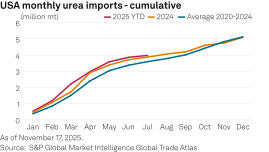
US urea imports January-July totaled 3.979 million metric tons, up 2.6% from the year-ago period, according to the latest data from S&P Global Market Intelligence's Global Trade Atlas. The 2025 imports are 10.6% above the five-year average of 3.596 million mt, indicating a general upward trend in imports despite monthly fluctuations.
Russia remained a key supplier to the US on a year-to-date basis, with imports increasing 31.3% to 1.390 million mt January through July, up from 1.059 million mt a year ago. This growth highlights Russia's continued importance as a supplier despite a 78.4% year-over-year decrease in July imports.
Platts, part of S&P Global Energy, assessed the NOLA-30 price at $385/st FOB Nov. 14, unchanged day over day.
| United States urea imports ('000 mt product) | |||||||||
| Origin | year-on-year | year to date-year to date | month-on-month | ||||||
| Jul-2024 | Jul-2025 | % chg | Jan-Jul 2024 | Jan-Jul 2025 | % chg | Jun-2025 | Jul-2025 | % chg | |
| Russia | 109 | 23 | -78.4% | 1,059 | 1,390 | 31.3% | 180 | 23 | -87.0% |
| Qatar | - | 38 | - | 704 | 740 | 5.0% | - | 38 | - |
| Algeria | 3 | 3 | -18.9% | 389 | 410 | 5.4% | 30 | 3 | -91.0% |
| Nigeria | 0 | - | -100.0% | 336 | 401 | 19.5% | - | - | - |
| Canada | 22 | 25 | 10.1% | 352 | 294 | -16.4% | 20 | 25 | 22.9% |
| Saudi Arabia | 0 | 0 | 123.9% | 296 | 249 | -15.8% | - | 0 | - |
| Trinidad & Tobago | 9 | 12 | 28.6% | 64 | 122 | 90.3% | 0 | 12 | 12470.7% |
| Bahrain | - | - | - | 0 | 88 | 69740.5% | - | - | - |
| Malaysia | - | - | - | - | 74 | - | - | - | - |
| Others | 20 | 17 | -15.3% | 677 | 210 | -69.0% | 41 | 17 | -58.1% |
| Total | 164 | 118 | -27.9% | 3,877 | 3,979 | 2.6% | 271 | 118 | -56.4% |
| As of Nov. 17, 2025 | |||||||||
| Source: S&P Global Market Intelligence Global Trade Atlas | |||||||||
| © 2025 S&P Global | |||||||||

Editor: