Fertilizers, Chemicals, Energy Transition, Renewables
November 05, 2025
FEATURE: Fertilizer sector navigates CBAM challenges, uncertainties ahead

HIGHLIGHTS
EU's CBAM adds costs to imported ammonia
Importers face uncertainties over CBAM calculations, benchmarks
Trade flows set to shift as carbon costs drive decarbonization
When Agropolychim switched off its ammonia plant in 2018 and moved to imports, it allowed the Bulgarian fertilizer giant to wean itself off natural gas and -- as a result -- Russian investment.
Like other European ammonia producers facing higher feedstock and production costs, the Bulgarian nitrogen and phosphorus company opted to eliminate the last molecule of gas in its fertilizer production chain, substituting it with imported ammonia, urea, and steam from local biomass to produce ammonium nitrate fertilizers. This strategy boosted production and helped Agropolychim become a critical supplier of fertilizers to Ukraine. However, it did not account for the EU's Carbon Border Adjustment Mechanism, which will add costs to imported ammonia based on carbon intensity, according to Philippe Rombaut, chairman and co-owner of the company.
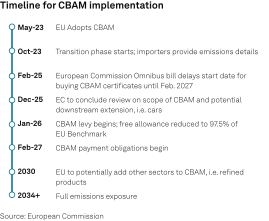
The CBAM, which will come into financial force on Jan. 1, alters the dynamics for Agropolychim and other European importers.
The legislation, which is aimed at addressing carbon leakage by imposing carbon costs on certain imported goods, aligning them with the costs borne by domestic producers, could lead to significant changes in trade flows as more carbon-intensive cargoes are redirected to other markets.
The European Commission defines the CBAM as a "tool to put a fair price on the carbon emitted during the production of carbon-intensive goods -- including fertilizers -- entering the EU, to encourage cleaner industrial production in non-EU countries." This legislation aims to create a level playing field between importers of CBAM goods and domestic European producers already required to purchase EU Allowances.
From a carbon accounting standpoint, CBAM liabilities will fall on importers and traders, who will be required to buy CBAM certificates in 2027 to offset the CO2 imported in the previous year. Importers, large trading houses, and suppliers of fertilizers and other designated CBAM products have been gathering data for over two years on the embedded emissions of various products covered by the mechanism, including all nitrogen-based products.
As contract negotiations intensify ahead of the January start of the implementation phase, importers and traders are doing everything they can to better understand the potential liabilities they may incur under CBAM. But many argue that this is also happening without much of the critical information needed to calculate those costs. Market participants are already stocking up in Q4 in anticipation of the CBAM implementation taking place next year, Rombaut said.
Some market players complain that key components of the formula remain undefined, such as the benchmark and default values that will determine how embedded emissions are charged. Additionally, there is no finalized list of approved verifiers responsible for auditing these emissions, nor is there clarity on how export compensation will be handled for companies like Agropolychim that rely on imported ammonia for producing export-bound fertilizers. The EU has said it will publish benchmark values on a product or commodity-code basis in early 2026, but Rombaut says this is not soon enough.
"The first year, nothing is clear," Rombaut said. "We don't know what the reference is. We don't know how it's going to be calculated. I mean they are still trying to figure out the benchmarks, and then the [verifiers] are not there. So, the first year, it's pointless just to say how much it's going to be because nobody actually knows."
The CBAM significantly impacts Agropolychim and other importers of ammonia and nitrogen-based products, which will be subject to the mechanism.
The company's ammonia imports originate from countries such as Trinidad & Tobago, Algeria and Egypt where the carbon intensities used for CBAM cost calculations exceed current European benchmark values but remain below the globally weighted default values for ammonia. This discrepancy is crucial because, in the absence of a verified audit of the production process, the EU will apply CBAM costs based on default values, which are yet to be finalized.
Additionally, Agropolychim has outlined a Eur250 million investment strategy aimed at exporting fertilizers to markets including Ukraine, and ammonium nitrate to Chile and Australia. Rombaut is advocating for a rebate on CBAM taxes paid on imported ammonia when these products are subsequently exported from the EU.
"What we've been saying also from the last two years is that if we want to be competitive in the outside world outside of the European Union, we should be able to process the ammonia coming in and then get the CBAM back or the rebate or whatever the CBAM back when we export it," he said. "Otherwise, basically, any factory in Europe will be noncompetitive."
Rombaut said he anticipates increased shipments of blue ammonia, produced using carbon capture technology, but he added that he believes the economics are unsustainable.
Changing trade dynamics
Despite the challenges, the CBAM is already influencing trade dynamics, according to Nick Ogilvie, a CBAM specialist based in London with CarbonChain.
CarbonChain, a provider of carbon accounting software, counts fertilizer importers and trading houses among its clients. Ogilvie notes that many of these clients have already established carbon accounting teams that collaborate with non-European producers to ensure smooth verification processes.
Ogilvie says that CBAM will affect trade flows, much like the EU Emissions Trading System influenced decarbonization investment planning when it launched in 2005. He predicts that, by the 2030s, CBAM will compel businesses to make a critical decision: invest in decarbonization or risk losing access to the EU market.
"The EU ETS saw businesses either invest billions of euros in decarbonization, or reduce or relocate their EU operations," he said.
This transformative impact underscores the urgency for companies or countries to adapt to the evolving regulatory landscape.
Egyptian fertilizer producers are considered among the most exposed globally to CBAM due to their significant trade volume with Europe and relatively high carbon intensity in production processes, according to a report published by the UN earlier this year. The country ranks as the second-largest exporter of fertilizers to the EU, behind Russia, and is particularly vulnerable to the CBAM due to its high emissions levels, according to the UN study.
Given the investment needed, government support will be critical to driving the decarbonization efforts globally, according to Nader Hegazy, head of the Marketing Section for Alexandria Fertilizers Company in Egypt. The company produces ammonia used in its urea and granular ammonium sulfate production processes, primarily selling to large trading houses in Europe.
"With the current complexity surrounding CBAM, we regularly follow up on the current situation and get updated gradually with the developments in the regulatory environment around us," Hegazy said.
In the short term, Alexfert is exploring efficiencies to manage operations in 2026, while in the long term, it may explore lower-emission ammonia production methods, he added.
"If we found another market at a premium price, we can go there," Hegazy said. "But as Europe [is] one of our major markets, and uncertainties over Europe nitrogen market, we will be coping with the changes until they reach their end line."
Need for transparency
Rombaut predicts a backlash from farmers due to anticipated rises in fertilizer prices in European markets, which are already grappling with affordability issues.
"When push comes to shove, Paris, the Danube bridges will be blocked [with tractors]," he said at an industry gathering in Lisbon last month. "Don't be surprised in January, February, March 2026 if you go to Paris and get into a traffic jam."
He also said he plans to be transparent with consumers about rising prices.
"We are going to sell our fertilizers with a special line, 'CBAM,' so that the farmers will know exactly that this is the extra cost for the CBAM -- and everybody should do the same," he said. "Let the farmers know, let the farmers know that the decisions of European Union, which were not well thought of, have an impact on their bottom line."
Related Content: The potential proliferation of CBAM: a fragmented carbon tariff landscape

Editor: