Fertilizers, Chemicals
August 12, 2025
European farmers embrace organic fertilizers amid rising prices

By Leia Velarde
HIGHLIGHTS
New policies promote sustainable fertilizer usage
Low crop prices challenge fertilizer affordability
High artificial fertilizer prices disrupt farming balance
Since 2024, the price of artificial fertilizers has surged in the European market. As a result, some farmers have shifted toward organic, sustainable fertilizers, driven not only by economic necessity but also by an increasing commitment to sustainable agriculture, according to sources.
This transition might reshape the agricultural landscape, highlighting a growing trend toward eco-friendly practices in the face of escalating costs and environmental pressures.
Farmers have observed that demand for traditional fertilizers like calcium ammonium nitrate, diammonium phosphate, and urea tends to decrease when their costs surpass profitable levels. This can be exacerbated when crop price levels are low, which has been the case in the current market, sources said.
"Until harvest is done, there will be little interest in fertilizer & with feed wheat at GBP160 +/- with premiums for milling and few enthusiastic buyers, I don't see a rush to procure tons," one agricultural merchant in the UK said.
While the synthetic fertilizers are known for their potency in enhancing crop yields, industry insiders indicated a rising interest in alternative growth solutions that can alleviate the financial burden of high-priced artificial fertilizers. For instance, the price of CAN in Germany soared from $265/mt CIF in July 2024 to $340/mt CIF by the end of July 2025, prompting many farmers to reconsider their options.
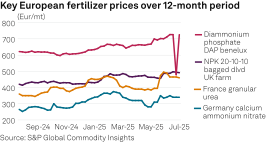
According to the Agriculture and Horticulture Development Board, crop prices for feed and wheat ex-farm in the UK were at GBP167/mt on Aug. 7, with fertilizer costs accounting for around 17%-20% of overall costs to produce the crop, according to one potash producer in Europe.
According to a source at a leading fertilizer producer, this pattern of declining demand for artificial fertilizers in favor of organic alternatives has been a recurring trend during periods of high prices, especially when crop prices are low and profitability margins are narrowed.
Also, new environmental policies have played a pivotal role in promoting the use of sustainable fertilizers and digestate products.
A recent report from S&P Global Energy analysts, published on July 31, said: "In Europe, policy and research have encouraged the production and application of digestate, notably the FPR (fertilizing products regulation) and proposals to advance the CE (circular economy) models in farming systems. In 2019, the FPR set standards for the production and use of fertilizing products, including digestate, by ensuring specific safety and environmental criterions were met. Nutrient-based evidence and real-world results demonstrating the benefits in crop production have supported digestate's regulatory classification as a fertilizer."
However, the transition to organic fertilizers has faced some challenges. Organic fertilizers "are raw materials, and materials are scattered and can be easily contaminated. There is a lot of cleaning involved and risks," the producer source said.
According to the source, artificial fertilizers benefit from established international trade infrastructures and consistent supply chains, making them more accessible for large-scale crop production, leaving organic fertilizers to catch up in their emergence into the global fertilizer market.
"The use of organic fertilizers is mainly localized in Europe, which is the traditional way -- there is currently no infrastructure for this outside of Europe," the producer source added, pointing to the limited availability of organic options in regions like South America and Africa.
More sustainable farming
The shift toward sustainable farming practices has also been driven by fertilizers' demand.
An agricultural merchant based in West Essex, UK, said, "CO2 emissions are being scrutinized more closely, and supermarkets are beginning to pay greater attention to their suppliers' carbon footprints." While the merchant acknowledged that there will always be a market for artificial fertilizers, he emphasized the industry's push toward promoting low-CO2 alternatives.
Some leading fertilizer producers have committed to expanding their portfolio of organic and sustainable fertilizers to align with the evolving needs of European farmers, sources said. Despite the infrastructure challenges, organic fertilizers seem an attractive alternative for producers who want to comply with environmental regulations.
