Energy Transition, Carbon, Emissions
December 20, 2024
COMMODITIES 2025: Mixed views on price sentiment for CORSIA Phase 1 despite thin supply

HIGHLIGHTS
CEC price hits all-time high of $20/mtCO2e on restricted supply
Verra-certified cookstove projects looking to transition to VM0050 methodology
Questions on viability of CORSIA scheme remain
Market participants hold mixed views concerning price expectations in 2025 for carbon credits under phase 1 of the Carbon Offsetting and Reduction Scheme for International Aviation, despite restricted supply following the International Civil Aviation Organization's announcement of eligibility criteria.
"By narrowing the scope, [ICAO] adds perceived value to eligible credits, enhancing quality and integrity while potentially supporting higher prices over time," said Chamss Ould, head of Carbon Finance at dClimate, a climate data and carbon solutions company.
"I expect prices to go up with the approved methodologies to sell at a premium as [we] get closer to the second half of 2025 and into 2026," Ould said.
According to a Europe-based cookstove developer, the announcement is "definitely a bullish signal [for] the market."
However, an end-buyer cautioned against overly bullish sentiment, which may defer airlines' willingness to transact CORSIA credits.
"It's an inflection point where airlines will either look to implement CORSIA or lobby for [non-compliance] penalty delays," the source said.
In a document issued on Dec. 6, ICAO confirmed that credits from four prominent carbon registries -- Gold Standard, Verra, Climate Action Reserve and Global Carbon Council -- are now eligible for the first phase of CORSIA, set to run from Jan. 1, 2024, through Dec. 31, 2026, although with some exclusions outlined in the document.
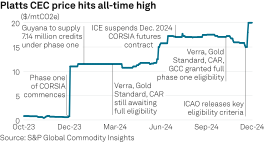
The Platts CEC price – which reflects CORSIA phase 1 eligible credits – was assessed at $20/mtCO2e on Dec. 19, having opened the year at $11/mtCO2e, upon pivoting from the pilot phase (2021-2023) to phase 1.
The failure of GS, VCS and CAR to gain full approval from ICAO in March led to the price reaching a then-record $17.55/mtCO2e Aug. 7. In the aftermath of the latest ICAO announcement, data from S&P Global Commodity Insights shows the price soared approximately 26% in December, with the assessment hitting an all-time high.
Limited supply, subdued demand
Since the transition to phase 1 of the scheme, the market has lacked adequate supply. According to data from Commodity Insights, only 7.14 million credits issued by Guyana under the ART Trees standard have been eligible.
Market participants expect the supply crunch to be exacerbated in the short term in light of the recently released eligibility criteria. Credits that use the VMR0006 and AMS-II.G methodologies issued by Verra will not be eligible for phase 1, as per the guidance document, which market participants told Commodity Insights limits supply in the near term.
The exclusion will have a significant impact on the market since many VCS cookstoves with a letter of authorization use VMR0006, a Europe-based developer/trader said. "They will switch to VM0050 when available so in the future those projects will be OK."
An India-based developer/trader said they expect the supply side to remain significantly short for the next six months and supply to pick up in the second half of 2025.
However, cookstove developers remain uncertain about how long it will take to transition to the VM0050 methodology.
The same India-based developer/trader said they expect the transition to take five to six months, while the Europe-based developer said it could be anywhere between four months to a year.
On the demand side, the end-buyer said the announcement did not "really change the current appetite."
"Airlines are still in wait-and-see mode," the end-buyer said. However, airlines may start to purchase test volumes of around 10,000 mt in 2025 and then look to take on more significant volumes in 2026, the end-buyer said.
The proposed GBP100 (approximately $127) penalty announced in the UK government public consultation, which launched Dec. 16, strengthened the case for an airline to acquire credits as it appears that CORSIA can be fully implemented.
Need for insurance
Furthermore, the ICAO eligibility criteria stipulated the need for some standards to ensure that carbon offsets "are the subject of a Guarantee approved by the program that covers all units to which the host country Letter of Authorization applies."
On Dec. 9, in a guidance document released shortly after it received full eligibility under phase 1 of CORSIA, Gold Standard confirmed that only carbon projects insured by the World Bank's Multilateral Guarantee Investment Agency were permitted.
A Europe-based developer said that a sole provider would further "curtail" the supply of CORSIA-eligible credits.
The sentiment was echoed by Ould: "It's good to have guidance ...but imposing one provider might be limiting," he said.
In the same CORSIA guidance, GS said it is developing and intends to establish a process to recognize insurance policies "from third-party private insurance companies as approved insurance policies to support guarantees for the avoidance of double-claiming under CORSIA."
Letter of Authorization
Moreover, challenges still remain concerning the ability of projects to secure a corresponding adjustment, or CA.
ICAO has required carbon credits used under CORSIA to obtain CAs, guaranteeing that the host country will not claim the credit against its climate goals, known as Nationally Determined Contributions, and will prevent the double counting of credits.
Currently, there are very few letters of authorization -- which are the first step to obtaining a CA -- in the market.
In September, analysts at Commodity Insights identified 10 countries as having LoAs, with the majority only authorizing one project for international sale. If all the eligible projects in these countries were to be authorized, there could be a maximum of 46 million credits available, meeting approximately 20% of Phase I demand, the analysts forecast.