Energy Transition, Carbon, Emissions
December 16, 2025
COMMODITIES 2026: New Zealand carbon market poised for steady recovery; elections in focus

HIGHLIGHTS
Forestry issuances likely to keep supplies higher
Auction performance, policy clarity crucial for recovery
This is part of the COMMODITIES 2026 series, in which our reporters bring to you key themes that will drive commodities markets in 2026.
New Zealand's carbon market is expected to recover in 2026, driven by compliance demand, with a focus on New Zealand Units issuances from the forestry sector and the election outcome, according to multiple local traders, brokers, consultants, and policy experts.
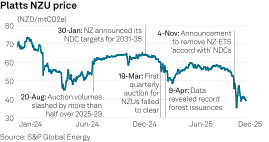
After a year of volatility and a near 37% drop in Platts NZU prices as of Dec. 12 following the government's decision to distance the ETS from core NDC targets, market participants are hopeful of steady growth over the next year.
Platts, part of S&P Global Energy, assessed New Zealand Units at NZ$39.25/mt of CO2 equivalent ($22.80/mtCO2e) on Dec. 12, steady day over day, and down 34.58% from a year ago.
"Some emitters that drew down their stockpiles this year and are not looking to overpay for auction units may stabilize the price with buying support, and we could see a flatter price line," said Sinead McAllery, senior ETS Consultant, Carbon Forest Services Ltd.
However, the upward price momentum for NZUs is unlikely to return until market confidence is restored, according to ANZ's carbon market chartbook on Nov. 28. Analysts at ANZ expect prices to trade within the NZ$38–$45/mt CO2e range in the short term and find support in the future.
Market likely to recover, but at a slower pace
After two volatile quarters, NZUs were rangebound between NZ$55/mtCO2e and NZ$60/mtCO2e in Q3. The prices traded in the range until October but fell nearly 49% between Oct. 31 and Nov. 13 following a major revision in the country's climate change law.
"I believe the price could recover by the end of February to around NZ$60/mtCO2e. A failed March 2026 government auction will not bode well for the [secondary spot] market price," a New Zealand-based foresters' group representative and ETS consultant said.
Meanwhile, a local trader said he expects the market to follow the 2025 trend amid higher volumes, with selling pressure building up in February and April.
Forestry Issuances seen higher, auction struggles likely
A key driver of the current NZU prices and auctions not clearing is a stockpile of NZUs in the secondary market, said New Zealand's Minister of Climate Change, Simon Watts, on Nov. 5
A significant portion of this stockpile originates from the forestry sector under the NZ ETS. To control this supply, the government passed a farm-to-forestry conversion bill, Sept. 18, restricting the large-scale conversion of farmland to forestry.
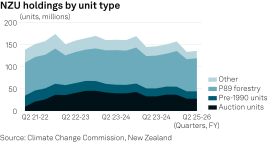
"We are at the end of a Mandatory Emissions Return Period for forestry, and EPA data on volumes of NZUs claimed from voluntary emissions returns to date suggests there is a fair volume of units still to be claimed next year," said Kristen Green, director at Kapiti Climate Insights and a former adviser to the government.
However, the effect of farm-to-forestry restrictions may not be visible next year and may even lead to a greater supply from foresters rushing to enter ahead of the restrictions. The bill will take a couple of years to show any actual impact, market participants told Platts.
All four quarterly auctions of 2025 for NZUs failed to clear amid low spot prices and an oversupplied market. Next year, the floor price is expected to increase to NZ$71/mtCO2e from the current NZ$68/mtCO2e, and the volume on offer is anticipated to decline to 1.3 million units per quarter, according to data from New Zealand's environment ministry.
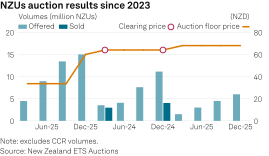
Trade participants do not expect the spot market to chase the floor price in the first two quarters of 2026; however, the trend could change once the market and entities receive the NZU holdings data in July after compliance surrenders at the end of May.
Elections to reshape NZ-ETS
The upcoming 2026 general elections in New Zealand are poised to inject a significant degree of uncertainty into the country's carbon market.
"Yes, of course [the elections will shape the market]. Labour-Green Party getting in would have a big impact," said Kapiti Climate Insights' Green.
If neither the center-left nor the center-right blocs secure a clear majority, coalition negotiations — and the policy stances of minor parties — will play a decisive role in shaping the future of the NZ ETS, according to Green.

Editor: