11 Nov 2022 | 19:51 UTC
New Democratic US state trifectas seen as chance to speed, codify climate goals

By Kate Winston
Highlights
Michigan, Minnesota, Maryland, Massachusetts go blue
States' role in flowing federal funds will also be key
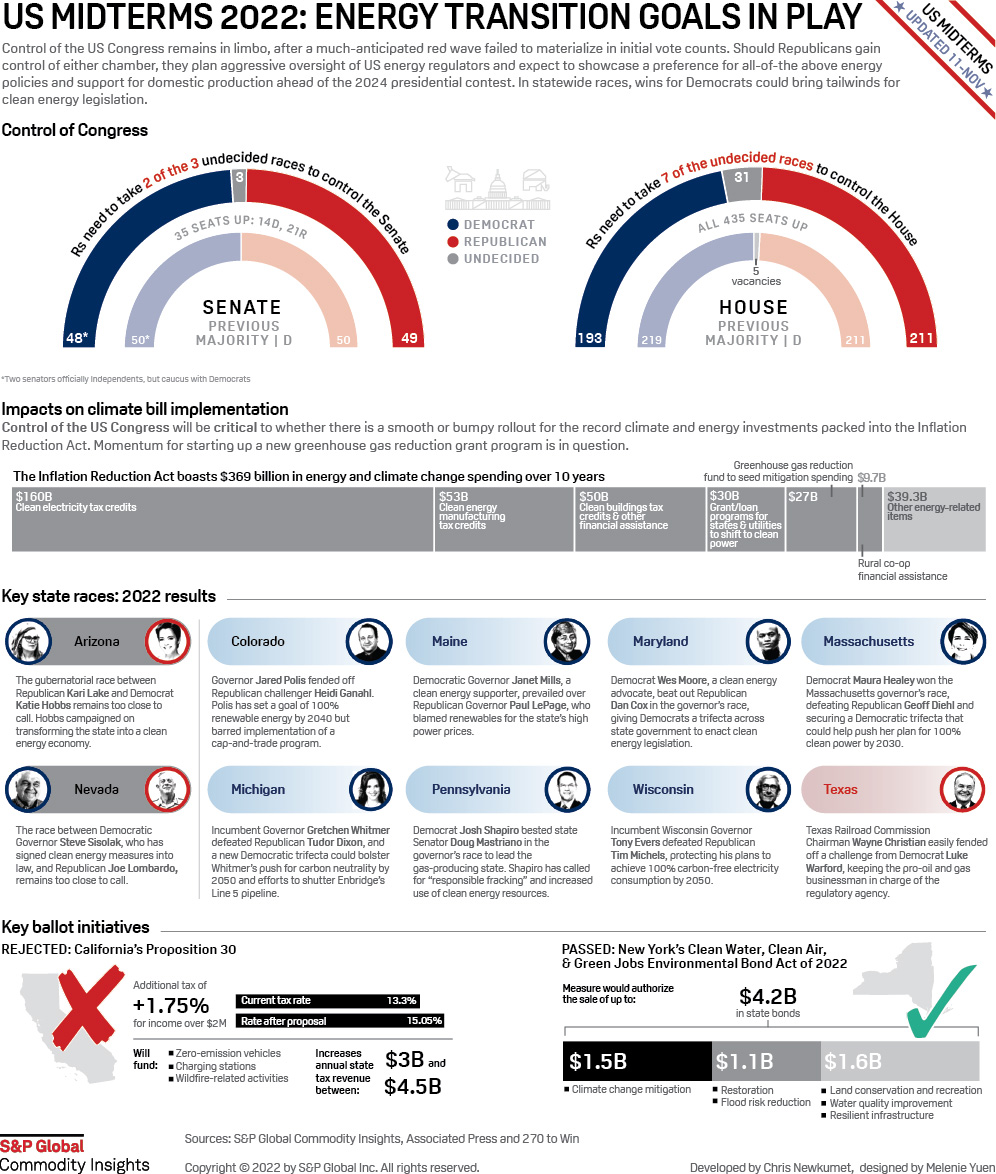
Democrats scored key victories in four states where they now have a trifecta of control over the governor's office and both houses of the state legislature, creating an opportunity for new climate and energy policies in Michigan, Minnesota, Maryland and Massachusetts.
"It is very clear to me that in these four new trifecta states there is a mandate to go bigger, bolder and faster on the clean energy transition," J.R. Tolbert, president of strategy and partnerships at the Advanced Energy Economy, said in an interview.
At the state level, the governors in Michigan and Minnesota could move to codify their climate goals in legislation, and governors in Maryland and Massachusetts could accelerate their climate goals.
Democratic control in these states could also facilitate the flow of money for clean energy from the Inflation Reduction Act and the Bipartisan Infrastructure Law. And the governors can play a key role in shaping the composition of the state utility commissions.
The state wins come as Democrats also performed better than expected at the federal level, blocking a Republican wave and leaving control of the US Congress in question.
Click here for full-sized infographic
Michigan's ambitions
In Michigan, Democrat Gretchen Whitmer held on to the governor's office and Democrats flipped both chambers of the state legislature.
Gaining a trifecta in Michigan is significant, Monica Hlinka, an analyst with S&P Global Commodity Insights, said. "Whitmer may finally be able to pursue her clean energy agenda and promises through the legislative process instead of through executive orders," she said.
Whitmer issued an executive order in 2020 calling for Michigan to achieve economy-wide carbon neutrality by 2050, and she may now seek to codify the goal in law. Another aspect of Whitmer's climate plan that could be codified is a recommendation to achieve a 50% renewable portfolio standard by 2030, Tolbert said.
Michigan currently gets 59% of its electricity from fossil fuels, so the plan would be a significant shift for the power sector
As governor, Whitmer has also prioritized electric vehicle manufacturing, Tolbert noted. The state's new trifecta could boost the opportunity for the state to marry state investments and incentives with federal incentives to create a clean energy manufacturing economy in the state, he said.
Whitmer has also thrown her support behind efforts to use federal money to restart the Palisades nuclear plant in Southwest Michigan that shut this spring. And Democrats' victory in Michigan could also help sustain Whitmer's fight to shutter Enbridge's Line 5 propane and crude oil pipeline to protect the Great Lakes from a potential spill.
Climate plans
In Minnesota, Democrat Tim Walz retained the governor's office and Democrats succeeded in flipping the state Senate, setting up a trifecta in the state. Control of the state legislature could create an opportunity for Walz to codify his goal of 100% clean electricity by 2040.
The change could also impact other sectors, analysts say. "A second Walz term with trifecta rule for Democrats will mean a continued push for the state to decarbonize, particularly on the transportation side," according to a Nov. 10 research note by Washington Analysis.
In Maryland and Massachusetts, climate change and clean energy were a key part of the new governors' platforms, Nick Abraham, state communication director for the League of Conservation Voters, said in an interview. "We expect that would be something they would tackle in the new term," he said.
Maryland has passed legislation requiring net-zero greenhouse gas emissions by 2045. With Democrat Wes Moore flipping the governor's office and creating a trifecta, that goal could be accelerated. Moore supports 100% clean electricity by 2035 and state-wide net-zero emissions by 2045.
"With Moore's victory, we expect debate over moving the state to a 100% clean energy standard, most likely by 2035 or else 2040, to receive serious consideration by the legislature in 2023," the Washington Analysis note said.
Renewable goals
Massachusetts has passed a law putting the commonwealth on a path to achieve net-zero GHG emissions by 2050. The victory by Democrat Maura Healey flipped the governor's office, opening the door for more ambitious climate goals. Healey has proposed to achieve 100% clean electricity by 2030.
Healey also vowed that if she won, Massachusetts would expeditiously permit the 5,600 MW of offshore wind procurements currently authorized by law and more than double the commonwealth's target to 10,000 MW of offshore wind by 2035.
Healey also envisions 10 GW of deployed solar by 2030 and a quadrupling of energy storage deployment by 2030, Hlinka said. Healey has also promised, in her first six months as governor, to convene a regional summit to develop a strategy for transmission, siting, market reform and cost allocation, she said.