Energy Transition, Emissions
September 24, 2025
First two UK HyNet CO2 capture projects reach financial close

HIGHLIGHTS
Projects to capture 1.2 mil mt/year of CO2
To feed Eni's 4.5 mil mt/year Liverpool Bay CO2 store
UK targets 20-30 mil mt/year CO2 capture by 2030
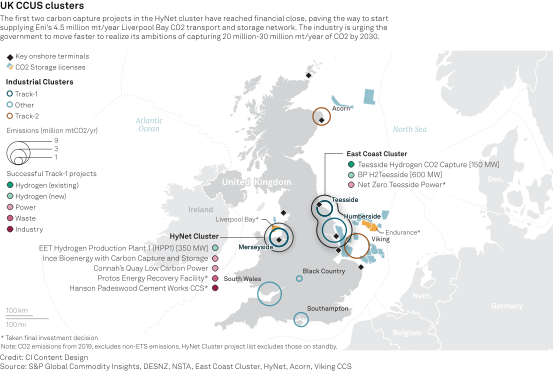
The first two carbon capture projects in the UK HyNet industrial cluster have reached financial close, and will start construction on facilities designed to capture a total of 1.2 million mt/year of CO2, feeding into the Liverpool Bay store.
Heidelberg Materials UK's Padeswood cement plant and Encyclis' Protos waste-to-energy plant in Ellesmere Port have signed final contracts with the UK government through the Low Carbon Contracts Company to begin construction, the Department for Energy Security and Net Zero said in a statement on Sept. 25.
"These two projects represent the role carbon capture, utilization and storage has to play in decarbonizing Great Britain's heavy industries and advancing energy from waste," LCCC Chief Executive Neil McDermott said in a statement.
The projects will supply captured CO2 into Eni's 4.5 million mt/year Liverpool Bay transport and storage system, which took a final investment decision in April.
The Carbon Capture and Storage Association said the "world-leading" projects would "decarbonize two of the most critical, and hardest to decarbonize industries."
Padeswood will capture around 800,000 mt/year of CO2 emissions, and Protos -- which is to produce 50 MW of power from non-recyclable waste -- will capture 400,000 mt/year. Both facilities are due to start construction later in 2025, with first operations from 2029.
Platts, part of S&P Global Energy, assessed nearest December UK Emissions Trading Scheme CO2 allowances at GBP57.04/mt ($76.70/mt) on Sept. 23, compared with industry estimates of full value chain CCS costs in the region of $130-$150/mt.
CCS cluster development
While welcoming the development, the CCSA also called on the government to accelerate the sector in order to reach climate goals and remain competitive.
The UK is targeting 20 million to 30 million mt/year of CO2 capture by 2030.
"To decarbonize our industries and remain competitive internationally, the UK needs to rapidly deploy a much wider pipeline of CCUS projects across multiple sectors and regions," the CCSA said.
In August, the UK government added six projects to expand the HyNet cluster in the northwest of England, bringing the total number of emitter projects in negotiations to 10.
DESNZ put two of the new projects -- the Connah's Quay CCS power plant from Uniper and Evero Energy's Ince bioenergy with CCS -- on the priority list, along with three projects that have already received government backing, while five more projects were listed in reserve.
And in June, the UK announced financial backing for the Viking and Acorn CCUS hubs as part of its spending review, providing development funding ahead of final investment decisions for the projects before the end of the current parliament.
It has allocated GBP9.4 billion ($12.7 billion) in capital investments across UK CCUS projects over the spending review period through 2029-30, including expanding the HyNet and East Coast Cluster Track 1 projects.
Acorn in Scotland and Viking on the east coast of England were given Track 2 cluster status under the previous government in 2023, but have been awaiting further details on backing and timelines ever since.
The government will provide "development funding to advance their delivery," with FID later in the parliament, "subject to project readiness and affordability."
East Coast Cluster
The East Coast Cluster focused around Teesside, with plans to extend infrastructure to serve Humberside, was the first to reach financial close in December 2024.
The Northern Endurance Partnership (BP, Equinor and TotalEnergies) took a positive FID in the UK's first carbon capture and storage project, to store up to 4 million mt/year of CO2, with first injections planned as soon as 2027.
Equinor and BP also took FID on their joint 742-MW Net Zero Teesside Power project -- the country's first CCS-enabled gas-fired power plant -- with operations set to begin in 2028.
However, BP's 600-MW H2Teesside blue hydrogen project remains stuck at the planning stage, awaiting the outcome of a decision by the UK government on whether to back a rival data center project that has received planning permission for the same site.
BP said in August the development consent order process for H2Teesside was "well advanced."
DESNZ has pushed back the deadline for a planning decision to Oct. 30, from a previous deadline of Aug. 28.
BP said the data center project development was "speculative," and planning approval for it had not taken the advanced stage of H2Teesside into account.

Editor: