Coal, Energy Transition, Natural Gas, Maritime & Shipping, Hydrogen
September 12, 2025
Hydrogen project pipeline shrinks 25% but robust expansion expected: IEA

HIGHLIGHTS
Global hydrogen demand up 2% to 100 mil mt in 2024
Low-carbon 2030 production potential drops to 37 mil mt/year
China has 65% of global electrolyzer capacity installations
The global low-carbon hydrogen sector is poised for substantial growth through 2030 despite recent project cancellations and persistent cost challenges that have reduced the pipeline of announced projects by nearly 25%, according to the International Energy Agency's latest analysis.
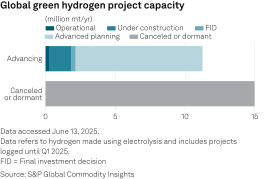
Low-carbon hydrogen production by 2030 could now reach up to 37 million mt/year, down from a potential 49 million mt/year based on announced projects a year earlier, the IEA said in its 2025 Global Hydrogen Review, published Sept. 12.
"Low-emissions hydrogen uptake is not yet meeting expectations set by industry and governments in recent years," the IEA said in a statement to accompany the report. "Growth is being restrained by high costs, demand and regulatory uncertainty, and slow infrastructure development."
It is the first time that projected potential low-carbon hydrogen production in 2030 has fallen.
However, projects that are operational, under construction, or have reached final investment decision by 2030 are still set to increase more than fivefold from 2024 levels to over 4 million mt/year, with an additional 6 million mt/year having strong potential if effective demand policies are implemented.
And projects to have passed final investment decision rose by 20%, representing 9% of the total project pipeline to 2030.
"To help growth continue, policy makers should maintain support schemes, use the tools they have to foster demand, and expedite the development of necessary infrastructure," IEA Executive Director Fatih Birol said in the statement.
Industry body the Hydrogen Council said global low-carbon hydrogen project capacity to have reached FID surpassed 6 million mt/year, with $110 billion committed across more than 500 projects.
Of this, 1 million mt/year of capacity is already operational, the Hydrogen Council said in its Global Hydrogen Compass report published Sept. 9.
Global hydrogen demand reached nearly 100 million mt in 2024, a 2% increase from 2023 and aligning with overall energy demand growth, with the vast majority of this supplied by fossil fuel-derived conventional hydrogen production, the IEA said.
Hydrogen production used 290 Bcm of gas and 90 million mt of coal equivalent in 2024, the IEA said.
The oil refining, fertilizers and chemicals industries are the largest consumers.
Demand from new applications accounted for less than 1% of the total, largely in the biofuels space.
The low-carbon hydrogen economy has come a long way from the IEA's first Global Hydrogen Review in 2021.
"Low-emissions hydrogen production projects have gone from just a handful of demonstrations to more than 200 committed investments for projects that are increasing in number and in scale, reflecting the importance of hydrogen for climate goals, energy security and industrial competitiveness," it said in the report.
Cost gap
The cost gap between conventional and low-emissions hydrogen has widened recently due to declining natural gas prices and higher electrolyzer costs driven by inflation and slower-than-expected technology deployment.
Platts, part of S&P Global Energy, assessed the cost of green hydrogen production via alkaline electrolysis in Germany, backed by renewable power purchase agreements, at Eur10.04/kg ($11.78/kg) on Sept. 10.
The assessment reflects one possible pathway for producing EU Renewable Energy Directive-compliant green hydrogen.
That compares with unabated steam methane reforming hydrogen production costs of Eur2.62/kg (including capex and carbon).
Despite this challenge, the IEA expects the cost differential to narrow by 2030 as technology costs decline and strong renewables growth in some regions spurs lower-cost hydrogen production alongside new regulatory frameworks.
China has emerged as the dominant force in electrolyzer deployment for renewable hydrogen production, accounting for 65% of global capacity that has been installed or reached final investment decision.
The country also hosts nearly 60% of the world's electrolyzer manufacturing capacity, though existing manufacturing capacity of more than 20 GW/year significantly exceeds current demand levels.
The IEA said installing Chinese electrolyzers outside the country did not offer significantly lower costs compared to other producers when factoring in transport costs and tariffs.
This finding challenges assumptions about cost advantages from Chinese manufacturing dominance in the sector.
Low-emissions shipping
The IEA identified that greater efforts are needed in the maritime sector to deploy compatible technologies and ensure adequate port infrastructure for shipping's adoption of hydrogen-based fuels.
However, nearly 80 ports have well-developed expertise in managing chemical products, indicating strong readiness to handle hydrogen-based fuels, with existing bunkering infrastructure often located near low-emissions hydrogen production facilities.
Southeast Asia is emerging as a significant hydrogen market, with announced projects potentially delivering 430,000 mt/year of low-emissions hydrogen production by 2030, up from just 3,000 mt/year at present.
Many regional projects, though, remain in early development stages, requiring faster renewable energy deployment, targeted policies, and expanded pilot project expertise to realize this potential, the IEA said.
