Energy Transition, Agriculture, Refined Products, Electric Power, Emissions, Hydrogen, Renewables, Biofuel, Jet Fuel
August 19, 2025
INTERVIEW: Energy transition capital plentiful even as investors reassess: ING
By James Burgess and Alex Blackburne
HIGHLIGHTS
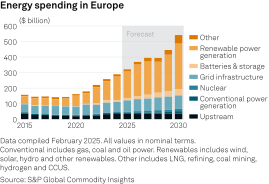
IOCs, utilities reassessing transition strategies at FID
Dedicated funds stepping up, but delivery capability in question
ING targeting Eur7.5 bil/year in renewables financing
Energy transition investments are entering a phase of realism amid mounting concerns over project delivery and technological challenges, but funding remains plentiful, according to ING Bank.
While international oil companies and utilities have cut spending on renewables, they are not giving up on the energy transition but rather recalibrating strategies, ING's global head of energy, Michiel de Haan, told Platts in an interview Aug. 11.
"You see the oil majors, and some of the larger utilities not walking away from the energy transition, but simply adjusting the pace at which they think they can do that in a responsible manner," de Haan said.
Many companies initially took transition investments as portfolio diversification hedges but are now questioning whether original assumptions remain valid when committing capital to projects, de Haan said.
IOCs have also been revisiting investment decisions amid an increased focus on energy security and a revised view on the pace of the transition.
"Clients are scrutinizing their dollar to be invested more heavily than in the past," the bank's global head of renewables Diederik van den Berg said. "Certain of their investments may not be as economically profitable as before."
Offshore headwinds
Multibillion-euro investments in Europe's offshore wind sector are coming under particular scrutiny, with developers continuing to grapple with inflation and supply chain challenges.
The new market dynamics have led certain offshore wind auctions to fail, most recently in Germany where 2.5 GW of capacity in the North Sea went unclaimed. Before that, a 3-GW auction in Denmark was unable to attract bidders, while the Netherlands has delayed tendering 2 GW of capacity due to "deteriorating market conditions."
The common thread is a lack of a revenue stabilization mechanism, such as contracts for difference, which give projects a fixed price for their electricity over the long term.
Developers "have been clear in their opinion that they need [...] revenue certainty," van den Berg said.
"That was ignored" in Germany, the banker added. "Revenue certainty is a must if you're asking people to take this amount of development risk."
The UK, which kicked off its latest offshore wind auction on Aug. 7, is one of the few European offshore wind markets to offer CFDs to developers.
"I suspect that the bid environment [in the UK] will be more positive than what we've seen in Germany simply because you get a better bang for your buck," van den Berg said.
The German government vowed in the aftermath of its failed auction to look at shifting to CFDs for future bidding rounds, with Denmark and the Netherlands having also pledged to do so.
For now, though, there is still a significant amount of offshore wind capacity in development in Europe that will not benefit from CFDs and has yet to reach final investment decisions.
That includes several gigawatts being developed by BP and TotalEnergies in Germany.
TotalEnergies' pipeline is so big that it has become Germany's largest offshore wind developer. In June, the company said it had launched a strategic review of the various concessions it has obtained since 2023 given delays in the build-out of the German transmission grid.
"The amount of gigawatts that they have secured in a country like Germany is enormous," van den Berg said about TotalEnergies. "A lot of people have questioned the rationale there. Is there enough offtake to even land that green power if and when it's built?"
Multiple gigawatts of offshore wind projects in the Netherlands are also yet to reach FID.
De Haan said many large developers viewed offshore wind as a "defensive move," securing capacity without CFDs in auctions during the sector's "boom years" to give them optionality in their portfolio.
"I think that's also what you now see play out when people need to start making FID," de Haan said. "Is that still in line with the assumptions we had when we bought the option? That's a discussion that now is taking place."
Green molecules
The investment pullback reflects inflationary pressures following COVID-19, a higher level of risk in renewable investments, and challenging new business models, particularly for "green" molecules such as hydrogen and sustainable aviation fuel.
"Replacing the fossil fuel-derived molecules is resulting in an economic bridge that is difficult to cross," de Haan said, noting that in many cases, a greater number of more energy-intensive steps were needed to produce the same end molecule.
"There's tension around the new business models for who should be willing to pay for these green molecules," the executive said.
De Haan said the EU's European Green Deal had raised expectations around the pace of the transition, which had pushed many companies to get "a bit ahead of themselves."
Van den Berg noted, however, that there was still a strong political will in Europe to deliver on targets, but also a "realism" that these might not be met by 2030.
"The energy transition is something that will span decades," de Haan said.
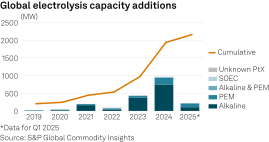
ING is interested in renewable hydrogen investments, though the bankers noted challenges around securing offtake agreements for projects, with many conversations focused on willingness to pay a green premium.
Rates of return
Meanwhile, there is a shift in the renewables investment landscape, with dedicated funds making significant inroads into the sector, and robust capital availability for energy transition projects.
Investors behind the funds are typically seeking stable long-term returns, and may not need such a high rate of return as utilities or IOCs, ING said.
Some IOCs such as BP have cut back spending in part as an attempt to close the valuation gap with US peers.
ING is committed to financing Eur7.5 billion a year in renewables projects, and is not funding any new oil and gas production, in line with the International Energy Agency's view that no further production is needed to meet energy and climate targets.
Van den Berg questioned whether some of the new investors had the expertise to deliver planned projects, but noted that capital availability was not a concern.
"The amount of capital that's been raised on the fund side is enormous," he said.