Energy Transition, Emissions, Carbon
August 04, 2025
Alberta carbon market grapples with sustained oversupply, 2026 review on horizon
By Madeline Ryan and David Lademan
HIGHLIGHTS
Program may not meet federal equivalency standards in 2026 review: market
Credit usage limits are increasing, yet oversupply persists
Secondary market prices within the Alberta compliance carbon market in Canada have decreased significantly year on year amid credit oversupply and an upcoming 2026 regulatory program review.
Credit and offset prices within the Technology Innovation and Emissions Reduction System, or TIER, market have fallen more than 55% since the same period last year. Platts, part of S&P Global Energy, assessed TIER credit and offset prices at C$24.50/mtCO2e on Aug. 4, down from traded levels reported at C$55/mtCO2e in the third quarter of 2024.
Platts launched the daily price assessments for instruments traded in the Alberta TIER market on Aug. 1.
Launched in 2019, TIER aims to curb emissions from high-emitting facilities while maintaining competitiveness, allowing compliance through on-site reductions, credit trading or fund payments.
Part of the oversupply can be traced back to the transition from the Carbon Competitiveness Incentives Regulation to the TIER program, one trader said.
The market has been oversupplied for the past 12 months, with a second market participant calling the supply situation a "persistent problem."
Platts heard estimates of three years of banked inventory in the market, with sources expecting the market to balance out by the end of the decade, provided aggressive regulatory changes are not made to the program's structure.
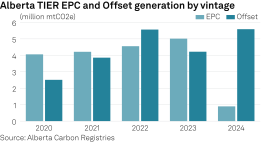
The same source said governmental oversight of supply is lacking, as there is no mechanism in place to withdraw or reintroduce supply when needed.
Provincial carbon price frozen
Tensions persist between Alberta's TIER program and the federal Output Based Pricing System, with the second source expecting Alberta Premier Danielle Smith may reduce or eliminate Alberta's carbon price, which would challenge national climate policy alignment.
The Alberta government froze its industrial carbon price at C$95/mtCO2e on May 12 in response to economic pressure, including the US tariffs on Canadian energy.
Previously, the province's carbon price rose from C$80/mtCO2e to C$95/mtCO2e, but credits continued to trade at a discount due to oversupply, the second source said.
However, keeping the price stagnant at the frozen level could affect TIER's effectiveness and credibility, a third source said, adding that keeping the price unchanged would increase market uncertainty in the long term.
Meanwhile, the Canadian government's carbon price -- separate from Alberta's price -- is set to increase by C$15 per year to C$170/mtCO2e in 2030.
Alberta TIER must meet federal stringency
Alberta's TIER system operates under provincial jurisdiction but must meet minimum standards set by the federal government's Output-Based Pricing System to remain compliant with national climate policy, the Greenhouse Gas Pollution Pricing Act.
Under the federal OBPS, facilities are assigned sector-specific performance standards, and any emissions above those thresholds must be covered by paying into a federal fund or submitting credits.
The OBPS is more centralized and maintains a clear trajectory toward a C$170/mtCO2e carbon price by 2030.
In contrast, Alberta's TIER system allows for more flexibility. The program allows for several compliance options, including on-site emission reductions, the use of credits or offsets and payment into the TIER fund.
Both a program review and an equivalency review are planned to take place in 2026.
"It will be hard for [Alberta] to justify that the current market is equivalent to the intent of the federal government's carbon pricing legislation," the third source said.
In Alberta's TIER market, benchmarks are structured either as facility-specific baselines based on a site's historical emissions intensity or as high-performance benchmarks based on the sector's best-performing peers.
Facilities are generally subject to the less stringent of the two benchmarks, ensuring flexibility while still encouraging emissions reduction.
Benchmark tightening has increased to 2% annually from 1% and will rise to 4% for oil sands in 2029, but these adjustments could be seen as insufficient to balance supply and demand dynamics.
2026 program review
As part of Alberta's agreement with the Canadian government, the province committed to conducting an interim review of the TIER regulation by December 2026 to assess its performance and alignment with federal climate policy benchmarks.
This review will evaluate whether the system continues to meet the federal government's equivalency criteria, which allows Alberta to operate the TIER program in place of the federal OBPS.
"The Alberta government is going to try to get ahead of this [review], with stringency increases as negotiation power against an emissions cap," the second source said.
If the federal government determines that Alberta's system no longer meets equivalency standards -- particularly in terms of pricing stringency and emissions coverage -- it could impose the federal backstop.
A federal backstop would significantly disrupt the market, given that credits are currently trading at a 70% discount relative to the federal backstop price of C$95/mtCO2e. A backstop could drive prices up to that level, which would be bullish for the market.
"In an efficient market, we would see price action in advance of the program review," the first market participant said.
Platts assessed Alberta TIER EPC and AEO prices at parity on Aug. 4, closing at C$24.50/mtCO2e, at a 74.2% discount to the federal backstop price.

Editor: