Energy Transition, Carbon, Emissions
July 09, 2025
Article 6.4 may provide more liquid carbon credits than Article 6.2: Asia Climate Summit

HIGHLIGHTS
Article 6.4 framework offers globally compatible carbon credits
Article 6.2 credits have limited interoperability across countries
Legacy CDM credits may 'contaminate' new mechanism
The centralized framework under the UN's Article 6.4 could deliver carbon credits that are compatible with more countries' eligibility criteria and eventually create a more liquid international market, when compared with the decentralized Article 6.2 mechanism, experts said at the Asia Climate Summit in Bangkok July 8-10.
The key rules under Article 6.4 were finalized only at the UN's COP29 in Baku in 2024, but most basic rules under Article 6.2 were finalized earlier at the COP26 in Glasgow in 2021. Consequently, the Article 6.2 market seemed to benefit from first-mover advantages. However, now the momentum has shifted, as countries seek to implement Article 6.2 in different ways, resulting in a fragmented market.
Article 6.2 creates a decentralized system where countries can tailor their bilateral agreements to determine which standards and carbon crediting methodologies to use. For instance, Singapore and Japan, two pilot buyer countries for Article 6.2 credits, have chosen completely different approaches to implement its provisions. Singapore leveraged the existing voluntary carbon market's methodologies, but Japan created its own Joint Crediting Mechanism.
Jay Mariyappan, head of Carbon and Renewables with PetroChina International, said his company has compliance obligations in different countries, such as Singapore's carbon tax and Japan's upcoming mandatory GX Emission Trading System.
When asked whether it is possible to source projects and credits that are compatible under these different mechanisms, he told Platts, part of S&P Global Energy, that "Each of the examples you mentioned has a different approach to an Article 6.2 credit that can be used in each of those compliance markets. So, it's not really buying one credit and being able to have the optionality to use across different jurisdictions."
"This may become a reality with Article 6.4 if they are then allowed into those different compliance markets, but that remains to be seen," Mariyappan added.
Perumal Arumugam, manager, Mitigation with the UNFCCC, said Article 6.4 has some competitive advantages relative to Article 6.2 credits.
As Article 6.4 credits are issued through a centralized system backed by the UNFCCC, Arumugam said such credits, primarily, have the UNFCCC's oversight, and, beyond governance, the benefit of these credits also lies in their practicality.
"I know that there are multiple traders in the room. If you're really looking at secondary market trading, then 6.4 PACM [Paris Agreement Crediting Mechanism] is a response, not necessarily 6.2 bilateral cooperation," he said, explaining that Article 6.4 credits would be issued through a multilateral, instead of bilateral, process, which delivers credits that have more flexible user cases and global-scale accessibility.
Arumugam added that meta-standards, like ICVCM and VCMI, have also been working on creating a uniform definition of high-quality carbon credits and enhancing the interoperability across different systems, bridging rules under Article 6.2 and 6.4.
An underlying concern
Despite the interoperability and liquidity of Article 6.4 credits, market participants told Platts that the legacy Clean Development Mechanism credits transferred to the Article 6.4 system could be an underlying concern that might "contaminate" the upcoming market.
The UN's Article 6.4 mechanism is an upgraded version of CDM, aiming to resolve the integrity issues in the old system, but it still leaves a gateway for some legacy CDM credits to pass through, be transferred and become Article 6.4 credits. Participants, who have witnessed the failure of CDM, noted that the transferred credits might also have questionable environmental integrity.
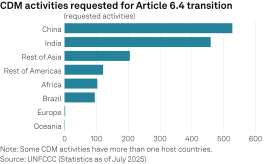
Arumugam said 80 host countries have submitted requests for the transition of 1,507 CDM activities, among which 527 were in China, 459 were in India and 205 were in the rest of Asia, jointly accounting for 79% of the requested CDM activities.
The requests for transition must be submitted before Dec. 31 and more countries and CDM activities are expected to make their requests in the latter half of 2025, he said.
The UNFCCC has been rigorous in terms of handling these requests, with only nine out of the 1,507 requests approved so far. Among the nine approved activities, two are in Ghana, two are in Cambodia and the remaining five are in Bangladesh, Arumugam said.
He added that two of the nine projects were approved and registered, while the remaining seven projects were approved with modifications required.

Editor: