Energy Transition, Carbon, Emissions
June 23, 2025
ACCUs rangebound amid limited demand, SMCs emerge as growing alternative
HIGHLIGHTS
Generic ACCUs averaged A$35.36/mtCO2e in May
Prices are historically higher closer to year-end
SMCs at a lower price, but ACCUs still preferred
Australian carbon credit unit prices for the liquid segment of the market have been rangebound lately due to limited demand as the compliance year is still in its early stages, while increasing consideration of Safeguard Mechanism Credits as an alternative is adding uncertainty to the price trajectory for ACCUs, market participants said.
The liquid segment of ACCUs encompasses Generic, Generic without avoided deforestation, and Human-Induced Regeneration ACCUs, which also reflect the cheapest credits available in the market. Prices in this segment have been rangebound in the range of A$35-36/mtCO2e ($22.41-$23.05/mtCO2e) since the Australian federal election on May 3.
"Feels like [the market] is well offered at A$36/mtCO2e, and that this appears to be a key level," a Sydney-based ACCU trader told Platts, part of S&P Global Energy.
A second ACCU trader also supported this, noting there were "enough sellers around A$36/mtCO2e at the same time to keep the price lower," suggesting that buyers were not keen beyond this level while sellers were also willing to match lower bids.
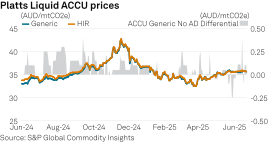
Platts assessed Generic and Human-Induced Regeneration ACCUs at A$35.60/mtCO2e on June 23, both down 15 cents/mtCO2e each on the session.
The monthly average price for ACCU Generic in May was A$35.36/mtCO2e, while in June it has averaged A$35.62/mtCO2e so far, indicating that prices are fluctuating around these levels on most days.
Generic ACCUs are produced by projects focused on avoiding emissions, whereas HIR ACCUs are created by projects that store carbon through the regeneration of permanent native forests using alternative land management practices.
Changing dynamics with SMCs
"The [ACCU] price fluctuates periodically. Historically, such as [in 2024], the price touched a high point at the end of the year, so it's hard to say price is not expected to go up," the second trader said.
The Platts assessments for both Generic and HIR ACCU prices hit A$42.15/mtCO2e and A$42.35/mtCO2e, respectively, on Nov. 18, 2024, the highest level since the launch of the assessment on March 1, 2023.
The introduction of SMCs earlier in February could change the dynamics of the ACCU price trend for this compliance year, especially if a number of Safeguard facilities include SMCs in their buying strategy, considering its lower price point.
The first trader said that SMCs are limiting a stronger increase in ACCU prices in the market, though it does depend on the facility's appetite for additionality and permanence.
"It depends on the preferences each emitter has. Not all emitters will prefer SMCs to ACCUs," the first trader added.
SMCs are unlike ACCUs in that they are not offsets but tradable credits that incentivize responsible emitters to reduce their facilities' emissions beyond their baselines. Emitters can either sell SMCs to others or use them for their own compliance obligations.
A total of 190,000 mt exchanged hands at A$34/mtCO2e in the SMC maiden trade on Feb. 28, marking a 76 cent/mtCO2e discount to Generic ACCUs at the time.
Platts assessed SMCs at A$35.01/mtCO2e on June 20, down 11 cents/mtCO2e day over day, as the discount to Generic ACCUs narrowed to 59 cents/mtCO2e.
Discussing forward spreads and levels, an Australia-based Safeguard entity representative said they "see no reason for the ACCUs to move down by a lot. I think they will rise toward the end of this year."
The representative further noted that entities do not distinguish between Generic ACCUs and SMCs. However, ACCUs remain the preferred option over SMCs as they are more liquid and offer better clarity.
"SMCs are limited to the entities. Brokers usually don't have them to offer, so it's easy to deal with ACCUs. But there is no clear differentiation between them among the emitters at this moment," they added.
The source further hinted that most emitters under compliance still appear in the market to get ACCUs with assurance of delivery on time, and do not actively seek credits with co-benefits or long-term integrity.

Editor: