Electric Power, Energy Transition, Metals & Mining Theme, Emissions, Renewables, Carbon, Non-Ferrous, Ferrous
June 06, 2025
China faces an uphill path to directly connect renewable producers, consumers
HIGHLIGHTS
Direct connection reduces the burden on public grids, creates a new business model
Heavy investment required to establish projects, address renewables' intermittency
Aluminum sector could be first mover for implementation
China recently launched its policy framework to enable direct connections between electricity producers and consumers, but industry participants told Platts, part of S&P Global Energy, that this blueprint faced crucial challenges when it comes to actual investment and implementation.
On the supply side, China has built the world's largest renewable power generation capacity, but the existing public grids have faced technical challenges in absorbing all the newly added renewable capacities, especially the most intermittent solar and wind capacities. On the demand side, China is the world's largest manufacturer of various products. Nowadays, from steel, aluminum to lithium batteries, many made-in-China products face carbon-related trade barriers. Consuming renewable electricity has become a key to addressing such hurdles.
On May 30, China's top economic planner, the National Development and Reform Commission, launched a policy framework to allow the direct connection of renewable electricity producers and consumers, without adding extra burden to public grids. However, many industry participants have taken this long-awaited policy with a pinch of salt.
"The policy marks another step forward in promoting renewable consumption by expanding the scenarios for enterprises to secure green electricity supplies. However, corporate power users will cautiously balance the costs and benefits with the operational liability and challenges associated, before they choose to directly connect to green power supplies," Peng Chengyao, Senior Director, Global Power and Renewables Research at Energy, said.
Challenging targets
A major concern of industry stakeholders is the ambitious targets in the policy.
"For direct connection projects, each renewable project shall ensure that at least 60% of its power supplies are consumed by the dedicated user. Each user shall also ensure that at least 30% of its total electricity consumption comes from the direct-connection project. By 2030, the consumer-end target will rise to at least 35%," NDRC said in the document.
Given the intermittent nature of solar and wind, to meet these targets as well as ensure stable power supplies, electricity users have two options -- investing in battery energy storage systems (BESS) or continuing to leverage thermal power to provide buffer supplies.
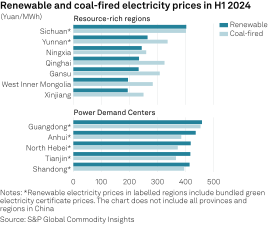
Industry participants said coal-fired electricity is still a more cost-effective option to provide buffer power supplies in many regions, especially for aluminum and steel producers that have captive coal-fired power plants. Users who do not have captive plants still need to rely on some grid-connected electricity to stabilize their power supplies, which involves heavy expenditure in terms of electricity procurement and various payments to grid companies, sources said.
Meanwhile, despite the significant reduction in BESS costs in recent years, scaling up BESS capacities still requires huge capital investments and may hinder small companies from participating in direct connection projects, a small local battery manufacturer told Platts.
"Electricity users need to think about two critical issues before stepping into this new ecosystem. First, whether they can smoothly meet the 30% target, without causing any problems like power shortage or blackouts. Second, if counting all the investments and expenditure, whether they could really afford and benefit from such direct-connection projects?" a Beijing-based analyst told Platts.
"Meanwhile, renewable suppliers must carefully choose the electricity users to collaborate with. What if the users end up consuming less than the committed amount of electricity? What if they go bankrupt and shut down their industrial plants? All risks need to be carefully evaluated," the analyst added.
"Despite the policy streamlining, we do not expect the scale of direct-line green power supply to scale up significantly in the near term owing to the constraints set on qualified demand and supply scenario," Peng pointed out.
Aluminum sector as first mover
The Aluminum industry might be a first mover to pilot the uncharted waters. Notably, the sector faced stringent requirements for decarbonization, from both domestic regulators and customers in major export markets, like the EU. Furthermore, many aluminum companies have captive power plants, providing an in-house solution for renewables' intermittency.
China currently accounts for about 60% of the world's total aluminum supplies. The aluminum industry has been widely seen as "an electricity-eating tiger" in China. As of 2024, the country's electricity consumption from aluminum production reached 582.4 billion kWh, accounting for 5.9% of the total electricity consumption of the society, according to data from state-backed industry think tank Antaike. Approximately 57% of the electricity used was generated from captive coal-fired power plants, Antaike's data showed.
"For some state-backed power groups, like SPIC [State Power Investment Corporation], they have both renewable projects and electrolytic aluminum smelters, which gives them a more comfortable position to coordinate internally and establish direct-connection projects," a Shanghai-based analyst said.
However, large aluminum companies also expressed concerns over implementing direct-connection projects.
"Not all of the smelters with captive power plants are able to build renewable plants," said a northern China-based source from a large company, highlighting that it takes time to build projects that can meet the NDRC's targets.
The source added that only some smelters in regions with abundant wind and solar resources met the necessary conditions to establish such direct connection projects, adding that smelters in Inner Mongolia, Ningxia, and Qinghai could be first movers.