Energy Transition, Hydrogen, Carbon, Renewables
April 25, 2025
EU, UK see joint hydrogen, CCS North Sea potential in energy security drive

HIGHLIGHTS
North Sea 'powerhouse' for clean energy, hydrogen: EC President
Joint UK-German government study on hydrogen trade potential
Exploring hydrogen pipeline options between the two countries
The EU and UK are eyeing regional cooperation on hydrogen and carbon capture and storage in the North Sea as part of a joint energy security drive.
European Commission President Ursula von der Leyen said the EU and UK could deliver the regulatory certainty and framework that investors needed to develop the sectors.
The North Sea is "a powerhouse [...] for clean energy and the energy of the future," von der Leyen said at the Summit on Future of Energy Security in London on April 24. "The North Sea region has it all [...]: offshore wind, marine energy, hydrogen, carbon capture and storage."
UK Prime Minister Keir Starmer said the country was focused on export opportunities in hydrogen and carbon capture, as well as in wind and nuclear.
"We are doing more with the EU to improve our interconnections and make the most of our shared energy systems," he said at the summit.
UK-German hydrogen trade
The comments follow a joint feasibility study commissioned by the UK and Germany on potential hydrogen trade between the two countries, published on April 23.
The UK could become a major exporter of low-carbon hydrogen, while Germany plans to import a significant portion of its hydrogen needs to achieve carbon neutrality by 2045.
"As the hydrogen markets develop in the UK and Germany, there is an opportunity to realize pipeline-based hydrogen trade between the two countries," the report, conducted by the German energy agency Dena, Adelphi and Arup for Germany's Ministry for Economic Affairs and Climate Action and the UK's Department for Energy Security and Net Zero, found.
"This could either be through a pipeline directly between British and German landfall, connected into an offshore hydrogen network or via connections to the Netherlands or Belgium," the report authors said.
UK industry minister Sarah Jones said the UK was "optimally positioned" to support a hydrogen economy.
"This joint study demonstrates the potential for future pipeline-based hydrogen trade between the UK, Germany and across the EU as we continue to collaborate under the UK-Germany Energy and Climate Partnership," Jones told Platts by email April 25. Platts is part of S&P Global Energy.
The study includes high-level infrastructure requirements and identifying regulatory, business model and commercial requirements for hydrogen trade between the two countries.
AquaDuctus link
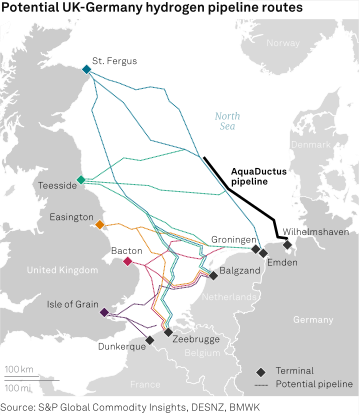
The infrastructure assessment considered four options: a base case offshore subsea connection to Germany from the UK east coast, tying into the planned German AquaDuctus offshore pipeline system; a direct connection to an onshore German terminal; and connection to the Netherlands onshore; and a connection via a Belgian coast landfall.
The study found that pipeline route options from the UK to AquaDuctus or mainland Europe are technically feasible "but require further assessment and more certainty on how the two countries' domestic networks will materialize in the next decade."
The report said it was unlikely existing gas interconnectors between the UK and mainland Europe would be available for conversion to hydrogen in the short to medium term "due to their existing contract requirements to supply natural gas and security of supply considerations."
Furthermore, repurposing existing infrastructure would require "significant work," the authors said, including evaluating the condition, purpose and lifespan of existing pipelines and addressing technical challenges such as pressure rating, material compatibility and the need for additional infrastructure such as compression stations.
Gascade is developing the AquaDuctus offshore pipeline in the German North Sea to connect offshore pipelines to the planned German hydrogen grid via Wilhelmshaven.
The first phase of AquaDuctus includes a 200-km offshore and a 100-km onshore pipeline, with a further 200-km offshore section planned in a second phase.
However, Norwegian gas pipeline operator Gassco scrapped a planned hydrogen pipeline project between Norway and Germany in 2024, after Equinor and Shell both pulled the plug on Norwegian low-carbon hydrogen projects.
One option for the proposed pipeline was to link to AquaDuctus.
Trade enablers
The report authors identified five enablers to facilitate UK-German hydrogen trade:
- Develop requirements to technically trade hydrogen
- Enable commercial trade between the two markets with minimal-to-no friction
- Develop an interconnector business model
- Develop the related regulatory framework
- Align delivery of the wider hydrogen value chain
The UK and German governments should work together to align hydrogen emissions standards and certification schemes, the report said.
The UK should assess its hydrogen export potential, including capacity, location, quality and timing, while Germany should assess offtaker requirements.
The UK should also "review the gas licensing framework to determine whether potential revisions may be required for the development and operation of hydrogen interconnectors," it said.
"The business case for the interconnector is underpinned by aligning market supply and demand," the authors said. "Given the current nascent nature of the hydrogen market, this will be a complex process."
Platts assessed blue hydrogen production via autothermal reforming (including capex and carbon) in the UK at GBP2.13/kg ($2.84/kg) on April 24, compared with EU Renewable Energy Directive-compliant green hydrogen production in Germany at Eur9.38/kg ($10.65/kg).
