Fertilizers, Chemicals, Energy Transition, Renewables, Hydrogen
March 31, 2026
INTERVIEW: Paradeep Phosphates considering buying more renewable ammonia: executive

Editor:
HIGHLIGHTS
Middle East war halts crucial ammonia supply
More domestic renewable ammonia deals eyed
Units in annual closure; stocks to last until mid-May
Indian fertilizer company Paradeep Phosphates is considering increasing its procurement of domestic renewable ammonia to strengthen raw material security amid the Middle East war, which has brought imports of conventional ammonia to a halt, a company executive told Platts, part of S&P Global Energy, March 30.
Paradeep Phosphates was among five fertilizer companies that signed agreements on March 30 to procure 670,000 metric tons/year of renewable ammonia for 11 plants as part of the Indian government's National Green Hydrogen Mission.
"Given a choice, we will go ahead with more quantities [of renewable ammonia]," RK Gupta, chief procurement officer at Paradeep Phosphates, said on the sidelines of the signing event for the renewable ammonia supply agreements.
"Now the clarity is there, the standard bidding parameter that has been issued by the Department of Fertilizers ... [clarifies] the subsidy and the differential pricing," Gupta added.
Paradeep Phosphates, which produces phosphatic fertilizers, has plants in Paradeep, Odisha; Mangalore, Karnataka; and Zuarinagar, Goa, that collectively require 600,000 mt/y of ammonia, procured mostly through imports, Gupta said.
Under the auctions conducted by the government's Solar Energy Corp. of India last year, Paradeep Phosphates secured 115,000 mt/y of Indian-made renewable ammonia -- 20% of its supply requirement -- to start by 2029.
SECI invited bids from domestic renewable hydrogen and ammonia developers to supply 724,000 mt/y of renewable ammonia to 13 fertilizer companies, with a three-year government subsidy.
"We are hopeful that in three years, the plant will be set up and quantities will be delivered," Gupta said.
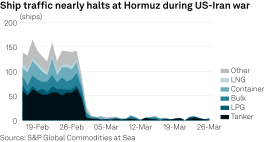
War impact
Since the war began on Feb. 28, Paradeep Phosphates' supply of conventional ammonia and sulfur for its three plants has stopped, with alternate sources driving costs sharply higher, Gupta said.
"If you see, 60% of the world's sulfur comes from the Middle East. So, if it is not available, we will not be able to produce the phosphoric acid that we need," Gupta said, emphasizing the impact of the war in the Middle East.
The company's units are shut down as part of an annual plan, but "we are comfortable [in terms of feedstock supply] up to mid-May," Gupta said. He added that ammonia is not stored in large volumes due to risk factors.
"More than 250 vessels are stuck in the Strait of Hormuz ... the war risk insurance has gone up," Gupta said. "Because of the nonavailability of vessels, the freight has gone up [threefold]. Bunkering has gone up maybe two times to two-and-a-half times."
Conventional ammonia supplies are unavailable at present, and some supplies available in Southeast Asia are priced significantly higher, according to Gupta.
India imports 2.8 million mt/y of grey ammonia for non-urea fertilizer units, Minister for New and Renewable Energy Pralhad Joshi said at the event on March 30. Most of the supplies are imported from the Middle East, but the SECI auction would replace about a third of them.
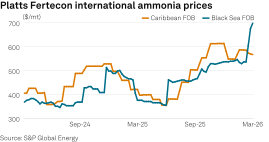
Low-priced deals
Gupta said that while the cost of domestic ammonia will be about $600/mt, conventional ammonia will be priced at about $800/mt and will remain costly even with the government's import subsidy.
ACME Cleantech's winning bid to supply renewable ammonia to Paradeep Phosphates's Odisha plant is Rupees 55.75/kg (59 cents/kg), the government said, while the winning price for the Goa plant is Rupees 62.84/kg.
SCC Infrastructure is to supply renewable ammonia to the Karnataka plant at Rupees 57.65/kg.
A two-week weighted-average price as seen on Fertecon and Argus will be taken as the set cost for conventional ammonia, and the government will cover the gap with the auction prices by paying the renewable hydrogen developer, according to Gupta.
"With regard to the auction pricing, everybody was saying it is the lowest," Gupta said. "Like solar energy started from Rupees 18 [/kWh] and fell, green ammonia will also come down."
In future auctions, Gupta said he would like to see the supply not tied to specific units to account for future changes in plant operations.
"A unit can be sold, or a new company created ... it can happen to anyone," Gupta said. "So definitely, from that perspective, there has to be fungibility."
Platts assessed Middle East renewable-derived ammonia delivered into East Asia (with high-capacity factors) at $840.66/mt (weekly price) on March 30, up 2.56% month over month.
Platts last assessed conventional ammonia FOB Middle East at $600/mt on March 30, up 26% month over month.
