Electric Power, Natural Gas, Energy Transition, Renewables, Hydrogen
March 10, 2026
Fog of war clouds European energy transition outlook, exposes gas ‘Achilles heel’: experts

HIGHLIGHTS
Europe's energy transition could gain from Middle East war
Inflation, interest rate risks could further jeopardize pace
Middle East war exposes Europe's LNG dependency
The Middle East war is the latest wake-up call for Europe as it confronts its energy import dependency, and while early signals from policymakers point to doubling down on renewables, inflationary risks from the conflict loom, according to industry experts.
France-based Societe Generale's Head of Commodity Research, Ben Hoff, said the Iran conflict had brought Europe's energy import dependency into sharp relief.
"This situation has really, in many ways, exhibited very clearly what Europe's Achilles heel is," Hoff told Platts in an interview on March 9. "What's happened is that the exposure has shifted from Russian pipeline to LNG imports largely from the US, and to a smaller extent from the Middle East."
Gas and oil prices also surged in the wake of the US-Israeli strikes on Iran.
Platts, part of S&P Global Energy, assessed Dated Brent crude at $102.84/b on March 9, after almost reaching $120/b in intra-day trade, up from $70.94/b before the war on Feb. 27. Dutch TTF day-ahead gas was at Eur56/MWh ($65/MWh) on March 9, almost double the pre-war level.
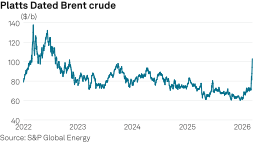
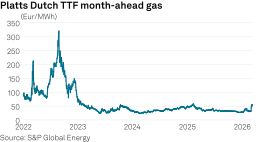
Europe faced its most severe energy shock in decades in the wake of Russia's invasion of Ukraine in 2022, and EU policymakers responded by redoubling efforts to accelerate renewables deployment, alongside scrambling to secure replacement gas supplies after pipelines from Russia were abruptly cut off.
Now, the US/Israeli war with Iran raises fresh concerns over Europe's fossil fuel dependency, and political leaders are already signposting the need for further renewables to address energy security of supply, cost, and sustainability concerns.
"The developments in the Middle East remind us once again of the risks of relying still too much on fossil fuels," European Commission President Ursula von der Leyen said on social media on March 6. "That is why we must continue improving the functioning of our energy market, attracting more investment in clean tech and moving forward with the transition towards clean, homegrown energy."
UK Energy Secretary Ed Miliband echoed this sentiment, arguing the country's exposure to global fossil fuel markets poses ongoing risks to energy security.
Hoff said it was too early to say if the words from political leaders translate into greater action, but von der Leyen used a speech at the Nuclear Energy Summit in Paris, France, on March 10 to argue for a greater role for renewables and nuclear.
"There has to be a realization that the problem isn't fixed," Hoff said. "It's just been reformulated, if you like, and still basically remains an issue of geopolitical concern where Europe ultimately doesn't have full coverage of its gas needs from strategically safe resources."
Resilient infrastructure
Energy Transitions Commission Deputy Director Mike Hemsley said renewables -- in combination with storage, flexibility, and other low-carbon options -- are increasingly seen as "a source of home-grown resilient infrastructure that can isolate economies from these price shocks."
"We are still on a sustained clean energy transition," Hemsley said in an interview on March 9. "You can question at what pace that's going to be and how some of these events disrupt that overall."
But vast volumes of solar and wind installations and accelerated electric vehicle deployment would continue.
"All of that points to a clean energy electrified future rather than this fossil-fueled one," he said.
However, the risk of an inflationary shock and rising interest rates from a protracted conflict could hamper Europe's energy transition in the short term.
That could disproportionately affect borrowing costs for clean energy projects, which are typically more capital-intensive.
There was a further political risk that the focus could move away from net-zero ambitions, Hemsley said. But the economics supported backing the transition, particularly given the secondary boost to European manufacturing, he said.
Inflationary pressures
"How long [the war] lasts is the ultimate driver as to what the potential inflation impact is likely to be," Hoff said.
A $20/b spike in crude sustained for three months "could lift global headline inflation by 0.8-1 percentage points during the affected quarter and trim global growth by 0.1-0.2 percentage points for the year," Soceite Generale said in a report published on March 2.
Eurostat data showed power equipment producer prices have risen by 15% in Europe since Russia's invasion of Ukraine.
Solar technology was likely least affected by the current conflict, because of its low-cost, highly modularized production, Hemsley said, while larger wind projects requiring longer-term financing could be more affected.
And while renewable hydrogen production costs have proven stubbornly high in Europe, India, and China were forging ahead and driving down costs, he added.
Interpreting the Middle East war as a temporary price spike, countered with subsidies, would "reinforce structural pain points" and put the transition at risk, Systemiq Energy Transition Platform Manager Boris Vergote told Platts by email on March 10.
"By contrast, recognizing price spikes as part of a pattern in the new geopolitical reality can accelerate support for renewables and electrification," he said. "This support is not free either, but it brings long-term economic returns."
Hoff said the conflict was upending assumptions about cheap, abundant fossil fuels.
"That's something that probably the most optimistic folks are being shaken a bit and starting to query," he said. "Let's see how this plays out, but I would imagine that people might be looking at that a little bit differently this time around."

Editor: