Electric Power, Energy Transition, Renewables
March 04, 2026
Brazilian small hydro plants expect a surge of new investments
By Felipe Peroni and Alexandre Silva
HIGHLIGHTS
Brazil resumes hydro auctions amid renewables
Wind/solar curtailments hit 21.7% in January
The Brazilian small hydroelectric sector is preparing for higher investments over the next few years, after several years of stagnation, as the government has resumed energy auctions focused on hydropower amid excess supply from intermittent wind and solar generation.
The sector is increasingly optimistic after the government conducted an energy auction in August 2025, aimed specifically at buying electricity from small-sized plants, having a second auction planned for this year.
"These auctions mark our return to predictability and long-term approach in the energy sector," Victor Protázio, sector director of the Ministry of Energy and Mines, said on Feb. 25. He spoke at the 9th conference of the Association of Small Hydroelectric Plants and Generators, which took place in Foz do Iguaçu city Feb. 24-26.
The energy auction held in August 2025 resulted in the addition of 815.6 megawatt-hour of installed capacity, with supply starting in 2030, including 65 small-sized hydro plants. The projects could include new plants or the expansion of existing units.
A similar auction of long-term capacity was planned for the first quarter of 2026, but the date is likely to be postponed to the second half of the year or early 2027, according to market participants. In March, the government will launch a capacity reserve auction -- a mechanism in which the government hires energy from existing and new plants, based on generation availability rather than the amount generated.
Small hydro companies are currently the most enthusiastic. "If we build 1,000 MW [in capacity] per year for 15 years, we will have an Itaipu spread across Brazil's interior," said Ademar Cury da Silva, financial director of Abrapch, in reference to the 14-gigawatt hydro plant co-owned by Brazil and Paraguay.
Generators are already preparing to buy equipment, with some believing it will be hard to find suppliers when construction work picks up.
"We haven't seen any spike in firm orders, but we are optimistic," an equipment supplier said on the sidelines of the event.
But after several years without an auction, equipment suppliers could be caught unprepared if construction demand surges, according to other market participants.
"Now is the time to anticipate the demand, as costs could surge soon," a source in a hydroelectric generator said.
Platts, part of S&P Global Energy, last assessed April 2026 forwards at Real 353/MWh on March 3. Platts also assessed May 2026 forward power prices at Real 353/MWh, and June 2026 at Real 349/MWh. Third- and fourth-quarter 2026 forwards were assessed both at Real 343/MWh, while the back of the curve softened slightly, with Calendar Year 2027 forwards at Real 268/MWh.
Excess wind, solar
The background to these auctions is an increase in wind and solar generation in Brazil over the last five years, which has posed greater challenges for maintaining the electric system's stability.
Power generation from these technologies is intermittent, dropping to near zero early in the evening, precisely when consumption begins to rise. As a result, hydroelectric plants are being called upon to help balance the system, increasing power generation when wind and solar are unavailable.
"Hydroelectric plants must be able to modulate their generation to the system's need for flexibility," Protázio said. According to him, the country expects to hire an additional 3 gigawatts of capacity from small hydro plants in 2026.
By 2024, Brazil had 235 GW of installed capacity, of which hydropower plants, including small ones, accounted for 46.5%, while solar had 20.5%, and wind had 12.5%. In 2020, the country had 180 GW of capacity, being 60.5% hydro, 4.4% solar and 9.6% wind.
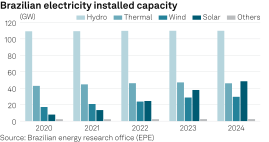
The investment in solar and wind generated an excess supply of electricity from 9 am to 3 pm local time, leading to widespread curtailments of these sources and reduced hydropower output.
Wind and solar curtailments surged to 21.7% of expected generation in January 2026, up from 16.2% in December and 10.1% in January 2025, according to ONS data. The sharp rise in generation restrictions has sparked concerns among market participants about potential shortages of international renewable energy certificates for wind and solar in an already illiquid market.
Platts daily assessment of vintage 2025 Brazilian I-REC was Real 0.90/MWh (17 cents/MWh) on March 2 for wind and solar. The value is higher than hydro, which was assessed at Real 0.76/MWh (15 cents/MWh) on the same day.
Flexibility
Hydro generators are being demanded to provide flexibility and increase energy capacity during hours when wind and solar power generation are lower. To secure that, the newly built plants would need to focus on reservoirs -- many of the small hydro plants were built with low or no reservoir capacity.
"Our current challenge is not only to generate electricity, but to store, distribute and secure the system's flexibility," Thiago Prado, president of the country's Energy Research Office, or EPE, said on Feb. 25.
While hydro generators expect to be financially rewarded for this flexibility, it is unclear whether any compensation is planned for existing or future plants, sources said.
"Our hydro power plants were not planned for intraday changes in generation. This will lead to higher maintenance costs in older dams," a consultant said.

Editor: