Energy Transition, LNG, Natural Gas, Emissions, Carbon
January 30, 2026
Gas-carbon correlation weakens further as fundamentals diverge
HIGHLIGHTS
Financials cut positions in carbon, shift higher in gas
US cold snap, geopolitical nerves push energy higher
Carbon outlook remains bullish despite portfolio changes
Financial players active in the EU carbon market have started curtailing positions while increasing bets on natural gas, amid a tightening fundamental energy picture and a mood shift from investors in EU Allowances.
This comes amid a sharp rise in volatility over recent weeks as heightened geopolitical instability and cold snaps in the US and Europe amplified gas prices, while carbon has moved to a seven-week low amid profit-taking.
"Speculators cut their position in EUA and may shift to the energy market," said a China-based carbon trader. "Gas and oil markets see momentum these days."
European carbon prices have historically tracked the Dutch TTF market -- higher gas prices typically drive up compliance costs for power generators across Europe.
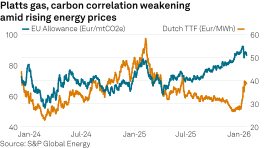
But the correlation started to unwind last year as financial players placed bets on the long-term bullish trajectory of the EU Emissions Trading System, pushing carbon prices higher, while natural gas prices trended lower on comfortable supply projections, with several new US LNG projects coming online.
Platts price assessment data showed a weakening correlation factor between gas and carbon, with the quarterly correlation factor at -0.99 in the fourth quarter of 2025, before moving towards zero at -0.30 during January to date.
Cold spell
The cold snap in the first half of January put a strain on storage withdrawals across Europe, pushing funds to increase their long exposure expeditiously to cover short positions over expectations of low storage levels by the end of the current winter.
CustomWeather forecasts show temperatures in Northwest Europe hovering below the five-year average between Feb. 2-6, after which they are set to significantly exceed seasonal norms for five days.
According to data from Gas Infrastructure Europe, gas storages in the EU were 42.9% full as of Jan. 28, more than 12 percentage points below year-ago levels.
Furthermore, in the space of 10 days, the NYMEX US Henry Hub futures more than doubled from $3.10/MMBtu Jan. 16 to $7.40/MMBtu Jan. 28, while the Platts daily Henry Hub reached levels above $30/MMBtu the day before, as heavy winter storms across the US pressured feedgas supply for LNG exports at a time when local demand surged.
Market jitters
Both physical and paper traders have moved based on this mix, with the Intercontinental Exchange's Commitment of Traders (CoT) report showing investment funds rebuilding length after sharp reductions last year.
The funds had assumed a net short position of around 11.4 million lots on TTF gas futures for the week ending Nov. 21 last year. Their net short position rose to around 92.7 million in three weeks.
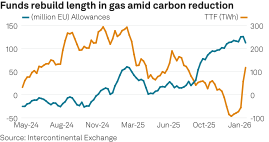
However, the cold snap and geopolitical risks led them to quickly unwind their shorts and flip to a net long position of around 57.7 million lots for the week ending Jan. 16. The latest report showed they increased their net long position to 118 million lots for the week ending Jan. 23, a 105% increase on the week.
Meanwhile, the data showed investment funds active in EU Allowances reduced net long positions by 13.5 million, or 10.7%, to 112.5 million as of the week ended Jan. 23 from a historic high of 126 million the week before, taking profit amid a weakening macro narrative.
The reduction aligned with last week's retreat in carbon prices amid geopolitical tensions following US tariff threats and concerns about Europe-US relations following the Greenland statements.
Further EUA price drops by the week's end led some traders to assume further profit-taking had been taking place, which could be reflected in next week's CoT data.
This comes as macroeconomic drivers play a greater role in European carbon as new players from the aviation, maritime and industrial sectors enter the market and historical physical and utility players become less prolific.
Supply balances for EUAs are negative in 2026, with the outlook set to tighten further in the second half of the year, once front-loaded REPowerEU volumes are fully phased out from the auction calendar.
Outlook
Geopolitical tensions in the Middle East remain a lingering concern, with traders closely monitoring the odds of a direct US military intervention in Iran and its ripple effects on LNG trade flows. Although short‑term forecasts are for milder weather, market participants are closely watching storage withdrawals and weather-related developments.
A recent cold snap in the US could have led to as many as 15 cargo cancellations, according to market participants.
However, the LNG demand from Asia has continued to be tepid, which has cushioned the immediate impact of supply concerns on the European market.
Platts assessed the North Asia vs Atlantic (via the Cape of Good Hope) arbitrage for US loading at minus $2.443/MMBtu Jan. 29, indicating a completely closed arbitrage to Asia.
"I think what matters now is a good forecast for the second half of February, warm and windy and probably Golden Pass will be announced and it's game over," said a EU-based gas and power trader.
The Golden Pass LNG liquefaction plant in the US is expected to deliver its first cargo in March, with commercial service sometime in early 2027.
"If gas storage remains over 30% full until March 31, prices will drop by another 10-15%," he added.

Editor: