Energy Transition, Natural Gas, Emissions, Carbon
January 30, 2026
EU carbon prices drop to 7-week low as traders unwind positions

HIGHLIGHTS
Carbon trading at Eur82/mtCO2e as geopolitical nerves persist
Funds cut length by 10.7% amid closing down of positions
Auction interest drops as spreads become less attractive
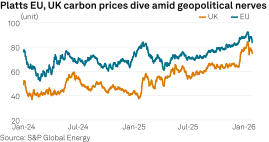
European carbon prices fell to their lowest since early December in the week ending Jan. 30 as geopolitical nerves prompted traders to liquidate positions.
EU Allowances were trading at Eur82.95/metric tons ($99.13/mt) of CO2 equivalent at 0950 GMT, according to the Intercontinental Exchange, a 6.2% weekly drop.
"[The market is] still recovering from the shocks of last week," a UK-based carbon trader told Platts, part of S&P Global Energy. "Nerves from specs and worry over the Iran outcome."
Remarks by US President Donald Trump over Greenland and threats of tariffs on European countries led to heightened volatility across commodity and stock markets throughout last week.
Ongoing US-Iran tensions are further fueling geopolitical uncertainties, putting pressure on the macro side, while supporting energy prices, with EUAs tracking the former.
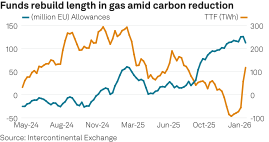
This mix has led to a weakening sentiment from financial players. Investment funds reduced net long positions in the EUA market to an eight-week low of 112.5 million, a 10.7% weekly decline.
Behind the move were curtailments of both gross short and long positions, with funds cutting longs by 11.5% and shorts by 15.2% or 17.5 million and 4 million, respectively.
Gas correlation diminishes
The week saw a continued breakdown in the correlation between Dutch TTF and EUA prices, with the role of utility demand diminishing in importance when it comes to EUA price moves.
"The gas-carbon correlation is overplayed," a carbon trader told Platts. "Power is a smaller part of the demand, and gas-coal switch dynamics are not playing a part right now."
Gas prices ended the week on a higher note, with geopolitical woes and a cold snap across the US pushing Dutch TTF spot and futures prices higher amid concerns about LNG deliveries to Europe amid shrinking storage-filling levels. Funds active in the gas market mirrored the increase, building positions, further decorrelating from carbon moves.
Storage fill across Europe stood at 42.9% on Jan. 28, a 12.5 percentage point decline from the same time last year. Reserves in the Netherlands, France, Germany, as well as some countries in Central and Southeast Europe were among the lowest, below 35%.
Auction interest wanes
Revenues totaling Eur780.72 million were gathered from four European auctions at a weekly average price of Eur84.15/mtCO2e, down from the yearly average of Eur86.51/mtCO2e.
The weekly bid cover ratio stood at 1.75, dragging the year-to-date average down to 1.91 from 1.96 previously, as players who typically take advantage of the spot-December spread lacked incentives to participate in the auction.
"Auctions have been weak due to spreads not offering attractive yields," said a UK-based carbon trader. "At these levels, the big spreads traders (big balance sheets, cheap financing) can't make enough money to justify buying spot and selling December."
Auctions are being closely watched this year because coverage of the EU Emission Trading System expanded at the start of 2026. The phaseout of free allowances is pulling more industrial players into the compliance market, while the maritime industry must cover 100% of emissions in 2026, and aviation players receive no further free allocation this year.
Volumes available at auction are set to further decrease later this year when REPowerEU -- the bloc's plan to end reliance on fossil fuels and Russian gas -- achieves its targeted Eur20 billion of revenue and volumes earmarked for the plan are phased out.
Since 2023, a total of Eur15.6 billion has been gathered towards REPowerEU, or 78.1% of the targeted amount.
"At current EU ETS prices, [the phaseout] is expected to happen in late May or early June 2026 -- well before the currently scheduled end date of Aug. 31," analysts at S&P Global Sustainable1 wrote in a recent market note.
"If auctions stop early, up to 38-40 million fewer allowances could be sold than planned. Any unused allowances would be reallocated back to member states for 2027–30, or returned to the Innovation Fund," they added.
UK carbon drops
UK carbon prices also ended the week lower, tracking the EUA moves but lower liquidity exacerbated volatility.
UK Allowances were trading at GBP63.84/mtCO2e at 1101 GMT, according to ICE, a 6.6% weekly decrease.
Platts assessed the spread between EU and UK allowance at Eur9.07/mtCO2e on Jan. 30, largely unchanged from last week.
Market participants are expecting updates later in spring about the expected link of the UK ETS with its EU counterpart. Officials are set to meet in Brussels to discuss the wider relations between the two jurisdictions in the aftermath of Brexit.
Funds have been positioned in anticipation of a link between the two markets since the second half of 2025, having amassed and held onto record length. Investment funds held 19.9 million allowances as of the week ending Jan. 23, increasing bets by 7.1% week over week.
Other participants, including investment firms, commercial undertakings and operators with obligations, remained largely flat.

Editor: