Fertilizers, Chemicals, Energy Transition, Agriculture, Electric Power, Maritime & Shipping, Refined Products, Renewables, Biofuel, Hydrogen, Jet Fuel
January 26, 2026
IEW 2026 INTERVIEW: India’s 500 GW non-fossil fuel power capacity goal may be raised: ministry official

HIGHLIGHTS
Subject to annual power demand growth of 6%-7%
Transmission upgrades in plan key for evacuation
Renewables capacity addition seen strong in 2026
India may raise its target of 500 GW non-fossil fuel power capacity by 2030 if electricity demand grows at the projected 6%-7% annually and transmission upgrades come online as planned, Santosh Kumar Sarangi, secretary at the Ministry of New and Renewable Energy, told Platts, part of S&P Global Energy.
India announced the target for its non-fossil fuel power capacity at the UN Conference of the Parties in 2021. Since then, renewable power capacity additions have accelerated, and large companies have made major projections for clean energy.
"Creation of this capacity is not so much of a problem, but finding offtakers is," Sarangi said ahead of the Jan. 27-30 India Energy Week 2026 in Goa, pointing out that demand for electricity will have to grow in step with the capacity additions. "We are sticking to the 500 GW target at this point in time. If a revision is required, we'll look at it, maybe in 2027."
According to Sarangi, there is a possibility of an upward revision of the key target if distribution companies buy more power and transmission infrastructure is ready for the new generation of solar, wind, and other non-fossil fuel-based power sources.
Currently, transmission upgrade planning has been done until 2030, and the MNRE has started discussions with the Ministry of Power and the Central Electricity Authority to plan transmission infrastructure expansion beyond that year, Sarangi said.
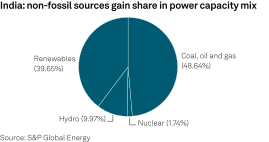
India added 49.12 GW of new non-fossil fuel-based power capacity in 2025 -- the highest annual additions -- taking the total clean power capacity to 266.78 GW, MNRE announced earlier this month.
"This year will be better than 2025," Sarangi said. "I also foresee that in the distributed renewable energy segment, the deployments are going to be much faster because I see a greater adoption of farm solarization and rooftop solarization by both consumers as well as state governments."
MNRE's agenda
MNRE will prioritize expanding firm and dispatchable renewable energy, focusing on round-the-clock supply backed by battery energy storage systems to maximize deployment and grid stability, Sarangi said.
Alongside this, the government will prioritize domestic manufacturing of renewable components, going beyond PV modules capacity to ensure India achieves self-sufficiency across the full renewable energy supply chain.
"We'll continue to push for increasing domestic manufacturing -- focusing on the upstream sector," Sarangi said. "For solar PV modules, we have enough capacity. The focus will be on solar PV cells, ingots, wafers and polysilicon manufacturing capacity."
Renewable hydrogen and electrolyzer production will remain crucial to India's energy transition, with the ministry pursuing both domestic market creation and export opportunities, according to Sarangi.
"Domestically, I see about 1 million mt-plus of green hydrogen being consumed," he said. "With Europe having developed its carbon target for 2040, we foresee that green hydrogen and green ammonia offtake will accelerate. I'll not be surprised if we go beyond 3 million mt by 2030 as well."
MNRE is examining existing productivity-linked incentive schemes for renewable energy components and is ready to tweak the rules if needed to attract investors and entrepreneurs, he said.
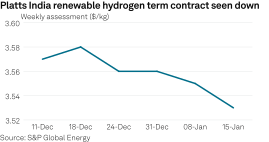
Platts, a part of S&P Global Energy, assessed the India renewable hydrogen term contract at $3.37/kg on Jan. 22, down 5.60% from Dec. 11, when the assessment was launched.
Growth challenges
The challenges for upstream renewables expansion include its capital intensity and high electricity consumption, with developers eyeing both incentives and policy measures, Sarangi said.
"In spite of a [productivity-linked incentive], which has been in place since 2021-22, we haven't seen much investment in PV ingots, wafers and polysilicon," he said. "So, we are now examining ways in which these sectors can be supported [further]."
In addition, MNRE is in discussions with state governments to determine how their industrial policies could jointly support these industries, he added.
Auctions conducted by the government, including tenders from Solar Energy Corp. of India, or SECI, have played a major role in India's renewables journey, and Sarangi said they will now see an enlarged role by floating tenders for other clean fuels as well.
"There are various ways in which green hydrogen and its derivatives could be utilized," he said. "For example, sustainable aviation fuel is another area. Producing methanol from biogenic sources, such as biomass, is another area."
MNRE is working with the Ministry of Ports, Shipping and Waterways on a green methanol tender to be issued by SECI, which will look at demand aggregation for ports to supply green methanol to shipping companies, Sarangi said.
MNRE is working on other innovative mechanisms such as the "Bring Your Own Buyer" scheme, to expedite the renewable hydrogen offtake, according to Sarangi.
"We'll find ways to aggregate demand and tie up the supply," he said.

Editor: