Electric Power, Energy Transition, Renewables
December 17, 2025
Solar module, cell imports drop in Q3 amid policy shifts, price increases

HIGHLIGHTS
US imported 6,907 MW of panels
Prices for imported solar equipment rise
Solar panel shipments to the US decreased in the third quarter, returning to the prior pattern of declining imports after a jump in the second quarter, according to S&P Global Market Intelligence Global Trade Analytics Suite.
At the same time, prices for imported solar panels have been on the rise.
The US imported 6,907 MW of panels during the quarter, down 35% from the 10,632 MW in the previous quarter and down 54.8% from the 15,271 MW of imports in the third quarter of 2024. The release of the trade figures was delayed compared to previous quarters, likely due to the US government shutdown.
The decline follows President Donald Trump's signing of the budget reconciliation bill on July 4 and a ramp-up in domestic manufacturing. The bill accelerated the phaseout of key tax credits and added new restrictions, including for foreign entities of concern. Imports also face tariffs, including nation-specific tariffs in place, adding another element for companies to navigate.
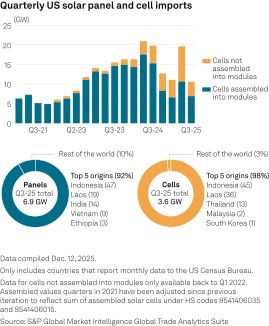
Indonesia was the largest source of module imports with 46.7%, followed by Laos at 18.7%, India at 14.3%, Vietnam at 8.8% and Ethiopia at 3.4%.
Ethiopia joined the top five exporters to the US in the third quarter, and Thailand and Malaysia dropped to sixth and seventh place, respectively. This highlights tariff-driven supply chain shifts not only from nation-specific tariffs, but also from new antidumping and countervailing duties.
The US imported 3,644 MW of cells in the third quarter, down 59.4% from the 8,973 MW in the second quarter and down 19.4% from the 4,519 MW in the prior-year quarter.
Indonesia was the largest source of solar cell imports at 45.4%, followed by Laos at 36.3%, Thailand at 13.4%, Malaysia at 2.2% and South Korea at 1%.
Indonesia's imports of both cells and modules slightly increased from the second to the third quarter. Following the conclusion of the antidumping and countervailing duty case for Cambodia, Malaysia, Thailand and Vietnam in May, cell and module imports from those countries have decreased. Cell imports from Cambodia have now stopped. The US is also not importing cells from Vietnam.
"Despite overall capacity growth in 2024, several leading [photovoltaic] manufacturers began scaling back operations in Southeast Asia — especially in Cambodia, Malaysia, Thailand and Vietnam — during the second half of the year. This was largely driven by the US Commerce Department's rulings imposing steep duties on solar products from these countries, undermining the viability of export-oriented production," S&P Global Sustainable1 analysts said in a Nov. 7 report.
Prices
There is also a pending antidumping and countervailing duty case on solar cell and module imports from India, Indonesia and Laos. Imports from Indonesia are increasing, while imports from Laos and India have decreased. India was the eighth-largest source of cell imports.
"Tariffs on these countries could significantly constrain cell supply for domestic module manufacturers, creating another layer of uncertainty," the Solar Energy Industries Association said in its fourth-quarter market report released Dec. 8.
SEIA highlighted manufacturing growth in the US, which now has the capacity to produce every major component of the solar supply chain. Currently, there is 64.8 GW of solar module manufacturing capacity online, with 11 GW under construction, as well as 3.2 GW of cell capacity operational, with 21.3 GW under construction.
"We're seeing strong growth today, but that momentum isn't guaranteed. If the administration continues down this path, they risk driving investment overseas, stifling job creation, raising costs on consumers, and handing America's manufacturing advantage to our competitors," SEIA President and CEO Abigail Ross Hopper said in an Oct. 29 statement.
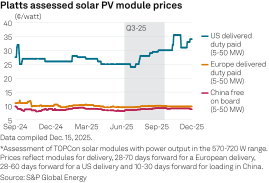
Average monthly prices for Platts assessed delivery-duty-paid US solar Topcon modules for 5-50 MW volumes generally increased during the third quarter, from 24.6 cents/watt in July to 27.4 cents/watt in August, then to 29.4 cents/watt in September. The average price continued to rise to 30.4 cents/watt in October and 33.6 cents/watt in November. Prices so far in December have averaged 33 cents/watt.
Prices for crystalline solar cell technology started to increase amid new nation-specific tariffs that went into effect in August and antidumping and countervailing duties. The price increase trend has generally continued.
Related content: 2025 Tier 1 cleantech companies: Balancing growth, headwinds and sustainability goals

Editor: