Electric Power, Energy Transition, Natural Gas, Emissions, Hydrogen, Renewables
September 15, 2025
Germany's Reiche presents 'reality check' ET report aimed at reducing costs

HIGHLIGHTS
Reiche sees 2030 demand some 20% below 750 TWh in EEG law
Less solar, wind needed to reach 80% in 2030 power mix
Slow demand growth requires urgent policy adjustments
German Energy Minister Katherina Reiche on Sept. 15 presented the monitoring report on the energy transition that will form the basis for key energy policy decisions by the new coalition government.
Based on the so-called "reality check," the government is maintaining its 2030 target of an 80% share of renewables, but sees much slower demand growth, which requires a slower expansion of solar and wind that currently required by law.
Reiche noted offshore wind and rooftop solar that would require adjustments to current support frameworks.
"Secure, clean and affordable energy is central to the German economy. Today, 60% of electricity already comes from renewable sources. By 2030, we aim to reach 80% and we are committed to this goal," Reiche said.
The report shows "urgent need for action" with the new government to "set the right course" with focus on lower system costs.
The minister, in a press conference, said that the most realistic 2030 demand projections were well below the 750 TWh that underpins current capacity targets in the green energy law (EEG 2023).
Reiche mentioned 530 TWh as the lowest forecast, while the ministry's statement sees a realistic range of 600-700 TWh, adding that current trends point toward the lower range.
"Even the 90-TWh gain within five years [from the current 510 TWh to 600 TWh] would be a major step," Reiche said, calling for a change to demand ranges in the underlying legislation, which is currently debated within the coalition.
The report pegs the median of major 2030 demand projections around 640 TWh, citing large uncertainties and wide ranges between normative and exploratory forecasts.
Analysts at S&P Global Energy forecast German 2030 power demand around 550 TWh.
"Only with realism can the energy transition succeed and generate growth. Climate neutrality and economic competitiveness must not be opposites -- we need both to secure Germany's prosperity," the ministry said, noting that "public financial needs to support the transformation have not yet been reliably calculated."
Market-focused renewables support
The ministry said in its conclusions based on the report that future support regimes for renewables will be system and market oriented. It proposed t10 measures to adjust German energy policy.
"This means the consistent abolition of the fixed feed-in tariff and the complete termination of compensation in the event of negative prices," the statement said.
Reiche specifically referred to rooftop solar as no longer requiring state aid.
"[B]ilateral contracts for difference (CfDs) and clawback mechanisms will be developed and implemented," the ministry said, also referring to direct marketing and power purchase agreements as market tools.
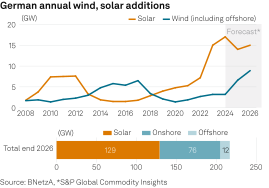
German solar capacity reached 100 GW earlier this year. The report assumes that under current policies, the 215 GW target for 2030 is reachable.
For on- and offshore wind, current trends indicate that current 2030 targets would be missed, noting various drivers, including record permits for onshore wind, while the latest offshore wind auction resulted in no bids from investors.
Technology-neutral capacity market by 2027
The ministry is currently fast-tracking tenders for flexible baseload power plants, especially new gas-fired units, with a prospect of conversion to hydrogen.
The tenders will be prioritized and designed pragmatically, the statement said.
In addition, a technology-neutral capacity market will be introduced "if possible by 2027," Reiche added.
"By the end of this year, we need clarity on the first tenders for the construction of new gas-fired power plants," the statement said.
Chancellor Friedrich Merz said Sept. 10 that the monitoring report, agreed upon in the coalition treaty, will serve as the foundation for energy policy decisions "for the coming weeks, months and hopefully years."
Merz acknowledged that renewables alone cannot guarantee secure power supply for Europe's largest economy -- marking a departure from the previous administrations' more prescriptive energy policies.
The main market tool towards climate neutrality would be carbon prices, Merz said.
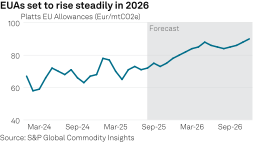
Platts, part of S&P Global Energy, last assessed EUA carbon allowances (nearest December) at Eur75.71/mt ($88.98/mt) on Sept. 12 after hitting a seven-month high at Eur77.19/mt on Sept. 10.