Energy Transition, Electric Power, Carbon, Emissions
September 15, 2025
California lawmakers send Newsom major wildfire, regional grid, carbon trading bills
HIGHLIGHTS
California legislation needed for Pathways Step 2
California's cap-and-trade program extended to 2045
California lawmakers passed a suite of climate and energy legislation on Sept. 13, including measures to reauthorize the state's carbon trading system, replenish a statewide wildfire insurance fund and create a wider regional electric market.
The bills now go to Governor Gavin Newsom, who is expected to sign them. Days before passage, Newsom and state legislative leaders announced a deal to advance the proposals, touted as major bills designed to help keep rising electricity rates in check as California continues efforts to decarbonize its economy.
Senate Bill 254 authorizes an extension of a $21 billion wildfire insurance fund created in 2019 for another 10 years, to 2045. If the state's big three investor-owned utilities choose to participate in the second phase of funding, their shareholders and customers would each contribute an additional $9 billion.
Newsom floated the proposal in July as questions mounted over the durability of the current fund following the catastrophic Eaton Fire in Los Angeles County in January, which has been linked to an idle transmission line owned by Southern California Edison, an affiliate of Edison International.
PG&E Corp. operating arm Pacific Gas and Electric and Sempra subsidiary San Diego Gas & Electric contribute to the current fund and can elect to participate in the extension.
The bill also requires the California Public Utilities Commission to prohibit a utility from including in its equity rate base its share of an additional $6 billion of wildfire mitigation capital expenditures approved on or after Jan. 1, 2026, according to a legislative analysis. Other provisions of the legislation authorize public financing of transmission infrastructure and streamline a California Energy Commission "opt-in" permitting process for clean energy projects.
All three utilities voiced support for the legislation.
"Senate Bill 254 will help strengthen the state wildfire fund to protect wildfire victims, without raising customer costs," the utilities said Sept. 15 in a joint statement to Platts, part of S&P Global Energy.
But more work is needed "to develop permanent and comprehensive solutions to increasing wildfire risk in California," they said, pointing to a desire to continue collaboration with the governor, policymakers and other stakeholders "on developing durable, holistic, solutions that protect victims and deliver energy affordability."
Equity analysts at Jefferies said in a Sept. 15 note that SB 254's passage was "a net positive" for California's utilities.
"While we view the 2025 shareholder-funded continuation account to set an unfavorable precedent for future funds, the construct was much more palatable than its 2019 predecessor -- with the lack of initial contribution and deferred contribution, starting in 2029," they said. "Incrementally, securitization exposure for wildfire mitigation capex was materially lowered from the $15 [billion] in the initial draft bill to $6 [billion]."
Regional grid bill
Assembly Bill 825 will enable California utilities to participate in a regional electricity market governed by an independent body and not the California Independent System Operator. AB 825 is an amended version of SB 540, which was filed in February but stalled due to changes.
"This marks a crucial next step toward independent governance of Western electricity markets -- a milestone shaped by years of successful and evolving regional collaboration," CAISO said in a Sept. 13 statement. "As the Pathways Committee develops the framework for the new regional organization, the ISO will coordinate closely to ensure alignment with legislative requirements. The ISO remains fully committed to the successful launch of the Extended Day Ahead Market and will offer technical support throughout the transition."
AB 825 builds on the West-Wide Governance Pathways Initiative to strengthen grid coordination across the West, which was launched in summer 2023 by a coalition of regulators from five Western states. Step 1 established a more independent and broadly regional approach to market decisions for both the Western Energy Imbalance Market, a real-time market launched in 2014, and the EDAM, which is expected to have its first market participant go live in May 2026. Step 2 lays out plans to transfer governance authority over existing regional energy markets from CAISO to a new regional organization, while Step 3 would continue expanding the scope of regionalized functions and services offered by the regional organization.
California legislation is necessary to implement Step 2.
"The Launch Committee is excited to see the California Legislature's passage of AB 825, enabling participation in the new, independent Regional Organization," Kathleen Staks and Pam Sporborg, Launch Committee co-chairs, said in a statement. "It is a critical step in implementing the work of the Pathways Step 2 proposal and achieving the largest energy market footprint possible resulting in the greatest affordability and reliability benefits for customers. We are looking forward to the incorporation of the new, fully independent Regional Organization in the next few months and seating the initial board."
California's market participation will also have a significant impact on the rest of the West, allowing states across the region to benefit from shared resources, reducing peak demand during times of grid stress and strengthening the Western grid, according to the trade association Advanced Energy United.
"This is a pivotal moment for the West, demonstrating California's commitment to regional collaboration and ensuring all states' voices will be represented," Leah Rubin Shen, Advanced Energy United managing director, said in a Sept. 13 statement. "The broad geographic footprint enabled by this legislation will provide the greatest economic benefits, improve affordability for consumers and support a more resilient future for the whole region."
The Clean Energy Buyers Association called the bill's passage "a critical step toward delivering more affordable, reliable and clean energy across the West."
"The West-Wide Governance Pathways Initiative is designed to facilitate the sharing and trading of clean energy with other Western states," CEBA said in a Sept. 13 statement. "AB 825 represents California's commitment to a broader, coordinated energy market that will serve as a model for inter-state regional coordination to deliver cost effective, reliable carbon emissions-free electricity as we experience unprecedented load growth in the West and nationally."
PG&E said the bill supports the state's efforts to expand energy markets across the West to optimize generation, transmission and storage assets across the western grid.
"This legislation will help save customers money by reducing reliance on pricey fossil fuel generation and increasing access to lower-cost renewable energy from other states, advancing energy affordability and the California's clean energy goals," PG&E told Platts Sept. 15.
SCE Spokesperson Gabriela Ornelas called AB 825 "smart policy that lowers electric bills, strengthens grid reliability and expands access to affordable clean power, potentially reducing statewide energy costs by about $1 billion annually."
Carbon trading
AB 1207 reauthorizes California's cap-and-trade program -- now called cap-and-invest -- through 2045. The California Air Resources Board was previously authorized to run the cap-and-invest program until 2031. Additionally, SB 840 opens new avenues of investment for the program's revenues.
These bills mark a significant milestone for the program, which has faced over a year of regulatory uncertainty. Delays in implementing new regulations and a legal challenge from the Trump administration led to carbon prices cratering this year and hitting the auction floor price in the second quarter.
Once these bills were amended on Sept. 10, carbon prices shot up to about $30 per allowance for the first time since April. Platts assessed next-December California carbon allowance costs at $32.50/alw on Sept. 15, rising 14% since the sudden movement on these key legislative items.
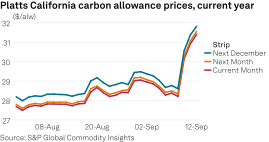
"The market was happy to see this extension formally passed," Energy analyst Matt Williams said. "But of course, the question still remains: When are we going to see new caps?"
However, language in the bill that places offsets "under the cap" is a bullish development for the market, Williams added.
"In the current market, offset utilization has allowed for larger bank builds," he said. "By reducing available allowances in a given year by the number of offsets utilized in the prior year, California is fundamentally tightening supply."
The program is also still under legal threat from the Trump administration. In April, President Donald Trump directed Attorney General Pam Bondi to "expeditiously" halt the enforcement of state climate laws, including California's cap-and-invest program.
The April executive order said that state climate laws "threaten American energy dominance" and that cap-and-invest "punishes" businesses by forcing them to pay "large sums" to trade carbon credits.
Trump sued the state during his first term in 2019 over a decision to link its carbon market with a similar program in Quebec, Canada, but a federal judge dismissed the case the following year.
Opponents of carbon compliance programs tend to center their criticisms on the impacts of cap-and-invest on consumer affordability. State Republicans introduced a ballot initiative in Washington state in 2024 to overturn its carbon trading program, saying it raises natural gas prices.
Washington state is now pursuing a linkage of carbon markets with California and Quebec, which would bring down carbon prices for the state and potentially boost its political stability as a result. The process is still in its early stages, with several steps remaining on California's end. Linkage is expected by 2026-2027.
The new legislation in California would redirect revenues from cap-and-invest toward directly reducing electricity prices for consumers.
While carbon pricing in theory offers a cost-effective mechanism for reducing emissions, the revenues must be used strategically to improve affordability at the consumer level, an economist at nonprofit research group Resources for the Future previously told Platts.
