Agriculture, Energy Transition, Electric Power, Natural Gas, Biofuel, Renewables, Emissions, Hydrogen
August 21, 2025
States can help US industry compete globally via decarbonized processes: experts

HIGHLIGHTS
More important amid federal policy ‘pullback’
Efficiency, electrification are quickest paths
US state governments can use regulations, incentives and technical support to facilitate decarbonization of their industrial sectors to help them compete in a world economy increasingly focused on mitigating climate change, experts say.
"The industrial sector is the backbone of the US economy from manufacturing to food processing to chemicals," said Elina Vanuska, industrial decarbonization fellow at the Renewable Thermal Collaborative, a coalition of companies, institutions and governments working to decarbonize thermal energy. "But, as global demand for clean technologies and low-carbon products grows, the US industry must adapt to stay competitive, and in order to do so, that means transitioning to cleaner heat sources."
Federal policies, including regulations and tax incentives, have frequently led such efforts, but states "are absolutely central to this transition to clean heat," Vanuska said during an Aug. 20 Renewable Thermal Collaborative webinar about such efforts.
"States control many of the important levers that enable industrial decarbonization," Vanuska said. "They set and enforce standards that can drive clean production. States also design and fund incentive and technical assistance programs that support those early movers. States also drive utility regulations and rate structures for public utility commissions, and that directly impacts the economics of switching from natural gas to electricity. States also manage permitting and infrastructure, which can speed up or slow down the deployment of these projects."
Additionally, states can often innovate more quickly than federal processes, Vanuska added.
"It's safe to say that our mission and our work has become even more important given the current lack of climate leadership and honestly, the pullback from the federal government on climate," Panelist Wil Mannes, senior program manager for Strategic Initiatives and Finance at the Colorado Energy Office, said.
'Low-hanging fruit' growing
About a third of US industrial combustion emissions come from "low- to medium-temperature" processes, meaning below 400 degrees Celsius (752 degrees Fahrenheit), according to Panelist Molly Freed, a senior associate at RMI, a Denver-based energy transition advocacy group formerly known as the Rocky Mountain Institute.
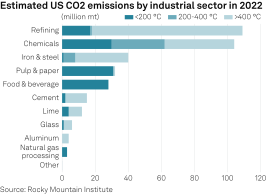
"So, when we talk about sizing the prize here, that's pretty substantial, especially when you look at the fact that there are alternatives available," Freed said. "Despite industry having been deemed hard to decarbonize, as I'm sure you all have heard this for many years, there are actually a lot of options on the table. I'm primarily focused on efficiency and electrification ... because we believe that alternative fuels like biogass and biomass and hydrogen and other sources of energy are better served actually as feedstocks for the chemical industry or for high-temperature heating applications."
On efficiency, which Freed called "low-hanging fruit that keeps on growing," she added that "most facilities are actually just scratching the surface of what's possible at their plant."
Electrification of industrial processes can help decarbonize industrial processes where the grid has a low emissions profile, Freed said.
"In Michigan, for example, the electricity that's being produced by the grid, if manufacturers were to tap into that to power their low to medium temperature processes, it actually results in more emissions than burning gas at the plant, both because of the grid mix and because of energy that's wasted along the delivery route of bringing electricity to that plant," Freed said. "But because of the state clean energy standards and renewable portfolio standards, this tipping point will soon be reached in Michigan and is already the case in many other states."
Overcoming barriers
Barriers to industrial decarbonization include the spark gap -- the cost of electricity versus the cost of equivalent natural gas energy -- as well as capital costs, technology, grid readiness and market uncertainties, Freed said.
"We want market conditions to take over," Freed said. "We want it to be a no-brainer for industries to invest in efficiency and electrification."
At the state level, that means establishing policies that focus on "what you're regulating" and establishing "long-term certainty" through standards and regulations, then adding incentives by "lowering the cost of electrification and efficiency" and increasing the value of and demand for products "created via clean heat."
Vanuska said RTC would "like to serve as a resource for state policymakers."
"The RTC bench has a lot of experts," Vanuska said. "We have a lot of technical knowledge that can help inform policy development, and we'd also like to foster collaboration among states and peer organizations to share lessons and replicate successful approaches."
