Electric Power, Energy Transition, Renewables
August 19, 2025
INTERVIEW: UK rooftop solar innovator Power Roll squares up to funding, expansion challenge

HIGHLIGHTS
Aiming to deploy alternative solar tech 'where silicon can't go': CEO
Untapped rooftop solar opportunity estimated at GBP250bil globally
Power Roll raising GBP10mil to complete commercialization
UK solar upstart Power Roll is embarking on a fundraising effort to help commercialize its innovative solar film technology and tap into a section of the market where traditional silicon panels cannot go, CEO Neil Spann told Platts, part of S&P Global Energy.
Power Roll's patented "microgroove" technology -- similar to holograms -- allows it to produce lightweight, flexible solar films using perovskites, a low-cost alternative to silicon. The films can be placed on rooftops and warehouses that are unable to bear the weight of standard panels.
The company has kick-started a GBP 10 million ($13.5 million) series A funding round to help complete commercialization of the technology. After that, it plans to build one of the UK's first solar gigafactories and expand into international markets.
"What we want to do is attack those surfaces where silicon can't go, because right now, picking a fight with the large manufacturers over in China is not a sensible strategy for a company like Power Roll," Spann said in an interview.
The company estimated the untapped market opportunity for solar on commercial and industrial rooftops to be worth GBP250 billion globally. Spann said one in four commercial buildings are unable to house traditional silicon panels, predominantly because the panels are too heavy but also because their roofs may be in shade or are curved.
Power Roll's solar film weighs about 0.5 kg per square meter, far lighter than standard panels, according to Spann. Potential deployment areas include warehouses, agricultural and public buildings, and in the longer term carports and residential rooftops.
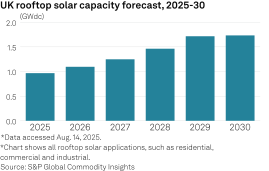
The UK rooftop solar market -- including all residential, commercial and industrial installations -- stands at about 1 GW today, which analysts at Energy see growing to 1.7 GW by 2030.
Spann said Power Roll's technology could also be used as a repowering tool, with the ability to put a layer of its film on top of existing solar panels to extend their lives.
"The economics of solar from a consumer perspective have never been better," the CEO said, adding that Power Roll aims to produce its product at "a lower cost per watt than even silicon made in China" once large-scale production begins.
Supply chain opportunity
Power Roll's growth ambitions come as the UK government attempts to triple the country's installed solar capacity to between 45 GW and 47 GW by 2030.
The vast majority of that will be ground-mounted solar installations, though the UK is also aiming to unlock a "rooftop revolution" to help cut consumer energy bills.
The capacity ramp-up will require a significant amount of imported equipment, chiefly from China, given that the UK has almost no domestic manufacturing capacity for conventional crystalline silicon solar panels.
In a recently published roadmap for the solar industry, the government acknowledged China's dominance in solar manufacturing. However, it said the UK is well placed to pioneer alternative technologies, highlighting Power Roll as one example.
"The UK is at the forefront of developing new types of solar modules, such as lightweight and flexible perovskite panels, and tandem module technologies," the government said. "This can provide the UK with a global strategic advantage if manufacturing can be scaled in the UK."
Beyond solar modules, the government also sees an opportunity for UK supply chain growth in areas such as transformers, switch gears, inverters, high-voltage cabling and steel racking.
Gigafactory plans
Power Roll's initial plan is to roll out a manufacturing facility with capacity to produce 100 MW/year, which will cost the company about GBP20 million to equip, Spann said. The facility could be up and running by 2027.
A future expansion to gigafactory scale will cost the company about GBP80 million. Spann attributed the "relatively low" equipment costs to the fact that Power Roll's manufacturing process is similar to what is already used in holographics and potato chip packaging.
Despite this "capital-light model," the CEO acknowledged that access to funding is likely to be one of Power Roll's limiting factors.
"Fundamentally, it's a challenging market generally in the world," Spann said. "I think cleantech has had a bit of a downshift in terms of [venture capital] investment over the last several years. It's not as buoyant as it was in 2021."
The CEO said Power Roll had undergone the "typical journey of a startup," with the business funding itself in its early years before turning to angel investors and family offices.
The company, headquartered in County Durham in the northeast of England, completed a GBP4.3 million funding round in 2024 that included a contribution from the UK government's Northern Powerhouse Investment Fund II.
The series A fundraise will likely target cleantech funds, Spann said. Subsequent funding rounds to finance the factory expansions will seek to engage larger financial institutions and the National Wealth Fund, the UK's policy bank.
"We know the technology works. We know that customers want it," Spann said. "It's now completing the final piece of development activities and raising the capital to get that factory built."
