Electric Power
August 15, 2025
Large loads challenge Texas grid reliability, require more transparency: report

HIGHLIGHTS
Queue tops 181 GW online by 2030
Concern raised about triggering restudies
Large loads are seeking interconnection to the Electric Reliability Council of Texas grid faster than ERCOT can accommodate, creating reliability issues that require greater transparency, communications, coordination and incentives for flexibility, a new report from The University of Texas Energy Institute shows.
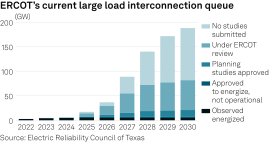
ERCOT's latest large load interconnection queue shows it had 4.6 GW of large loads energized and another 2.1 GW approved but not yet energized as of July 30, but it has more than 181 GW of large loads in the various stages of the process that are slated to start operating by 2030. ERCOT consider a large load to be a single site with aggregate peak demand of more than 75 MW.
As context, ERCOT's current official record peakload is 85.4 GW, set Aug. 10, 2023.
On Aug. 14, the UT Energy Institute released "Findings from the 2025 Large Load Symposium at The University of Texas," which occurred July 24, comprising 65 representatives from the Public Utility Commission of Texas, ERCOT the Texas Reliability Entity, industry stakeholders and academic experts.
ERCOT's representatives cited three main types of challenges: system adequacy, response and control, and voltage ride-through capability.
'Limited visibility' into loads
The system adequacy issue is closely intertwined with uncertainty over the likelihood of large loads developing when and where proposed, which prompted a call for "clear standards and requirements."
"ERCOT lacks direct communication with load operators, resulting in limited visibility into operational behavior," the report states. "The group recommended improved transparency in the interconnection process—including queue dashboards and more structured communication among loads, transmission and distribution utilities, and ERCOT."
Grid operations, planning and regulatory specialists "noted that loads, unlike generators, are not registered market participants and thus face fewer obligations to provide data or models," the report states.
However, participants representing large loads expressed "fear that updating models, as ERCOT requests, could trigger restudies and jeopardize interconnection timelines, creating a disincentive to submit additional information updates."
Another system adequacy issue was cited by transmission providers, who noted "the need for 765-kV transmission and improved ramping capabilities for large loads."
"Risks from fast-ramping loads, limited participation in security-constrained economic dispatch (SCED) dispatchable Controllable Load Resources (CLRs), and outdated underfrequency relays are emerging," the report states. "Utilities stressed the need for more granular visibility and coordination to support real-time reliability."
Transmission providers urged the PUC "to establish interim standards within three months to avoid recurring grid stress in 2026."
System stability at issue
Voltage ride-through capability refers to how a power element – a generator, load or connector – responds to sudden events such as a lightning strike.
"Utilities noted that voltage events are just as serious as frequency issues," the report states. "They cited operational incidents where large loads were dropped but not restored, leading to price distortions and reliability concerns."
The report's recommendations included:
- Develop a standard large load interconnection agreement
- Create a systemwide study reporting platform
- Create a third-party modeling data repository
- Require telemetry for large loads
- Enable batteries and microgrids to help with voltage ride-through issues
"Stakeholders broadly agreed that without immediate action the grid will remain vulnerable to both operational and investment risks," the report states. "The path forward requires urgent but deliberate attention, disciplined coordination, shared responsibility, and a willingness to modernize foundational practices. The rapid growth of large loads presents unique technical challenges, while also offering new opportunities for increased grid resilience. If implemented with urgency and accountability, the solutions discussed at this symposium can position Texas to lead in integrating the next generation of large loads."
