Electric Power, Energy Transition, Renewables
July 30, 2025
US regional heat waves restricting power resource sharing across markets

HIGHLIGHTS
Widespread power supply-demand tightness
Gross power demand has neared all-time high
Widespread heat waves in June and July have covered the Central, MidAtlantic and Northeastern regions of the US, limiting the degree to which power grid operators can import and export power between markets in the Eastern Interconnection, a New York Independent System Operator executive said July 30.
"It has been an interesting summer from an operations perspective, and we've all experienced some pretty high temperatures, high humidity really starting in June and as you all know extending through the month of July," Emilie Nelson, NYISO executive vice president and Chief Operating Officer, said during a Management Committee meeting.
Through the past several years, the dependency on emergency assistance has been reduced when modeling the installed reserve margin to better align with what is expected to be realized in real-time operations, she said.
"I also think that is why this summer has been interesting because the conditions have been really similar across the Eastern Interconnect, so the dependency, the opportunity to rely on neighboring areas is more limited," Nelson said, adding that this is an opportunity to revisit those reliability models to see if the assumptions are solid.
The NYISO experienced a heat wave from June 23-25 that impacted the entire Eastern Interconnection, so all regions are experiencing tight system conditions simultaneously.
The Eastern Interconnection covers the states, wholesale power markets and regional entities east of the Rocky Mountains. The regional entities regulated by the North American Electric Reliability Corp. are the Midwest Reliability Organization, Northeast Power Coordinating Council, ReliabilityFirst and the SERC Reliability Corp..
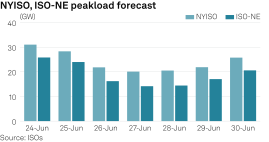
June 24 marked the peakload during that heat wave which reached 31,857 MW in hour 18, or 6 pm, which has been the power demand peak for the year to date, Nelson said.
The maximum solar power output on June 24 was 4,643 MW at 12 pm and when peakload was reached at 6 pm solar output had dropped to about 1,000 MW, she said.
Real-time loads on June 24 approached the NYISO's summer 90-10 forecast, and the grid operator declared an Emergency Energy Alert Level 1 due to tight capacity conditions. "We ultimately purchased some emergency energy from the neighboring control areas," she said, adding that on June 24 and multiple other days this summer NYISO called on its external installed capacity suppliers.
A Major Emergency was also declared on June 24 due to a total operating reserve shortage with the grid operator activating its emergency demand response resources to mange the peakload, Nelson said.
Power demand approached record highs
Real-time power prices have been "elevated" coincident with the tight power system conditions which reflects that NYISO is committing and dispatching the bulk of the New York power generation fleet including some less efficient resources to ensure meeting the peakload, she said.
There have been shortages of reserve products and transmission and with the activation of demand response NYISO has observed scarcity pricing conditions representing the "full complement" of energy market signals, Nelson said.
At the end of June, several power generators were unavailable day ahead going into real time. That impacts the conditions that need to be managed in real time and generators with a day-ahead commitment who do not realize that commitment in real time have to buy out of that position at escalated real-time power prices, according to the grid operator's monthly operations report.
During June there was "quite a bit" of behind-the-meter solar power production and wind power also produced a significant volume of energy including over the peak on June 24, Nelson said.
Tight power system conditions have continued in July. On July 29 at 6 pm peakload reached 30,645 MW, which required the grid operator to activate demand response resources and call on external capacity.
"When thinking about these peakloads, certainly when you add back in the contribution from behind-the-meter solar and demand response activations from a gross load perspective, especially on June 24, we are seeing conditions very similar to the all-time peak in 2013.
NYISO's all-time peak power demand of 33,955 MW was reached in July of that year between 3 pm and 4 pm.

Editor: