Electric Power, Energy Transition, Renewables
July 30, 2025
European data center power demand to double by 2030, straining grids
By Camilla Naschert and Susan Dlin
HIGHLIGHTS
Data center power demand to reach 36 GW by 2030
Germany, UK, France leading markets in 2025
Grid access a major challenge for new capacity
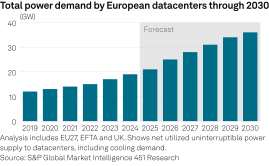
The rapid growth of data centers in Europe will result in a near doubling of the sector's electricity needs by 2030, according to the latest forecast from S&P Global Market Intelligence 451 Research.
Power provided to hyperscale, enterprise, leased and crypto-mining data centers in Europe reached 18.7 GW at the end of 2024, and is set to rise to 21.3 GW by the end of this year, 451 Research data shows.
By 2030, the analysts expect the region's total electricity demand from data centers to reach 36 GW.
The analysis covered the 27 EU member states as well as Iceland, Liechtenstein, Norway, Switzerland and the UK.
The projected demand growth comes as the EU invests Eur200 billion ($231 billion) to spur new AI data centers and supercomputers.
Known as the AI Continent Action Plan, the European Commission's strategy aims to make the EU a "global leader in AI," helped by the construction of AI factories and gigafactories, and a tripling of the EU's data center capacity in the next five to seven years.
The strategy marks a significant shift for a region traditionally skeptical of technology companies and inclined toward their regulation.
Access constraints
To deliver the new data center capacity, European policymakers will have to address constraints in grid access. The region's power grids are already strained as electrification of industry progresses.
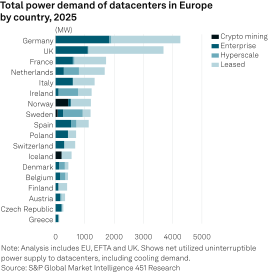
Germany, Europe's largest economy, has the highest load from data centers at 4.26 GW in 2025. The other major markets are the UK at 3.69 GW and France at 1.72 GW. Leased data centers make up the majority of demand in each of the three markets.
German utility E.ON said last year it was working to connect 6 GW of data center capacity in Germany by 2030. Most of the sites are in the Frankfurt area.
Frankfurt, along with Europe's other key data center hubs -- such as Dublin and Amsterdam -- is already heavily congested, and growth potential is limited.
This means AI investments could be diverted into other markets where power access is easier, energy and climate think tank Ember said in a June report.
Sustainability pressure
While many tech firms have already committed to powering data centers with renewables, sustainability concerns are gaining priority at the UN.
"A typical AI data center eats up as much electricity as 100,000 homes," UN Secretary General Antonio Guterres said July 22. "The largest ones will soon use 20 times that."
Major tech firms should power all data centers with 100% renewables by 2030, the secretary general added. In addition, water in cooling systems needs to be used "sustainably," Guterres said.
By 2030, data centers globally could consume as much electricity as all of Japan does today, Guterres said.
"This is not sustainable — unless we make it so. And the technology sector must be out front," Guterres added.

Editor: