Electric Power
July 29, 2025
'Dangerous' heat drives up power prices, demand as it moves across US
HIGHLIGHTS
Triple-digit power prices widely observed
Daily temperature records could be broken
A dangerous heat wave continues moving across the Central and Eastern US causing heat advisories and emergency alerts among power grid operators as high temperatures increase electric cooling demand, peakloads and power prices.
"A strong upper ridge will continue to generate a dangerous and prolonged heat wave across the Central and Eastern US through the end of the month," the National Weather Service said in a July 29 short-range forecast.
"Daily high temperatures well into the 90s [Fahrenheit] and 100s with little to no overnight relief will be particularly dangerous to those without adequate cooling or hydration," the NWS said.
The heat is also likely to break daily temperature records through the week, especially across Florida July 29 with highs around 100 F. In the Northeast, highs in the mid- to upper 90s F may tie or break existing temperature records, and "numerous warm minimum temperature" records are also expected, according to the NWS.
Central US
The Midcontinent Independent System Operator and Southwest Power Pool both issued heat-related advisories July 29.
MISO issued a maximum generation alert effective for its entire 15-state footprint from 3 pm ET to 10 pm July 29 because of "forced generation outages, above-normal temperatures, higher-than-forecasted load and loss of import interchange schedules" and a transmission advisory effective from 8:10 am July 29. The grid operator also remains under conservative operations and a hot weather alert through 10 pm July 29.
SPP issued a conservative operations advisory for its entire 14-state balancing authority, effective from 1:50 pm CT to 8 pm CT July 29 because of "forced (unplanned) outages, high load, uncertainty in variable energy resource forecasts and elevated temperatures across the SPP territory." The entire footprint also remains under a resource advisory that is scheduled to end at 8 pm July 30.
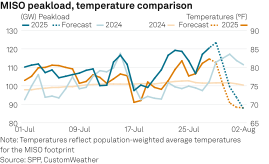
MISO forecast systemwide peakload on July 29 at 123.4 GW, which would be 13.2% higher than the monthly average through July 28 and 21% more than the July 2024 average. The population-weighted temperature across MISO's footprint on July 29 was forecast at 81.3 degrees Fahrenheit, which is 4.8% hotter than the monthly average through July 28.
SPP forecast systemwide peakload on July 29 at about 54.3 GW, which would be 13.1% higher than the monthly average through July 28 and 16.3% more than the July 2024 average. The July 29 forecast approaches SPP's monthly peakload record of 54.394 GW, set on July 15, 2024.
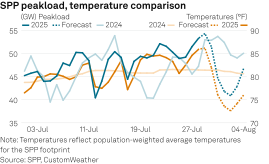
The population-weighted temperature across SPP's footprint on July 29 was forecast at 86.2 F, which about 6.2% hotter than the monthly average through July 28.
MISO's Indiana Hub on-peak day ahead power for July 30 delivery shed about $66.25/MWh on the day to trade near $108.71/MWh during July 29 trading on the Intercontinental Exchange. By comparison, Indiana Hub day-ahead on-peak locational marginal prices have averaged about $79.82/MWh so far in July, 81.6% higher than the July 2024 average, according to MISO data.
SPP's South Hub on-peak day-ahead power for July 30 delivery rose nearly $4/MWh to trade at $63/MWh on ICE. By comparison, South Hub day-ahead on-peak LMPs have averaged about $47.44/MWh so far in July, 9.3% higher than the July 2024 average, according to SPP data.
Mid-Atlantic
PJM Interconnection has issued hot weather and maximum generation alerts for its 13-state and Washington footprint for July 29 as hot weather persists throughout the region it serves, the grid operator said in a statement.
Real-time power prices had risen above $500/MWh in the Dominion, PPL and PEPCO Zones as of mid-afternoon July 29.
Tracking widespread weather advisories, the PJM West Hub's real-time price for July 29 peak hours traded around $273/MWh on the Intercontinental Exchange, reflecting a sharp increase of triple digits from the previous day.
Meanwhile, with temperatures forecast to start declining, the corresponding West Hub price for July 30 decreased by almost $40, still maintaining a triple-digit level around $196/MWh.
The PJM West Hub day-ahead on-peak price for July 29 averaged $233.77/MWh. The West Hub day-ahead on-peak power price has averaged $55.43/MWh year to date, according to PJM data.
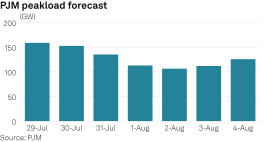
The elevated power prices were being driven by power demand levels that were some of the highest of the summer. Peakload was forecast to reach 158,716 MW July 29 before falling back to 152,540 MW July 30.
PJM peakload reached 161,117 MW June 24 during an earlier heat wave.
US Northeast
ISO-New England day-ahead on-peak power prices showed similar trends, as the Mass Hub day-ahead on-peak price for July 30 decreased by about $28 from the day before, settling around $147.50/MWh.
ISO-NE real-time power prices July 29 hovered just below triple-digit levels across the footprint by mid-afternoon, according to ISO data.
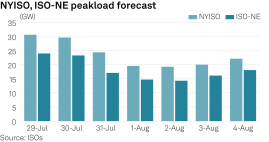
ISO-NE peakload was forecast to reach 24,000 MW July 29 before dropping to 23,300 MW July 30.
In New York, heat advisories were in effect for portions of the Southern Tier, Mohawk Valley, Capital District, Mid-Hudson, New York City and Long Island Regions, according to Governor Kathy Hochul's office. "Feels-like temperatures" will be in the 90s F across much of the state and could exceed 100 F in portions of the Mid-Hudson, Long Island and New York City Regions July 29 and July 30, the governor's office said in a statement.
In New York Independent System Operator territory, the on-peak locational marginal prices for Zone J NYC and Zone G Hudson Valley averaged almost $20 lower on the day, settling at approximately $172.75/MWh and $147.75/MWh, respectively.
NYISO peakload was forecast to reach 30,642 MW July 29 before declining to 29,657 MW July 30.
Looking ahead, power prices may continue to recede, as the PJM on-peak balance-of-the-week contracts for July 31 to Aug. 1 delivery fell by over $30 on ICE, trading around $54/MWh. The corresponding ISO-NE and NYISO contracts were also valued in the $50s/MWh, down about $28 and almost $20, respectively.

Editor: