Electric Power, Energy Transition, Renewables
July 03, 2025
Negative hourly power prices in Europe to dissipate amid summer bullishness
HIGHLIGHTS
Evening hourly prices settle at Eur200-500/MWh on July 1
Surging fossil generation in recent evening hours
Negative hours at record in Q2 but decreasing in June
Rising summer demand is set to ease Europe's growing problem of negative hourly power prices due to its surging solar capacity.
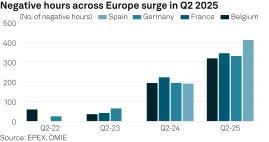
There were 2,426 negative hourly power prices in EU10 markets during the second quarter of the year, surging 55.7% on a year-over-year basis, as solar PV output in this region rose 18% to 45.8 GW.
But the number of hourly settlements below zero declined to 786 in June, with 141 concentrated in Germany alone, compared with 66 German cases in the same month of last year.
While hourly prices reached lows of minus Eur350/MWh ($412/MWh) in the Netherlands and minus Eur462.33/MWh in Belgium on May 11, settlement highs of Eur517.57/MWh were hit in both countries for delivery in the evening of July 1.
A so-called 'hitzeflaute' phenomenon brought temperatures of over 32 C in major European capitals during recent days -- and 40 C in Madrid, with flexible fossil units, especially gas, called to produce right after sunset hours when supply from solar PV vanes.
On 2100 CET on July 1, an extra load of 6 GW in Germany and 5.3 GW in Spain from average demand levels during June evenings implied fossil generation at 25.6 GW and 15 GW, respectively, more than two times and 25% higher than the average fossil burn in both markets since the start of June.
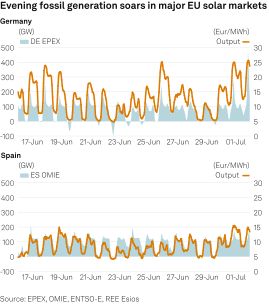
"Despite robust hydro and solar output in late June, Spain's power market has leaned on its thermal fleet to satisfy surging cooling demand during early evening hours. This reliance has amplified the flexing capabilities of Spanish combined cycle gas turbine units, which have ramped up production by an average of 2 GW between 1600 and 1900 CET. But the return of Spanish nuclear plants from maintenance has reduced required transmission system operator redispatch needs as a sufficient level of thermal assets were connected to the grid, making recent dispatch opportunities responsible for the rise in gas-fired generation," Alexandre Mace, European power analyst at S&P Global Energy, said.
PV installed capacity in the EU-27 area is expected to reach almost 414 GW by the end of 2025, according to Energy estimates, with nearly 76 GW of additions this year.
"The buildout of solar capacity across the region has seen negatively priced hours proliferate substantially on weekdays. The last quarter saw production during peak solar hours frequently outstripping demand, prompting price-led curtailment of traditional production units. A key issue here is the large share of subsidized and price-unresponsive capacity, like in Germany or Spain, which has fed into higher volumes of curtailment there and in other parts of Europe," added Daniel Muir, Energy senior power and renewables analyst.
But an increase in cooling demand amid hotter weather in June has helped counteract high solar output and lowering instances of negative prices. Spain, in particular, registered 55 negative hours in June compared with over 200 in May.
Solar leads German mix
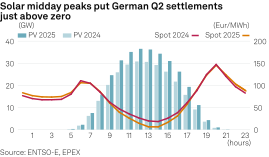
Europe's biggest solar market, Germany, now has well over 100 GW installed, with hourly output peaking above 52 GW for the first time ever on June 20.
Solar is projected to top Germany's power mix for both Q2 and Q3, with the country being one of the few European markets registering a lower Q2 day-ahead average.
However, solar cannibalization deflated solar capture prices by 56% quarter over quarter to a Eur35.58/MWh weighted average in Q2, according to Platts.
Post-Spanish blackout
In Spain, total solar capacity stands at around 35 GW, according to grid operator REE, an increase of 7% on the year.
Solar curtailments in the Spanish market have continued throughout June, with overall generation at noon hours capped at around 23 GW for most of the period since the April 28 blackout. The highest output last month was recorded at 24 GW on June 18, significantly below the 2025 peak of 40.8 GW on April 21.
The country's weighted capture solar in Q2 stood at Eur22.36/MWh, tightening 64.5%.
Analysts at Energy expect average demand in Spain to exceed 29 GW in July, up by 2% on the year.
"Q3 typically provides for an element of power demand upside, particularly in Southern Europe, as cooling demand lifts. This could provide some much-needed value for commercial solar producers, for whom capture prices have across Europe sunk to record lows through Q2," Energy Muir said. "Less price-sensitive markets in Northern Europe should still exhibit frequent in-day negative prices, which in thermal-dependent markets could potentially result in substantive price spikes in evening hours."
Latest forecasts show maximum temperatures to drop in the next few days but to rebound by mid-July, with peaks of 31 C expected in Berlin and 34 C in Paris. Those in Madrid should hold below 38 C, closer to seasonal norms.

Editor: