Electric Power, Energy Transition, Renewables
June 10, 2025
German solar capture price sinks below Eur20/MWh in May as cannibalization deflates value

HIGHLIGHTS
Record number of negative hourly prices
Over $2 bil state aid to balance EEG in May
Solar focus on EEG reform after 'reality check'
German solar market values plunged to a five-year low in May as strong renewables generation lifted the number of negative hourly prices to an all-time high.
The May capture price for solar was pegged at Eur19.97/MWh ($22.82/MWh), down 37% year over year, system data showed June 10. This was the lowest since May 2020, when power prices crashed due to coronavirus lockdowns.
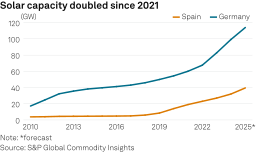
Solar's capture rate plunged to 29.7%, the lowest on record, as so-called cannibalization depressed market values after installed solar PV capacity doubled since 2020 to over 100 GW.
Solar remained Germany's biggest single source of electricity in May, with generation up 13% on the year at 9.8 TWh.
However, wind rebounded -- registering its first on-year gain in seven months -- by 26% on the year to 9.7 TWh, adding further pressure amid weak demand.
The number of negative hours rose to 129 in May after 75 hours had already settled below zero in April.
Negative hourly prices trigger various payment halts under Germany's green energy law (EEG).
Wind capture values fell to a 10-month low, but at Eur61.71/MWh for onshore and Eur63.38/MWh for offshore wind, remained some 10% above May 2024.
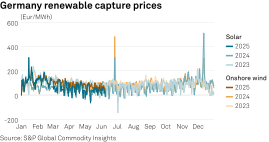
Platts, part of S&P Global Energy, assessed daily capture prices in May in a range from minus Eur64.40/MWh for solar to Eur105.05/MWh for offshore wind.
Higher payouts
Payouts to renewable assets owners from the EEG account rose to Eur1.9 billion ($2.1 billion) in May amid a widening gap between market prices and contract values under various EEG schemes that support wind and solar.
The government had to inject another Eur1.6 billion in May to balance the EEG account, bringing federal subsidies for the year to date above Eur5 billion.
Higher market values in the first quarter amid low wind production reduced payments by 43% or around Eur1.9 billion year over year.
The EEG account balances guaranteed payments to green energy producers with monthly market income.
In 2024, the shortfall widened to over Eur18 billion. For 2025, grid operators estimated a Eur17 billion shortfall back in October 2024.
Germany's new government plans to reform the EEG system and also adjust 2030 capacity targets following a "reality check" or monitoring report on energy transition milestones.
Near-term focus is on reducing the number of negative hours with new regulation for solar already implemented.
German Wind, Solar Market Values (Eur/MWh)
| Jan-25 | Feb-25 | Mar-25 | Apr-25 | May-25 | May-24 | |
| Onshore Wind | 85.06 | 115.91 | 75.13 | 73.14 | 61.71 | 56.08 |
| Offshore Wind | 97.02 | 117.41 | 81.36 | 73.18 | 63.38 | 55.82 |
| Solar | 115.11 | 110.99 | 50.27 | 30.41 | 19.97 | 31.61 |
| Spot Average | 114.14 | 128.52 | 94.73 | 77.94 | 67.34 | 67.21 |
Source: EEG Netztransparenz.de

Editor: