Electric Power, Energy Transition, Renewables, Hydrogen
May 13, 2026
INTERVIEW: Zelestra aims for US growth with long-term PPAs amid data center demand
By Mauricio Avila and Ricardo Plata iii
Editor:
HIGHLIGHTS
Zelestra targets hyperscaler power deals in US
BESS market expansion expected in 2027-2028
Long-term PPAs rise amid AI data center demand
The Spanish renewable developer Zelestra is expanding its footprint in the US, one of the company's key markets after three years in the country, by targeting long-term power purchase agreements with hyperscalers to meet surging data center demand, Zelestra's US business unit CEO Phillip North told Platts.
The company has a portfolio spanning 17.7 gigawatts of solar, 30.1 gigawatt-hours of battery energy storage systems, 3.4 GW of wind power, and 0.6 GW of hydrogen projects, with operations spanning across Spain, Italy, Chile, Peru, Germany and the US. It has a total portfolio size of 33.8 GW, of which 5.1 GW is contracted with clients.
The US headquarters in Arlington, Virginia, manages 15.6 GW across 53 projects, with 1.6 GW already contracted with clients, most of them with hyperscaler companies.
The company has a particular interest in BESS technology for growth in the US, which North considers has a "beauty" due to the multiple use cases it offers, and as it has potential in some of Zelestra's key markets in the US, such as the Electric Reliability Council of Texas, the Midcontinent Independent System Operator, the Southwest Power Pool and the Pennsylvania-New Jersey-Maryland Interconnection.
"The market is really going to start to boom. You are going to see a number of BESS projects developing in MISO, in PJM and really across all markets where capacity needs are available [...] I really think 2027, 2028 are going to be years where we see the battery markets broaden," North said.
Zelestra has about 4 GW of BESS capacity in the US, but it hasn't been commercialized yet. "In ERCOT, the primary motive for people to turn on batteries has been to be merchants and try to catch market-design-value. That's not the value in the business for us," North said.
BESS can be "put in a strategic location to improve transmission, hyperscalers are putting it behind the meter and are utilizing it to really smooth out their load while not causing disturbances on the load zone," North said.
BESS revenues across ERCOT's North, South and West Load Zones have seen a 76.50% year-over-year increase, reaching $2.55 million from Jan. 1 to May 12, with the North accounting for $909,041; the South for $697,767; and the West for $944,356, according to Platts, part of S&P Global Energy.
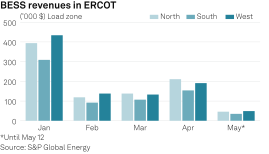
Volatility has remained constant in the BESS markets as daily revenues range from minus $12,500 to $275,300, highly sensitive to weather events and grid conditions. The Jan. 1 through May 12 average daily revenues at the North, South and West load zones stood at $6,939, $5,326 and $7,209, respectively. January saw the highest revenues amid market volatility peaking during Winter.
The 'post-AI' era of PPAs
At Zelestra, the focus remains firmly on traditional PPAs, avoiding merchant contracts to ensure a balanced risk allocation between the company and its customers. North described the PPA market as having undergone profound changes over the past 24 months, dividing it into "pre-AI" and "post-AI" eras.
In the pre-AI period, North explains, PPAs were primarily signed with hyperscalers seeking the most cost-effective way to achieve decarbonization, resulting in shorter contracts with lower risk profiles.
Today, however, customer demands have shifted significantly. Longer-term contracts that lock in electricity prices have become essential for hyperscalers, making working with utility providers and Regional Transmission Organizations (RTOs) an "existential" necessity as they seek reliable power to support their expanding data center operations.
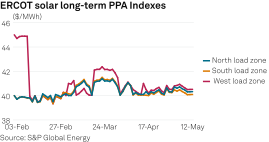
The increasing energy demands of data centers are driving a shift toward longer-term PPAs focused on price stability.
With RTOs like PJM facing potential capacity shortfalls of 50-60 GW over the next decade, interconnection queues are severely backlogged. Only 23 GW of the 103 GW of projects with completed interconnection agreements since 2020 have entered service, with permitting delays cited as the biggest obstacle.
"[Companies] are being more thoughtful around locking in operating costs associated with projects. [...] I do think [the main focus is on] interconnection around the load and from that working with the end-use customers," North said.
Long-term PPA prices are being driven up by the impending sunset of federal tax credits, supply chain delays, and the rising demand from hyperscalers to secure additional generation amid interconnection delays.
Platts, part of S&P Global Energy, launched its PJM Western Hub Long-Term Solar PPA assessment on May 8 for projects with electricity generation capacity of at least 20 megawatts. From May 11-12, the assessment rose 43 cents to $82.32/MWh.
