Natural Gas, Electric Power
May 06, 2026
Surging US data center power demand tests sustainability targets
By Garrett Hering and Susan Dlin
Editor:
HIGHLIGHTS
US data center power demand tripled to 64 GW
Texas on pace to surge 35.9% to 13.5 GW in 2026
The US data center building boom is putting the sustainability ambitions of power-hungry hyperscalers to the test, with capital expenditures climbing, natural gas deals proliferating and demand for electricity outpacing even some of the most bullish forecasts.
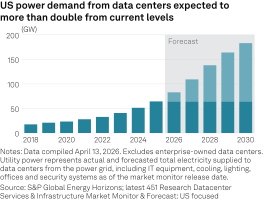
US grid power supplied to hyperscale, leased and crypto-mining data centers increased 25% in 2025 to reach about 64.4 gigawatts and has nearly tripled since 2020, according to data from 451 Research, part of S&P Global Energy Horizons. That amount exceeded the group's June 2025 forecast of 58 GW needed by the end of last year to power data center IT equipment, cooling, lighting and other applications.
Fueled by the emergence of artificial intelligence, the digital infrastructure expansion shows no signs of slowing down.
451 Research's latest Datacenter Services & Infrastructure Market Monitor & Forecast, released in April, estimates that data center grid power demand will nearly triple again between 2025 and 2030, reaching about 183.2 GW at the start of the next decade. This estimate is also up significantly from June 2025, when 451 Research anticipated 117.1 GW of data center grid power demand by 2030.
The companies building data centers that can consume as much power as entire communities broadly echo such buoyant views.
"We deeply believe that AI, in conjunction with cloud, is one of those foundational technologies of the 21st century," Rowan Digital Infrastructure CEO Charley Daitch said. "It'll be as revolutionary and central to our lives as electricity is. And the infrastructure build-out required to support that is massive. ... We are still in the first inning, and maybe even the first batter of the first inning, of where this is going."
Backed by energy transition investor Quinbrook Infrastructure Partners and alternative asset manager Blackstone, Rowan focuses on developing sustainable data centers for hyperscalers by ensuring facilities have access to renewable energy, use water responsibly and minimize carbon emissions embedded in project construction.
"When you look at Google, Amazon, Meta, Microsoft Corp., these companies are leading the corporate world in what it means to have bar-raising sustainability goals," Daitch told Platts, part of S&P Global Energy. "They all have 100% renewable goals, they all have net-zero carbon goals, they all have water-positive goals."
'We're going to pay our own way'
Rowan's portfolio includes data centers in Maryland, Oregon and Texas, states that are all seeing strong local growth but also mounting community concerns over data centers — largely centered around energy, environmental and cost impacts.
Opposition to data centers coalesced into a national political force in 2025, blocking or delaying projects worth at least $156 billion as lawsuits, moratoriums and local resistance spread, according to Data Center Watch, an initiative from AI security firm 10a Labs.
"Our goal is to focus on the 99% of community members that are genuinely just trying to make sure that this works for their communities," he said. "They also see the huge economic benefits that these projects have."
Before joining Rowan in 2023, Daitch directed energy and water strategy teams at Amazon Web Services, helping to build the world's largest corporate renewables portfolio. Previously, he led business development at utility Puget Sound Energy Inc. in Washington state.
A "power first" approach has helped the company navigate some of the biggest concerns of communities by focusing on sites that do not need new transmission lines.
"Communities are largely not opposed to data centers, but they are opposed to transmission lines running through their backyards," Daitch said. "That sometimes spins up some of the friction that we've seen."
When substation upgrades and other grid investments are required, Rowan works with utilities to ensure that costs are not shifted to other customers.
"Rowan has been at the forefront of working with utilities to say, 'Hey, we're going to pay our own way.' And if that means we have to pay up front for some of the infrastructure that's being developed, or that means we have to post credit, we're willing to do that."
But concerns around data center costs persist. A bipartisan coalition of governors in midwestern and mid-Atlantic states in April urged the PJM Interconnection, the largest US wholesale grid operator, to help shield ratepayers from data center costs.
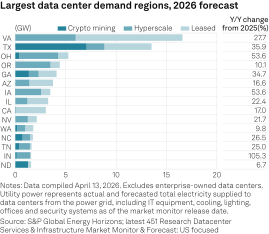
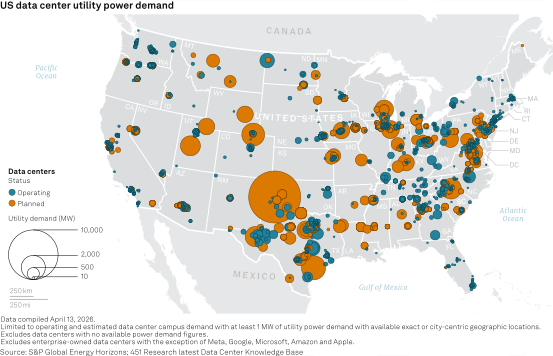
Among them is Virginia Governor Abigail Spanberger, a Democrat, whose state will remain the leading market for data center utility power demand in 2026, rising 27.7% from the year before to reach 16.6 GW, according to 451 Research forecasts.
Several states will surpass that growth rate this year. Texas is on pace to surge 35.9% to 13.5 GW in 2026, the second-highest total among states, according to the outlook. Both Ohio and Iowa are expected to see even larger percentage increases, more than 50% each in 2026, to 5.3 GW and 3.5 GW, respectively.
Georgia's demand is predicted to expand 34.7% to 4.1 GW this year, while Indiana's data center grid power demand is expected to more than double, to 1.6 GW, according to the forecast.
Such growth is driving demand for various sources of grid and on-site power, ranging from revived nuclear stations and small modular reactors to natural gas, fuel cells, solar and batteries.
A recent S&P Global Energy Horizons report pointed to rising adoption of battery storage systems at data centers.
"The huge investments by US hyperscalers in AI and the country's significant grid bottlenecks, including in locations that new data centers target the most, will make US data centers adopt [battery storage] more than anywhere else in the world," co-authors Henrique Ribeiro and Tiffany Wang said in the report, released in April.
Some major battery storage projects at data centers are already online or under construction, the report noted, highlighting X.AI's Colossus 1 and 2 data centers in Tennessee and Mississippi and Oracle Corp.'s Stargate Abilene project in Texas.
Michigan energy regulators in March approved a series of energy storage contracts for DTE Energy Company subsidiary DTE Electric Company, totaling nearly 1.4 GW, to help power another Oracle data center.
Batteries are a versatile technology that can address multiple challenges data centers face, including the "volatile, spiky load profiles of AI training workloads, which account for most of the new data center capacity planned for the near future," the Horizons analysts said.
The report cited five primary use cases for batteries to complement data centers: pairing with renewables in power purchase agreements; providing flexibility with behind-the-meter projects; reducing reliance on diesel backup systems; smoothing AI loads; and optimizing on-site natural gas generation.
Daitch views on-site resources as more of a bridge to grid power.
"Those often come with some combination of natural gas and storage, and we're working to integrate renewables as well," he said. "All of the projects so far are really an acceleration to that grid power. And then ultimately, that natural gas resource gets used very infrequently when the grid is there."
Chris Taylor, CEO of battery storage developer GridStor, is particularly upbeat on the ability of batteries to smooth AI training loads.
"That's going to be a whole business," Taylor said in a recent interview. "Just that piece right there is a multibillion-dollar opportunity."
GridStor, which is backed by Goldman Sachs Asset Management, is focused on developing battery storage projects in the Western US, including in top 10 data center power demand markets Arizona, California and Oregon.
"AI has completely changed the game," said Taylor, who previously led clean energy investing for Google's global data center business.
GridStor is pursuing both behind-the-meter and front-of-meter deals with hyperscalers, data center leasing companies and utilities.
Those opportunities are significant even if bullish data center power demand estimates, such as 451 Research's, do not materialize, according to Taylor.
"I'll take the under on the estimate," the executive said. "Take the rock bottom, low-end of the estimate and it's still a shockingly large number."
With data center operators emerging as a core clientele, Taylor is concerned that the "generalized bipartisan opposition" to digital infrastructure expansion could disrupt the battery storage industry.
But more than just the battery industry could be at risk unless US data center developers find sustainable paths forward.
"I don't think people have fully come to grips with what that would do to our economy if we stop letting data centers expand," Taylor said. "If that gets shut off, it's going somewhere else."
