Electric Power, Energy Transition, Emissions
January 29, 2026
Data center opposition gains momentum as power demand spikes
By Garrett Hering and Kirsten Errick
HIGHLIGHTS
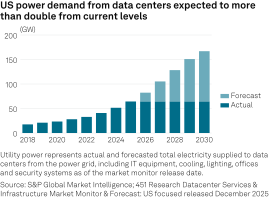
Data centers on pace to require 167 GW by 2030
20 projects delayed or canceled in recent months
As power-hungry data centers continue to proliferate across the US, so too does local opposition.
From the suburbs of Northern Virginia to the banks of the Columbia River, communities are voicing deep concerns over data centers, often centering on their energy, environmental and affordability impacts.
Many projects continue to advance, promising significant community benefits, including jobs and tax revenue. But the digital infrastructure boom, with its massive appetite for electricity, is increasingly encountering local resistance and has become a controversial issue ahead of US midterm elections in November.
"As long as the data center expansion keeps growing ... it's likely that the opposition is going to grow along with it," Miquel Vila, lead analyst for the Data Center Watch project, told Platts, part of S&P Global Energy.
The second quarter of 2025 marked an inflection point for development risk, according to Data Center Watch, an initiative from AI security firm 10a Labs, which identified 20 projects delayed or canceled over the three-month period. The affected proposals, representing an estimated $100 billion in investment, exceeded all derailed projects previously identified since 2023.
"We are seeing widespread opposition across the country, but there are certain states where things are picking [up] more than others," Vila said.
There are at least 188 activist groups nationwide, with the largest clusters in the Midwest and mid-Atlantic regions, according to Data Center Watch. But the opposition spans the US, touching all top data center markets, where pressures on the power grid and ratepayers are escalating.
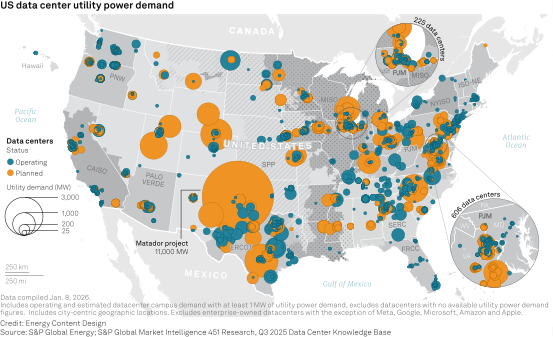
And the tech sector's fervor for more electricity keeps rising.
451 Research, in its most recent Datacenter Services & Infrastructure Market Monitor & Forecast, released in December 2025, estimated that utility power provided to hyperscale, leased and crypto-mining data centers is on pace to more than double again by 2030, reaching about 167 GW.
That is up from a September 2025 forecast of 134.4 GW by 2030 and a June 2025 forecast of 117.1 GW by that time.
Trouble in 'Data Center Alley'?
At the forefront of the US data center build-out is Virginia, with its dense concentration in Loudoun County known as "Data Center Alley."
Virginia's data centers will require 16.6 GW of grid power in 2026, up from 13 GW in 2025 and quadrupling from 2020, according to 451 Research, which expects the state's data center fleet to need more than 33 GW by 2030 — exceeding demand from all US data centers just four years ago.
Only Texas is seeing volumes near Virginia's, with 451 Research expecting demand for grid power to reach 13 GW in Texas this year and 28 GW by 2030.
Amid the surge, Virginians overwhelmingly attribute rising electricity costs to data centers and want state lawmakers to do more to manage their growth, according to recent polling.
The state's General Assembly will consider several measures focused on data centers in early 2026. That includes legislation seeking to further shield utility ratepayers from infrastructure costs related to data centers, building on action taken at the Virginia State Corporation Commission in November 2025, when regulators approved a new rate class for large energy users in Dominion Energy Inc.'s Virginia service area.
Virginia's new governor, Abigail Spanberger, seems aligned with such efforts after campaigning to "make sure data centers don't drive up energy costs for everyone else in Virginia." In one of her first actions as governor, the Democrat on Jan. 17 directed executive branch agencies to prepare a report within 90 days with recommendations for reducing Virginians' costs, including for energy.
"Lawmakers are seeing the writing on the wall in terms of impact to ratepayers for the cost of all this infrastructure," Julie Bolthouse, director of land use at Piedmont Environmental Council, told Platts. The council created the Virginia Data Center Reform Coalition.
The cost of supplying power to data centers is attracting the attention of Congress and the White House as well. President Donald Trump, in a Jan. 12 Truth Social post, said data centers must "pay their own way."
Just days later, governors from 13 states in the PJM Interconnection LLC, the nation's largest wholesale power market, signed a "statement of principles" with US Energy Secretary Chris Wright and Interior Secretary Doug Burgum urging PJM to file tariff revisions at the Federal Energy Regulatory Commission related to data centers and calling for implementation of a backstop capacity auction by the end of September.
In doing so, the governors, including outgoing Virginia Gov. Glenn Youngkin (R), pledged to use their authorities to "allocate costs to data centers and protect residential customers."
PJM on Jan. 16 unveiled several initiatives to address cost and reliability concerns, including expedited interconnection for data centers that bring their own generation.
Other legislative proposals in Virginia would require state regulators to consider whether data centers and other large loads have secured sufficient zero-carbon generation or energy storage resources, whether there is enough transmission capacity for new projects and how to harness large loads as flexible demand-side resources.
One such "power-flexible" data center in Virginia is scheduled to enter operation in the first half of 2026, touted as a template for AI infrastructure that can support grid reliability and affordability instead of adding stress and cost.
Over the past six months, however, at least four data center projects in Virginia were canceled, and a model data center has yet to emerge, according to Tim Cywinski, communications director for the Sierra Club Virginia Chapter.
"I think you'll see a bit of a slowdown in the proposals that you'll see in Virginia," Cywinski said.
A "common thread" among the recently abandoned projects was their proximity to homes, in residential areas surrounded by agricultural land being rezoned for industrial use, Cywinski told Platts. "In what world is it okay to build one of the biggest industrial projects in the country 50 feet away from someone's house?"
"It's really all about the scale of these facilities and the cumulative impacts," added Bolthouse.
Calls for reforms and 'frank conversations'
The Sierra Club and Piedmont Environmental Council pointed to several potential reforms, including legislation to restrict the proximity of data centers to neighborhoods and to set ratepayer protections. They also want to see sustainability standards and restrictions for on-site fossil fuel generators.
"We're playing whack-a-mole with each project," Bolthouse said.
Bolthouse and Cywinski said there needs to be more transparency, oversight and community engagement in data center development.
"We need more information about energy usage, water usage and emissions because if we don't know that, then it's really hard to do any kind of oversight," Bolthouse said. "So NDAs — nondisclosure agreements — that a lot of these companies are signing are hindering that information becoming public."
Concerns over the impact of data centers go far beyond Virginia, affecting all states where data center demand for power is surging.
In the eastern US, that includes Georgia, North Carolina and Pennsylvania. Hotspots in the West include Arizona, California, Nevada, Oregon and Wyoming. In the Midwest, Illinois, Indiana, Iowa and Ohio will see the data demand for grid power more than double this decade, according to 451 Research.
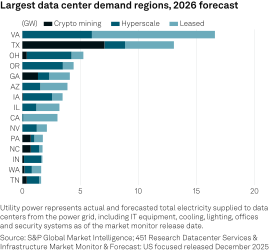
By 2030, grid power demand from data centers will exceed 4 GW each in 12 states, up from three states in 2025 (Oregon, Texas and Virginia).
In Arizona and Michigan, attorneys general recently challenged their respective state utility regulators over data centers and electric rates, citing a lack of transparency and public process.
In Oregon, Gov. Tina Kotek on Jan. 20 announced a new data center task force to deliver recommendations related to project siting, grid reliability, water use, clean energy and electric rates.
"Oregonians have made their concerns about rising utility bills clear," Kotek said in a statement launching the initiative. "As our state faces rapid growth of data facilities, we must have frank conversations about the challenges and opportunities ahead."
The task force builds on a 2025 law that directed the Oregon Public Utility Commission to create a new customer class for large loads, with its own tariff schedule, billed as a model for other states.
Many utilities, regulators and data center developers are turning to such large load tariffs as a potential solution to affordability concerns.
Exelon subsidiary Commonwealth Edison, for instance, on Jan. 6 announced a new agreement for large load tariffs in its northern Illinois service area, backed by data center operator Equinix.
Industry responds
Tech giants and other data center developers said they are eager to alleviate concerns over the sector's expansion, pledging to pay their share of power costs, purchase clean energy, reduce water use and take other measures.
"We support paying our full cost of service for electricity," said Dan Diorio, vice president for state policy at the Data Center Coalition, which represents hyperscalers Google, Amazon.com, Meta Platforms and Microsoft as well as data center companies CyrusOne, Digital Realty Trust and Equinix.
"We want to ensure that costs are allocated appropriately and there's no stranded asset costs that are passed on to other customers," Diorio told Platts.
Microsoft wrote in a Jan. 13 blog post that it is focusing on community-first AI infrastructure, including paying for its electricity, managing its water usage and adding to local tax revenue.
But skepticism remains.
Microsoft, along with Meta, Google, Amazon and other data center developers, in January responded to a US Senate investigation into the data center-affordability nexus opened by Democratic Sens. Elizabeth Warren of Massachusetts, Chris Van Hollen of Maryland, and Richard Blumenthal of Connecticut.
Although they secured several new commitments that companies would pay their fair share of electricity costs, the senators are continuing their probe.
"These commitments do not explain how Big Tech companies — not American consumers — will bear the full cost of data centers," Warren said in a Jan. 22 statement. "Google knows there's a difference between paying its electricity bill and fully covering the significant infrastructure upgrade costs associated with these data centers."
Warren echoed calls for more transparency.
"If these companies are serious about paying their fair share, at a minimum they'd be more transparent about their data centers' operations instead of forcing local communities to sign NDAs," the senator said.
Digital infrastructure builders say they are open to addressing public scrutiny.
"You're seeing the data center industry very much lean in with both the public and elected officials and infrastructure providers to really share information about their projects, share information about the benefits the project brings to the communities, how it is impacting resources and the industry is working with those infrastructure providers to ensure that there is no harm from resource use," Diorio said.

Editor: