Metals & Mining, Energy Transition, Electric Power, Chemicals, Non-Ferrous, Renewables
April 27, 2026
Middle East war hits renewable energy supply chains directly and indirectly
By Kirsten Errick and Anthony Rizkala
Editor:
HIGHLIGHTS
Aluminum, copper disruptions at issue
Petrochemical shortages threaten batteries
The war in the Middle East has continued to affect the energy sector, particularly oil and gas, but has also disrupted renewable energy supply chains.
"You can't really separate the two anymore," Jon Powers, president of solar and battery storage developer CleanCapital, told Platts, part of S&P Global Energy. "It has been an oil- and gas-centric conversation, but you marry that to the demand ... that's been growing and it's sort of hitting everywhere."
The war has led to the effective closure of the Strait of Hormuz, a critical shipping passageway connecting the Persian Gulf to the Gulf of Oman and the Arabian Sea. Shipments of oil, gas and related materials have been essentially blocked, along with important feedstocks for renewables and battery storage, such as aluminum, copper, helium and sulfuric acid.
But the impacts of the conflict have been uneven for manufacturers of renewable energy infrastructure.
'Aluminum supply crisis'
Aluminum is used in solar panels, wind turbines and battery storage systems, exposing companies to various vulnerabilities, depending on their supply chain dependencies.
The Gulf Cooperation Council, a group of six countries in the Persian Gulf, accounted for 8.3% of global primary aluminum supply in 2025, according to the International Aluminium Institute.
"We are teetering on an aluminum supply crisis," Joe Quinn, executive director for the Washington, DC-based SAFE Center for Strategic Industrial Materials, told Platts. "The sudden disruptions in the Middle East could remove up to 5 million [metric] tons of aluminum from the global market." For context, Quinn said the US produced less than 700,000 metric tons of primary aluminum in 2025.
Iranian missile strikes on March 28 caused significant damage to Emirates Global Aluminium's Al-Taweelah smelter in Abu Dhabi, which processes 1.5 million metric tons per year, and Aluminium Bahrain's 1.6-million-mt/year smelter.
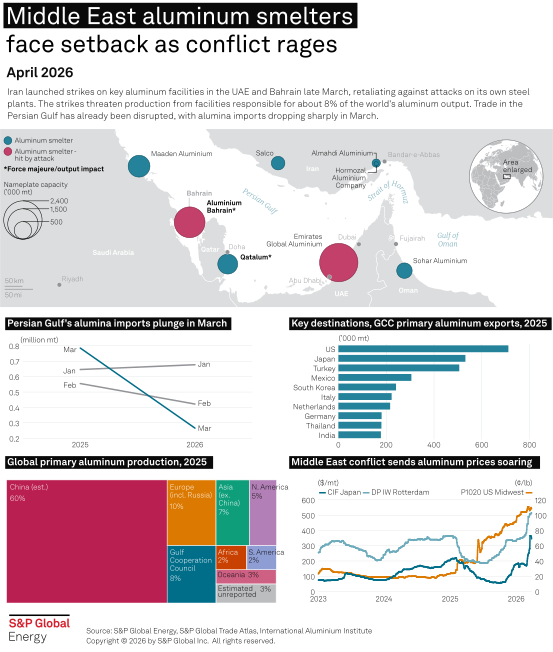
Emirates Global Aluminium said restarting its smelter might take up to 12 months, while Aluminium Bahrain has not yet provided an operational update.
The London Metal Exchange price for aluminum, the global benchmark, reached a four-year high on April 13 amid concerns of a global supply shortage and has risen 17.9% since Feb. 28, when bombings in the region began.
Higher aluminum prices are putting pressure on some solar companies, including First Solar, the largest US panel producer.
Aluminum price hikes could increase the war's total commodity cost headwind for First Solar to at least $150 million, or 3% of its 2026 revenue guidance, analysts at BNP Paribas said in an April 21 note. But the thin-film-module maker's crystalline-silicon competitors "are likely facing similar (if not greater) headwinds," the analysts added.
US tariffs, including the 50% tariffs on aluminum and copper under Section 232 of the Trade Act of 1974, have also contributed to supply chain disruptions, further adding to market volatility.
"In aluminum, we've now seen a sequence over the last couple of years that feeds into this cycle of volatility and uncertainty, both in terms of price and supply," Harry Knott, senior business architect at commodity trading and risk management software provider Quoreka, told Platts.
Knott added that aluminum fabricators and traders are now requiring a lot more information to understand how to navigate a historically volatile global market and reduce their risk exposure.
"The tariffs are creating uncertainty about sources of supply," David Victor, nonresident senior fellow at the Brookings Institution and professor of innovation and public policy at the University of California San Diego, told Platts.
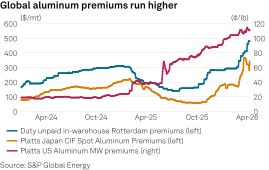
Countries that restrict aluminum imports to protect domestic suppliers are more vulnerable to supply disruptions.
"The biggest impacts are being felt in Europe and the US, because they're not taking Chinese aluminum and China has got aluminum," John Mitchell, president and CEO of the Global Electronics Association, told Platts.
The war is also disrupting the production and shipping of copper, another element that is vital to renewable energy supply chains, Mitchell said.
But some companies are more insulated or could even benefit from such disruption.
Texas-based solar-panel maker T1 Energy has stopped relying on imported aluminum frames in favor of American-made steel frames. T1 Energy and photovoltaic manufacturer Qcells told Platts that they do not expect their supply chains to be affected. Nextpower is supplying US-made steel frames, including to T1, as an aluminum alternative. Nextpower also has a joint venture in Saudi Arabia that could benefit from increased solar demand in the Middle East.
"Nextpower Arabia ... is poised to benefit from potential surcharged solar growth in Saudi Arabia as [a] result of Iran conflict and associated oil & gas price/supply concerns," the BNP Paribas analysts said.
Other materials also at risk
Some materials are affected more indirectly. Sulfuric acid, a byproduct of oil and gas refining, is used to process copper.
"There were some concerns about what it's going to mean for copper processing or extraction," Nathaniel Horadam, president and founder of Full Tilt Strategies and former critical minerals vertical lead for the US Energy Department, told Platts.
Copper is used for renewable energy, particularly in the wiring of electrical components. The Copper Development Association said a solar power system can contain 5.5 tons of copper per megawatt, and a 3-MW wind turbine might use up to 4.7 tons.
"When you think about copper, that's the actual goods that run the electricity in terms of renewable energy grids, batteries, data centers," Mitchell said.
The shortage of sulfuric acid could disrupt processing of high-pressure acid leaching nickel in Indonesia and the conversion of spodumene into battery-grade lithium, Horadam said, adding that outside of China, this processing is mostly done in Japan.
The lithium-ion battery supply chain could face shortages and price hikes for essential petrochemical inputs.
"Sulfur, plastics are one that concerns me," Horadam said. "I don't think folks outside the battery industry appreciate how much of this stuff — ethylene, polypropylene, [polyvinylidene fluoride] — which are all petrochemical byproducts of oil and gas refining — are absolutely critical to battery manufacturing, just because they're not seen as the battery minerals themselves.
"You can't make a lithium-ion battery without electrolytes or anode or electrode binders or separators," Horadam said. "And so those things being disrupted could potentially just shut down production."
Horadam noted that the US produces a small amount of these components, which are primarily made in Japan.
"You could see those geographical constraints actually starting to come into play based on where this stuff is available," Horadam said.
Helium, a byproduct of natural gas processing, has also been affected by the conflict. State-owned gas company QatarEnergy said helium production would decrease 14% as a result of strikes that damaged its Ras Laffan Industrial City LNG facility. Qatar produces about one-third of the world's helium and is second to the US in helium production, according to the US Geological Survey.
Helium is used to make semiconductors, which are used in solar, wind and battery energy storage systems.
"If you think about semiconductors, they're everywhere," Mitchell said. "And so that's going to impact things like AI training, [electric vehicles], clean energy infrastructure, including solar panels."
Other repercussions
The supply chain challenges could affect renewable energy projects, but the impact might not be felt immediately.
Developers of solar and wind projects are racing to begin construction by July 4 to be eligible for key tax credits.
"Now you're driving up their construction costs even further," Horadam said. "That will continue to impede the ability of projects to move forward into construction to reach a final investment decision, and that's where you start to see the impacts several years on down the line."
Some analysts believe the tax credits could be extended because of the war.
"We speculate the three-way combination of Iran sending energy costs higher, Democrats taking the House in November and significant clean energy investments from Biden's [Inflation Reduction Act] in Republican states will lead to an extension of the clean energy tax credits President Trump's [One Big Beautiful Bill Act] eliminated and phased out," analysts at CreditSights said in an April 13 note.
The conflict could prove to be a net positive for solar, analysts said.
"Rising energy prices tied to Middle East disruptions are boosting solar economics, prompting initial upward revisions in global solar forecasts," analysts at Jefferies said in an April 1 note.
"The price of energy comes more or less out of the oil market, because so many non-oil products are priced de facto in competition with oil," Victor said. "So, when the price of oil goes up, the price of everything else looks more attractive."
