Electric Power, Energy Transition, Renewables
March 27, 2025
INTERVIEW: Morocco-to-UK green power project targets procurement deals in 2025
HIGHLIGHTS
Targeting deals this year ahead of financial close
Project 'around GBP70-GBP80/MWh' strike price
19 hours/d of firm power, flexible optimization
Transmission developer Xlinks aims to conclude procurement deals this year ahead of a financial close on its GBP22 billion ($28.5 billion) Morocco-to-UK renewables-based mega project, company CEO James Humfrey told Platts March 27.
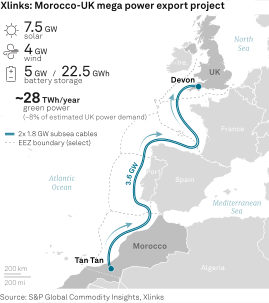
The 4,000-km, 3.6-GW high-voltage direct current cable from an 11.5-GW energy park in Tan-Tan, Morocco, to North Devon in the UK is dependent on the agreement of a bespoke Contract for Difference with the UK government.
"We've indicated that, when you wrap it all up, we're around the GBP70-GBP80/MWh mark on strike price in 2012 terms for a CFD," Humfrey said.
This translates to around GBP100/MWh in current money, cheaper than Hinkley Point C, the only other bespoke CFD, which has a current strike price of GBP124.65/MWh.
"We estimate the project could reduce GB wholesale prices by 9.3%, and power sector emissions by a similar amount, in the first year of operation," he said.
Targeting operation in the early 2030s, Xlinks currently has over 95% of its procurement needs out in the market for the 7.5 GW of solar, 4 GW of wind and 5 GW of battery capacity it plans in Morocco.
Quality acceptance processes are underway for the 2 x 1.8-GW cable "and we're into final negotiations for converters -- that has been a tight market but we have the right manufacturing slots," Humfrey said.
Cost offset
While global demand had put upward pressure on HVDC costs, these were partially offset by falling costs on the generation side, Humfrey said.
Further, the freezing of federal offshore wind permits and leasing areas in the US had cooled the HV market in recent weeks.
"HV costs are not investors' main concern," he said. "Complexity is a concern, but the track record for the component parts of our project -- solar, wind, transmission -- are strong in terms of meeting cost and time targets."
Negative correlation
Xlinks believes the difference in generation profiles between Morocco and the UK is a unique strength and could set a precedent for future south-north links.
"We have over two years' of measurements for solar and wind resource, which we're using to optimize site design [at Tan-Tan]," Humfrey said.
The data showed Morocco's wind type is negatively correlated to North Sea cyclonic wind.
"Morocco has a convection wind. As the land mass cools, you get a more consistent wind that tends to peak in the evenings. It is inversely correlated to the UK and nicely matches daily irradiation patterns for solar," he said.
And while there was some seasonal difference in Morocco, this was much less marked than in Northwest Europe.
"What you get is a remarkably firm profile of solar and wind when combined with some diurnal shifting from the batteries. That allows us to offer 19 hours/d of firm power to the UK grid. We optimize this around peak demand, 4 pm-7 pm, but with four hours' notice we can shift it to any four-hour period -- it's a remarkably flexible profile," Humfrey said.
Morocco's solar irradiation is over five times stronger in winter months than in the UK, and although 4,000 km away, the response time on the cable is sub-second, allowing the asset to offer frequency response services.
Shift in ET thinking
While losses along the line would be around 15% -- a function of length, temperature, cable burial and soil type -- Humfrey was happy to debate electrification over vast distances versus moving green molecules.
"For subsea cables, the frontiers are more around depth than length -- that is the constraining factor for HVDC, although some mass-impregnated cables are planned to go down to 3,000 meters," he said.
The CEO noted significant growth in large interconnector projects in the last couple of years and predicted innovation and a move to standardize around 525 kV would lower costs.
Meantime "there's been a shift in transition thinking. Rewind two or three years, and the discussion was around moving electrons through vectors like hydrogen," he said.
"Round-trip efficiency for [electrolytic] hydrogen delivers losses of around 70% versus our 15%. Everything depends on the use case, but it's tough [for hydrogen export]," he said.
Local supply chain
Humfrey said the project is expected to unlock "billions" in macroeconomic social and industrial benefits in Morocco, and directly create 10,000 jobs.
"The role of local content in the project means we can play a significant role in Morocco's strategy to develop its supply chain at scale, in order to become a global green hub," he said.
Alongside export credit agencies and commercial banks, "we're seeing a lot of interest from people with mandates who used to invest in oil and gas and are comfortable writing bigger cheques -- our size is proving to be an advantage," Humfrey said.
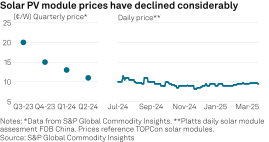
Meanwhile, solar panel prices have almost halved since 2023.
Platts, part of S&P Global Energy, assessed utility-scale TOPCon solar modules at $0.09/W (FOB China, 50-100 MW) on March 26, up 6% since the beginning of the year, but well below 2022 levels.
| Xlinks: key facts |
| 11.5 GW of large scale solar and wind coupled with 22.5 GWh battery storage |
| Aims to supply 8% of GB's electricity needs by early 2030s, reduce sector emissions by c. 10% in first year of operation |
| Generation site in Province of Tan-Tan, 140-km from Moroccan coast |
| 4,000-km subsea cable hugs coasts of Portugal, Spain, France at an average depth of 120 meters |
| North Devon landfall, then 14-km buried line to Alverdiscott substation |
| GBP100 million development funding from TAQA, Total Energies, Octopus, GE Vernova, AFC |
| JPM, SocGen supporting debt building |
| Source: Xlinks First Ltd. |