19 Mar 2020 | 05:21 UTC — Singapore
It's time for Asia to give wings to its hydrogen dream, says industry expert
By Sambit Mohanty and Deepak Kannan
Highlights
China, India offer scope to produce hydrogen from coal
Storage, transport and delivery some key challenges
S&P Global Platts has started hydrogen price assessments
Hydrogen offers Asia a practical option to cut carbon emissions as well as reduce dependence on fossil fuel imports, creating an urgent need to frame policies aimed at encouraging production and demand that would eventually lead to effective price discovery, a top industry official said.
In addition, policymakers will have to push technologies that encourage production of hydrogen from coal in countries like India and China, rather than expanding power output from coal-based power plants to drive electric vehicles, said Ravinder Kumar Malhotra, president of the Hydrogen Association of India.
"As soon as we can create demand and a market place for hydrogen, we will need a price discovery mechanism," Malhotra, who is also the director general for the Federation of Indian Petroleum Industry, told S&P Global Platts in an interview.
"For Asian countries, hydrogen is a more reasonable option. China is looking at fuel cells seriously, South Korea is also eying hydrogen fuel cells seriously. Japan is also looking at hydrogen fuel cells," he added.
Platts has started providing independent hydrogen price assessments based on the value of hydrogen produced at hubs in the United States and Europe.
Analysts are of the view that Asia needs to quickly find ways to slash hydrogen production costs, drawing in investors and diversifying its usage beyond oil refining, fertilizers and petrochemicals.
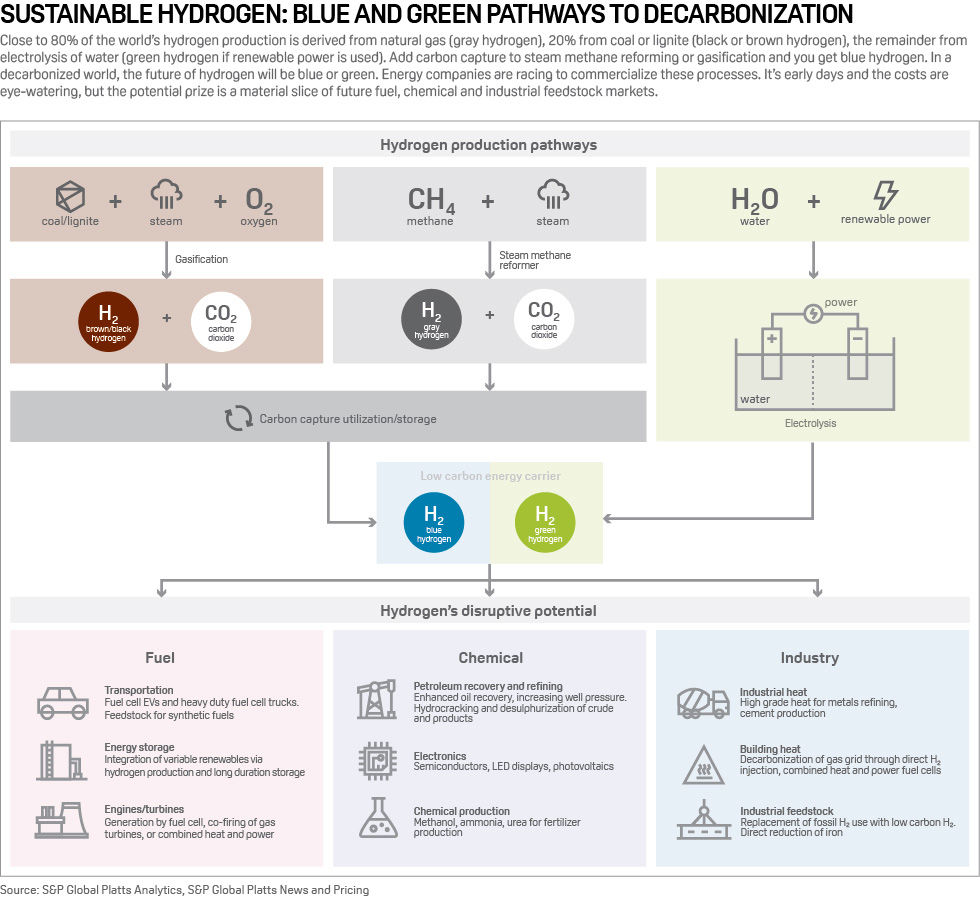
Hydrogen is produced predominantly through Steam Methane Reforming (SMR), which utilizes fossils fuels, such as natural gas or coal, and through Proton Exchange Membrane Electrolysis, which splits water into hydrogen and oxygen using a current of electricity.
Currently, hydrogen is mainly used by refineries, the largest producers and consumers of hydrogen, as well as in ammonia and methanol production.
"In the near term, may be until 2030, the cost advantage of producing hydrogen from fossil fuels is likely to continue. We will have to fix carbon while producing hydrogen from oil and gas or even coal," Malhotra said.

"Time is right"
The International Energy Agency said in a study last year that the "time is right" to tap into hydrogen's potential as it offers ways to decarbonize sectors such as long-haul transport, chemicals, iron and steel, where it is proving difficult to meaningfully reduce emissions.
Malhotra said that for Asian countries with plentiful supplies of coal, producing hydrogen from coal with new technologies may prove to be cost effective.
"China has started producing a lot of hydrogen from coal. India can also take the coal gasification route by promoting new technologies. This is what we have been urging the policymakers to do," Malhotra said.
"However, carbon emissions in hydrogen production from coal amounts to 19 mt of CO2 per mt of hydrogen produced, which is twice as much as for the hydrogen produced from natural gas. This means that carbon capture, utilization and storage technologies will need to be used if hydrogen from coal is to have a place in the era of energy transition," Malhotra added.
Making a relative comparison between hydrogen and electric power, Malhotra said that currently when hydrogen is produced by electrolysis then only 30% of the energy is lost, but when electricity is made from coal or natural gas, 60-70% of the energy is lost in production and distribution.
"We also need to compare the overall carbon emissions. It is estimated that as long as we continue to produce electricity from coal and use it in electric vehicles, the carbon emissions issue would be even more serious as compared to use of petrol and diesel," he said.
Opportunities lie ahead
The IEA has identified a few ways to create demand for hydrogen: making industrial ports nerve centers for hydrogen use; introducing clean hydrogen to replace a small portion of natural gas supplies; powering high mileage cars, trucks and buses; and launching trade in hydrogen.
"In Asia, the transportation sector offers the best opportunity to push hydrogen. According to Toyota, it plans to bring the price of fuel cell cars to the level of hybrid cars by 2025. Even Tata Motors in India is looking as a hydrogen fuel cell bus," Malhotra said.
Malhotra said that storage, transport and delivery of hydrogen offer some major challenges in Asia. Infrastructure plans will need support from their respective oil and gas industries.
"The oil and gas industry have experience of handling hydrogen in refineries, besides transportation, supply and distribution of natural gas. That industry can therefore have smooth transition to produce and distribute hydrogen for various applications," he said.
"Although the challenges are slightly different -- for example embrittlement of steel with hydrogen and high pressures required for storage -- they are not insurmountable and can be easily addressed," he added.
Giving an example, Malhotra said India is building a large gas grid to supply natural gas which will cover almost 70% of the country's population. "We can always have decentralized hydrogen reformers close to the natural gas pipeline and supply hydrogen in nearby areas," he added.
Click here to see full-size image