Electric Power
January 26, 2026
US power prices remain elevated, crews work to restore power after winter storm

By Kassia Micek
HIGHLIGHTS
MISO, PJM forecast to break winter load records
PJM West Hub traded at $1,300/MWh for Jan. 27
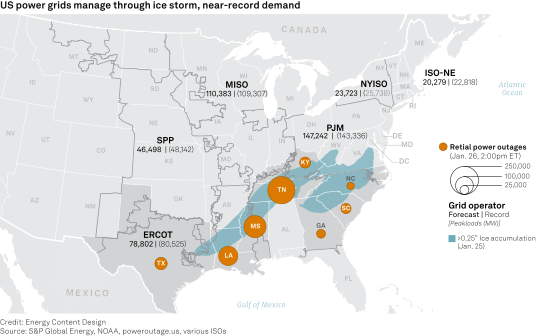
Two US grid operators forecast peakload to surpass winter records in the coming days, while many regions elevated or extended grid notices as a major winter storm left nearly 800,000 customers without electricity at midday Jan. 26.
Power outages across the US started Jan. 26 at over 800,000, but decreased to 725,000 by 2 pm ET, according to poweroutage.us. Tennessee has the majority of outages at over 238,000 followed by Mississippi with nearly 157,000 and Louisiana with around 117,500.
"Much of the eastern two-thirds of the country will remain in a deep freeze following the expansive major winter storm with lake-effect snow lingering downwind from the Great Lakes," The US National Weather Service's Weather Prediction Center said in its Jan. 26 forecast.
An extreme cold warning, among other weather warnings, spanned from Texas to Florida to New York state. Parts of New York and New England are under a winter storm warning and winer weather advisory.
Utility response
The Tennessee Valley Authority said its power generation plants were performing well, but "due to heavy ice and high winds, many customers remain without power following the storm," TVA said in a statement.
"Crews are assessing storm damage, repairing TVA's transmission lines, and also helping local power companies restore their distribution lines," TVA said in the statement. "We are making progress despite difficult conditions for workers, including fallen trees, deep snow, icy roads and frigid temperatures."
Currently, 17 local power company delivery points are out of service, affecting 12 of TVA's 153 local power companies, according to TVA, adding 16 161-kV line sections, four 69-kV sections and five 46-kV sections remain out.
In Louisiana, Entergy expected that 90% of customers in areas with favorable access along the I-20 corridor who can safely receive power will be restored by Jan. 28 evening, the utility said in a statement.
"Restoration in other highly impacted, hard-to-access areas may experience restoration efforts continuing through the end of the day Jan. 29," Entergy said.
Duke Energy had restored power to more than 131,000 customers in the Carolinas as of 2 pm ET Jan. 26, according to a statement.
"Our crews are on track to restore most outages by tonight (Jan. 26)," Duke Energy storm director Rick Canavan said in a statement. "We're seeing isolated pockets of more extensive equipment damage along the Blue Ridge Escarpment – in places like Hendersonville, Travelers Rest and Clemson – so some customers in those areas may not have service restored until Tuesday (Jan. 27)."
PJM, MISO could break peakload records
Wholesale power prices continued to climb, with the exception of trading locations in the Electric Reliability Council of Texas, where on-peak day-ahead for Jan. 27 traded at $127/MWh on the Intercontinental Exchange, as the on-peak balance-of-the-week package traded at $90/MWh. ERCOT, which remains under a weather watch through Jan. 27, issued a Transmission Emergency around 9 pm CT Jan. 25 due to the loss of generation and transmission line issues in the San Antonio and Houston area.
In the PJM Interconnection, West Hub on-peak real-time for Jan. 26 traded at $550/MWh on ICE, while on-peak day-ahead traded at $1,300/MWh and off-peak traded at $750/MWh.
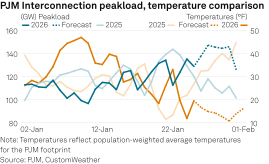
PJM forecast peakload at 147.242 GW Jan. 27, 2.7% above current winter record of 147.336 GW reached Jan. 22, 2025.
"Peak demand has the potential to exceed 130,000 MW for seven straight days, a winter streak that PJM has never experienced," PJM said in a Jan. 25 blog.
As the cold weather drove up heating demand, PJM declared a maximum generation emergency/load management alert and an EEA1 for Jan. 27.
"Generation dispatchers should provide PJM with an estimate of the amount of time they need to return to service any generator on a planned outage," according to the notice.
The grid operator also extended the cold weather advisory, which started Jan. 24, through Feb. 1.
The Midcontinent Independent System Operator forecast peakload to reach 110.383 GW Jan. 26, 1.076 GW above the current winter record of 109,307 GW reached Jan. 6, 2014. MISO extended its Conservative Operations Declaration, which started Jan. 23, through Jan. 29 due to the "significant snow and icing expected, along with cold temperatures." It also extended its cold weather alert, which started Jan. 23, through Jan. 31.
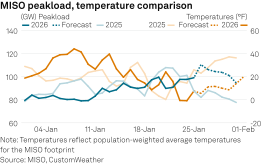
Over the weekend, MISO declared a maximum generation event or Energy Emergency Alert 1 starting Jan. 24 for the Central and North regions due to forced generation outages, below normal temperatures, and transfer capabilities. It later upgraded to an EEA 2 before easing back to an EEA 1 through midnight Jan. 25.
MISO's Indiana Hub on-peak day-ahead was bid at $325/MWh, while on-peak bal-week was bid at $560/MWh and offered at $900/MWh on ICE.
Return to normal
In the neighboring Southwest Power Pool, operating conditions returned to normal as of 12 pm CT Jan. 26, but the grid operator extended its Weather Advisory, which started Jan. 23, to noon Jan. 28 "to continue maintaining awareness of the potential for weather-related impacts on system resources." Weather advisories do not require the public to conserve energy. The resource and conservative operations advisories expired at 12 pm CT Jan. 26 as scheduled.
SPP North Hub on-peak day-ahead was offered at $450/MWh, while South Hub traded at $300/MWh on ICE.
In ISO New England, Mass Hub off-peak day-ahead traded at $775/MWh on ICE, while on-peak bal-week traded at $794/MWh and off-peak traded at $708.33/MWh. The grid operator implemented at 9 am ET Jan. 25 master local control center procedure No. 2, or abnormal conditions alert, due to severe weather. The alert requests operators "not engage in activities that may jeopardize the availability of resources or transmission under your control."
New York Independent System Operator did not have any active grid alert, although prices remained elevated. Zone G balance-of-the-week was bid at $750/MWh and offered at $1,025/MWh on ICE, while Zone A was offered at $975/MWh and Zone J was offered at $1,125/MWh.

Editor: