Electric Power, Energy Transition, Renewables
January 14, 2026
US SOLAR TRACKER: 2.25 GW solar capacity added in Q3, in line with projections
HIGHLIGHTS
Texas added the most solar capacity in Q3 at 965 MW
Indiana knocked Illinois out of the top 10 ranking
Solar-powered generation fell behind energy storage in US clean energy additions during the third quarter of 2025, making up 30% of total renewable installations, even as installations were in line with projections.
The US added 2.25 GW of solar capacity in Q3, an increase of 1.5% from the end of Q2 and climbing 15.8% from a year ago, according to data from S&P Global Market Intelligence.
"Solar capacity additions are increasing, supported by the relatively short development timeline of 18 to 24 months for utility-scale projects," said John Murray, principal analyst at S&P Global Sustainable1 focused on North America renewable markets. "Solar energy represents the most expedient avenue for states to expand utility-scale generation capacity."
The US had 50.7% less solar additions in Q3 compared to Q2, which had 21% less than the amount added in Q1.
Capacity additions
Only nine states added solar capacity in Q3, down from 22 states in Q2, which was down from 29 states in Q1, according to Market Intelligence data.
Texas leads the US in solar capacity with 32.748 GW by the end of Q3, or 21.7% of US solar capacity, according to the data. The state added the most solar capacity in Q3 at 965 MW, or 43% of Q3 solar addition.
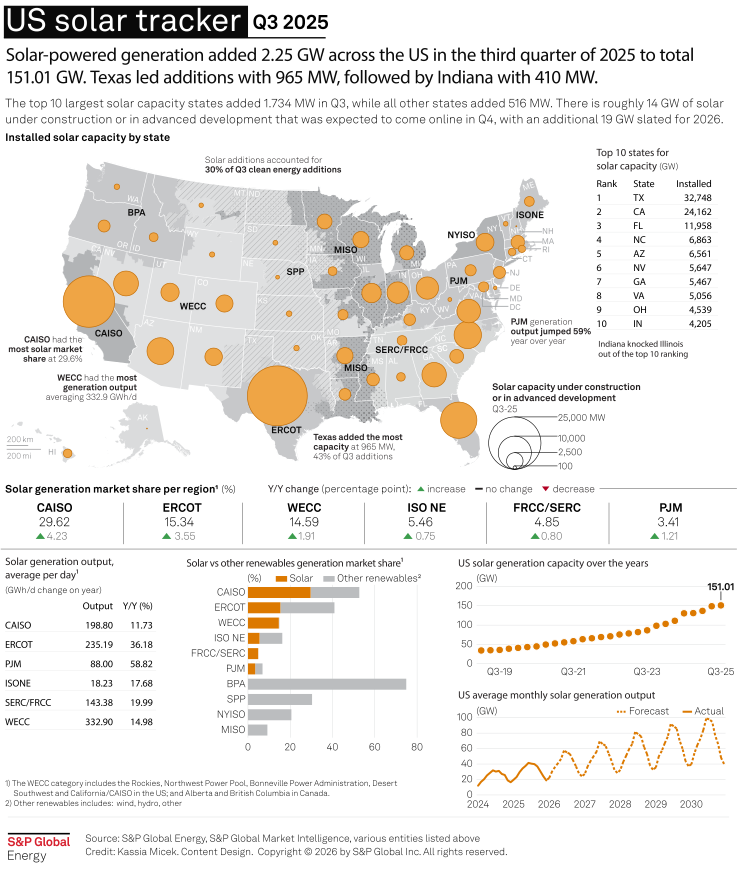
California ranks second for solar capacity with 24.162 GW and added 359 MW in Q3, or 16% of Q3 solar additions.
In total, three states have over 10 GW of capacity, 24 states have between 1 GW and 10 GW, and 2 states have less than 1 GW. North Dakota remains the only state without any solar capacity, although the state has 200 MW in the project pipeline that is slated to come online in 2027, according to Market Intelligence data.
What's next
By technology, solar made up the largest share of the project pipeline, the American Clean Power Association said in its Q3 report. The solar pipeline has grown at an average pace of 2% each quarter over the last two years.
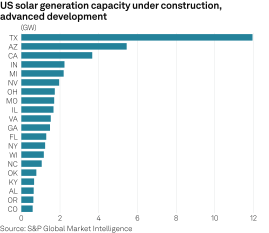
There is roughly 49.2 GW of solar projects across 44 states under construction or in advanced development in the US, according to Market Intelligence data. The majority of that is in Texas with 11.95 GW, followed by Arizona with 5.45 GW and California with 3.67 GW. Rounding out the top five are Indiana with 2.2 GW and Michigan with 2.2 GW.
Capture prices trend mixed
Despite the forthcoming phase-out of tax credits in 2027, declining solar costs have rendered solar power cost-competitive with other generation sources, Murray said.
The California Independent System Operator observed a slight downtick in average capture prices across its three generation hubs, decreasing 35 cents year on year in Q3 to an average of $29.26/MWh, according to Platts data.
CAISO's bearish average regional capture prices were driven by rising capacity additions both year over and quarter over quarter.
Further explaining these decreases, CAISO's average peakload demand in Q3 fell 5.52% year on year, averaging 35.35 GW in Q3 2025, according to CAISO's demand data. SP15 was the only CAISO hub to maintain year-over-year capture price increases, rising 3.46% to average $35.74/MWh in Q3, according to Platts data.
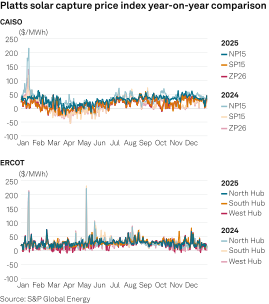
The Electric Reliability Council of Texas saw the opposite trend, with year-over-year Q3 capture prices increasing about 14.05% to average $30.76/MWh across its three hubs, according to Platts data. This also tracked year-over-year peakload demand changes, which rose 4.37% to a average of 77.32 GW in Q3, according to ERCOT's demand data.
Renewable output breakdown
As for total solar output across the US, greater capacity bolstered higher output. Solar generation output was up year over year in all regions of the country.
The Western Electricity Coordinating Council had the most solar generation output in Q3, averaging 332.9 GWh/day, an increase of 15% year over year, according to S&P Global Energy CERA data. The WECC data includes the Rockies, Northwest Power Pool, Bonneville Power Administration, Desert Southwest and California in the US, and Alberta and British Columbia in Canada.
However, the PJM Interconnection footprint had the largest year-over-year increase in solar generation output at 58.8% to average 88 GWh/day in Q2, according to data from the grid operator.
CAISO remains the region with the most solar market share in its fuel mix, averaging 29.6% in Q3, up 4.2 percentage points from a year ago, according to CAISO data.
Solar output across the lower 48 states is forecast to average 29.7 GW in Q1 2026, which would be a 20.7% quarter-over-quarter increase and a 22.8% jump from Q1 2025, according to S&P Global Energy CERA data.

Editor: