Crude Oil
December 31, 2025
COMMODITIES 2026: Industry calls for more oil, but capex spending sees muted growth

HIGHLIGHTS
E&P investment well below pre-pandemic levels
Environmental pressures ease, but capital hard to come by
Lower oil prices create harder investment climate
This is part of the COMMODITIES 2026 series, where our reporters bring to you key themes that will drive commodities markets in 2026.
Oil majors are unanimous in their calls for greater upstream investment, but globally, exploration and production spending is lagging behind historical norms -- including from the majors themselves.
Total upstream spending from the seven majors – ExxonMobil, Chevron, BP, TotalEnergies, Equinor, Eni and Shell -- is expected to tick slightly upward in 2026, but it has largely remained flat since 2023 and is well below pre-pandemic levels, according to industry analysts and companies' spending projections.
Spending on exploration has declined each year since 2023, as has the share of total upstream expenditure allocated to discovering new resources, according to analysts with S&P Global Energy CERA.
Upstream capital expenditures across all oil and gas companies were already slowing before the COVID-19 pandemic rocked the global economy, and investment fell further over the following years, as policy shifts emphasizing the energy transition and decarbonization took root.
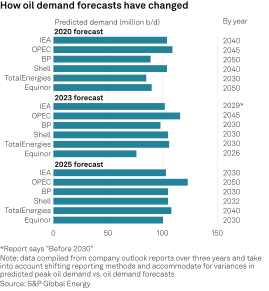
Some of that sentiment has reversed as energy security concerns in the wake of the Russia-Ukraine war gained prominence, but the industry has warned that without ramping up investment, a supply crunch may loom if forecasts of growing demand come to pass – with potential destabilizing impact on the world.
"It's a big near-term risk that you could have energy shortages," said Joe McMonigle, president and CEO of the Global Center for Energy Analysis.
Investment from banks and other financers may be increasingly hard to come by for exploration and production companies with oil prices mired in the low-$60s/b and many forecasts of a near-term oversupply, said Andrew Byrne, executive director of energy equity research at CERA.
"Lower oil prices should mean lower reinvestment rates, which in turn leads to lower volumes, tighter markets, and a future increase in prices due to shortfalls in production," he said.
Meanwhile, the majors, who largely self-fund their upstream operations, are scaling back their spending.
Spending specifically on exploration for new reserves has hovered around $10 billion annually since 2020, with levels from 2016-2019 closer to $12 billion-$13 billion coming off a nearly $20 billion spending spree in 2015.
Matti Teittinen, director of upstream companies and transactions research at CERA, added that many companies are now more financially disciplined and favoring returns to shareholders rather than spending purely for growth.
"The issue is not access to capital, but allocation of capital," he said.
Upstream spending as a total share of cash spent has climbed slightly since a low in 2021, but still hasn't reached anywhere near 2015 levels of 87%. In 2025 and 2026, CERA expects upstream's share of total spending to reach 76%.
Shifting spending priorities
S&P Global Energy estimated that 28 million b/d of new production sources will be needed by 2050 to meet global demand and shore up existing reserves, with the vast majority of that supply developable at $60/b.
Even with a slight spending uptick expected in 2026, organic upstream capital spending among the biggest firms is still below pre-pandemic norms. In 2019, the oil majors spent around $100 billion in the upstream sector, according to CERA data.
In 2025 and 2026, cash allocated to the sector is expected around $91 billion-$93 billion annually – roughly on par with levels from 2023 and 2024 and approximately 60% of the decade high of $153 billion in 2015, the CERA analysis shows.
Looking to keep costs in check and develop greener energy sources, the biggest IOCs have focused less on large-frontier opportunities in the recent past.
For Shell that strategy will continue.
"We prioritize shorter-cycle, higher-margin, lower-carbon barrels," Eugene Okpere, Shell's executive vice president of exploration, strategy and portfolio, told Platts, part of S&P Global Energy.
But across the board, that strategy has resulted in smaller discoveries that do less to shore up existing reserves, according to analysts at CERA.
The International Energy Agency has warned that existing fields are declining fast, with average depletion rates of 5.6% for conventional oil fields. TotalEnergies and Eni did not respond to requests for comment on their strategies, while Equinor declined to comment.
Shell has earmarked $12 billion-14 billion annually through 2030 for its upstream portfolio, enough to grow production roughly 1% each year, maintaining liquids production and growing gas production, and grow LNG sales by 4-5% per year.
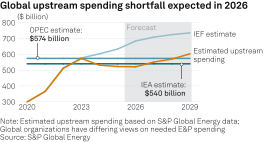
"With natural decline and recent industry underinvestment, continued upstream investment is essential to support energy security and a balanced energy transition," Okpere said.
BP pointed Platts to a February company update that said: "We have learned a lot over the last four years and...see that we haven't invested enough in our oil and gas businesses in that time period."
BP increased its prior guidance of around $8.5 billion per year for 2025 to 2027, to an average of around $10 billion per year and is planning to bring 10 major projects online by 2027 with an eye to boost production to 2.3 million to 2.5 million b/d in 2030, up from a previously expected 2.2 million b/d in the next five years.
Chevron directed Platts to its investor day presentation where the company noted it has lowered its capital expenditure guidance and its reinvestment rate. It said its hydrocarbon production will plateau through 2040, but maintains an option to grow its output.
ExxonMobil Vice President of Global Exploration John Ardill said: "We've never taken our foot off the pedal in exploration and production."
ExxonMobil is not "capex constrained" and is focused on developing its portfolio, including its giant Stabroek block in Guyana, he said. The company plans to spend between $28 billion and $32 billion annually from 2027-2030, compared with $26 billion spent in 2024, he added.
Ardill said that the old "slow and steady" exploration approach today has been sped up with the help of better technology that translates to faster, more efficient exploration and, ultimately, faster cash flow. Competitive fiscal terms, investor protections via contract stabilization and international arbitration are crucial to attracting Exxon's capital, Ardill said. Additionally, governments and investors must be aligned on development and investment terms.
Subdued spending
Beyond the biggest IOCs, smaller players are also expected to increase investment, with global exploration and production spending growing 3.7% annually through 2029, according to CERA.
But with long lead times on many projects, the clock is ticking on meeting future supply needs.
"Internationally, we are expecting to see increased spending for upstream projects," Rouzbeh Fazlinejad, managing director and head of Middle East and North Africa oil & gas at Houlihan Lokey, said. "We may find ourselves in a scenario where increased capital spending does not address the supply constraints, as many of these projects take a long time to develop."

Editor: