Crude Oil, NGLs
December 30, 2025
Venezuelan oil production, exports fall as US ramps up sanctions enforcement
By Kate Winston and Mery Mogollon
HIGHLIGHTS
Orinoco Belt crude production at 540,000 b/d
Chevron JV production stable
Exports fall to 17.6 million barrels in December
Venezuelan crude production and exports declined in December as the US intensified enforcement of sanctions on oil tanker shipments.
December oil production in Venezuela has averaged 963,000 b/d so far in December, down 158,000 b/d from November, according to preliminary data from a source at the Ministry of Hydrocarbons.
"Production fell in December, due in part to ongoing failures in automated systems and uncertainty over the US military presence in the Caribbean," said the official on condition of anonymity.
"We have a preliminary estimate of production, without details from joint venture fields so far," the official said.
Production in the Orinoco Belt, Venezuela's main oil-producing area, fell to 540,000 b/d in December from 630,000 b/d in November, according to the source.
Output from western fields, in Zulia and Trujillo regions, fell to 280,000 b/d in December from 326,000 b/d in November.
Production from fields located in Monagas state fell to 120,000 b/d in December from 140,000 b/d in November, the source said.
Monagas produces the Mesa and Santa Barbara light crudes that PDVSA uses in its refining system and also to dilute extra-heavy crudes from the Orinoco Belt.
Offshore condensate production was 18,800 b/d, and the production of PDVSA gas was 4,200 b/d in December, according to the source.
Total production in the joint ventures in which Chevron participates in Venezuela remained above 245,000 b/d in December, according to a Chevron source, who spoke on condition of anonymity.
When asked about oil production in Venezuela, Bill Turenne, a spokesperson for Chevron, said, "Chevron's operations in Venezuela continue in full compliance with laws and regulations applicable to its business, as well as the sanctions frameworks provided for by the US government."
PDVSA could not be reached for comment.
Exports to China fall
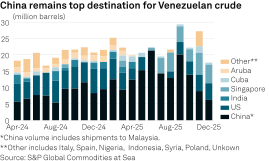
Venezuela has exported 17.6 million barrels of crude so far in December, down from 27.2 million barrels in November, S&P Global Commodities at Sea data shows.
Exports to the US remained stable at 5.1 million barrels in December, while exports to China fell to 2 million barrels in December from 8.9 million barrels in November. Still, exports to Malaysia, which are likely to go to China, rose to 4.2 million barrels in December from zero in November, according to CAS data, making China the top destination for Venezuelan crude.
The US seized two tankers carrying Venezuelan crude on Dec. 20 and Dec. 10, and has been in pursuit of a third tanker, the Bella 1.
On Dec. 16, US President Donald Trump ordered a "total and complete blockade" of sanctioned oil tankers to and from Venezuela, escalating pressure to remove Venezuelan President Nicolás Maduro from power.
Rachel Ziemba, a senior adviser with Horizon Engage, said that exports are down because ships are struggling to access and leave Venezuelan waters.
While lower Venezuelan exports are likely to continue, this may not have a meaningful impact on global prices due to the relatively small volumes from Venezuela and the record amount of oil on water, which is effectively acting as floating storage, Ziemba said.
"In my view, a major increase in oil prices would require not only losses from Venezuela, but also concurrent losses from other producers, including either sanctioned economies or any OPEC+ countries," Ziemba said.
It will be important to watch and see if Venezuelan authorities take any action to disrupt the US-bound supplies, which have remained stable in recent weeks, Ziemba said.
The US has intensified pressure on Venezuela in recent months, sending its largest aircraft carrier and strike group to the Caribbean, while attacking alleged drug trafficking ships.
With increased US action, oil supplies from Venezuela remain a huge question mark for 2026, experts say.
The US confirmed its first land strike against Venezuela, according to comments made by Trump on Dec. 29.
The number of US attacks on suspected drug smuggling vessels in the Caribbean and Eastern Pacific has risen to 30, with a death toll of 107, since September, according to the New York Times.
The US has also increased sanctions on Venezuela. On Dec. 11, the US sanctioned two individuals, six shipping companies and six tankers for operating in Venezuela's oil sector.
On Dec. 30, the US Department of Treasury's Office of Foreign Assets Control sanctioned 10 individuals and entities in Venezuela and Iran for their role in Iran's unmanned aerial vehicle trade with Venezuela.
"Iran's ongoing provision of conventional weapons to Caracas constitutes a threat to US interests in the Western Hemisphere, including the homeland, and the United States will use all available measures to prevent this trade," OFAC said in a Dec. 30 statement.
The sanctions include measures targeting the Venezuela-based company Empresa Aeronautica Nacional, which assembles Iranian UAVs in Venezuela, as well as company chair Jose Jesus Urdaneta Gonzalez.

Editor: