Refined Products, Crude Oil
December 22, 2025
COMMODITIES 2026: European refiners plead for CBAM protections

HIGHLIGHTS
Refining not in current scope of EU or UK CBAM
500,000 b/d of capacity shut down in 2025
Green investments stall amid policy uncertainty
European refiners warn they face an existential threat without import protections to address their unique carbon tax burden. Yet as calls for CBAM support continue to go unresolved, the coming year could prove consequential.
As the first place in the world to introduce carbon pricing, Europe imposes higher emissions charges than any other geography. As a result, it devised the carbon border adjustment mechanism (CBAM) to prevent its industries from being undercut.
From 2026 in the EU and 2027 in the UK, imports of CBAM products -- iron, steel, aluminum, cement, fertilizers, hydrogen, and, for the EU, electricity -- will incur a carbon charge, theoretically leveling the playing field against countries with low or no emissions costs.
Under the cap-and-trade ETS system, EU refiners have paid for a share of their emissions since 2013. However, the sector is not covered by CBAM, creating what producers call an untenable disadvantage.
Today, fuel producers pay for 30% of their emissions under the ETS, with the share set to rise to 75% by 2035. In the UK, refineries spent GBP200 million on compliance in 2024, according to Fuels Industry UK, a lobby group representing the downstream oil sector.
"It's a massive disappointment that the refining sector is not included in CBAM," Paul Greenwood, head of ExxonMobil UK, told the House of Commons Dec. 17. "We have very, very burdensome CO2 taxes imposed on us that the international competition does not." Perversely, emissions taxes can increase Europe's carbon footprint, he said, incentivizing long-haul shipments from hubs like Asia and the US.
Rising tax bills, combined with high labor costs and energy prices, have put pressure on producers. Despite healthy margins in 2025, Europe lost almost 500,000 b/d of its refining capacity, and the UK alone lost two of six facilities. Increasingly, oil majors have shed assets.
Some companies are willing to bet on policy intervention to preserve the sector. The UK's EET Fuels is investing $1.2 billion on cutting emissions at its Stanlow refinery by 95%, aiming to slash compliance costs and survive long-term. "We still believe CBAM will be implemented for fuel at some point, given it makes sense, but this will take time," said Viral Gathani, the company's head of strategic transitions.
In a Dec. 16 report, the European Commission set out two potential approaches to a refining CBAM -- exclusively covering products used as chemical feedstocks, or the entire commercial fuel sector. The UK government also recently confirmed it is considering including refined products in its CBAM.
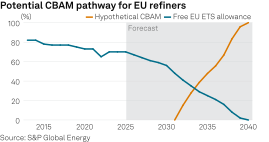
S&P Global Energy CERA analysts expect an EU refining CBAM to be debated in 2026, introduced in 2031 and scaled up until 2040, with an export rebate.
The energy challenge
As a sector subject to emissions charges, refining is an automatic CBAM candidate, but it faces unique practical and political hurdles that have delayed its inclusion and kept timelines fluid, said Dan Maleski, a CBAM specialist at environmental risk consultancy Redshaw Advisors.
In its report, the EC said that monitoring and verifying refined products emissions would be complex due to the "diverse products and production processes involved," although not technically insurmountable.
As the EU prepares to debut CBAM in Phase 1 sectors, Brussels is already troubleshooting problems like export leakage, resource shuffling and indirect cost compensation before it can expand into new, complex sectors, said Aaron Cosbey, senior associate at the International Institute for Sustainable Development.
With the system still in its pilot phase, policymakers are likely also to exercise caution before tackling the fuel sector.
"Taxing energy in general is politically challenging -- the recent delay of ETS 2 points to the difficulties there," said Catherine Wolfram, professor of energy economics at MIT Sloan. The EC also acknowledged "economic and social implications" linked to targeting fuels already subject to taxation.
History demonstrates strong policy inertia around fuel taxes, as exhibited by France's 2018 "yellow vest" protests. It is notable that President Donald Trump immediately excluded energy from his sweeping tariffs this year, perhaps recalling the backlash to crude and fuel duties in 1975.
Cheaper oil could tame inflation fears, and with Brent crude trading around $60/b, policies could become less politically charged. EV uptake may also dilute public scrutiny on diesel and gasoline retail prices.
On the other hand, politicians may feel less compelled to preserve a domestic refining sector. Recent plant closures have not received government bailouts, and Europe has become increasingly accustomed to importing more fuel.
In the rare cases of past interventions, policies had an obvious base, said Ewan Gibbs, an energy historian at the University of Glasgow. Britain, for example, introduced fuel import duties in the 1960s to support domestic coal use, but the landscape has changed dramatically. "Now there isn't the same argument for the welfare of millions of workers in the way that there was once around domestic coal and related infrastructures," he said.
Gone, too, are most state refining interests. The privatization of BP preceded the closure of all four of its former UK refineries, while national participation has shrunk across Europe. More often than not, government-backed stakes involve foreign entities, such as Socar, Rosneft, and Sonatrach.
Time pressure
If protections are coming, timing is critical. Refining margins are attractive by historical standards, but competition is fierce.
In 2026, India's Panipat and Barmer refineries will add 280,000 b/d of new capacity, while Africa's largest refinery, Dangote, plans to double in scale by 2028.
S&P Global Energy CERA forecasts European light sweet cracking margins falling from $8/b in real terms in 2025 to $6.4/b within the next decade, contrasting to the US where levels ease from $14.8/b to $13/b.
From a climate perspective, uncertainty over import protections could also defer critical investment.
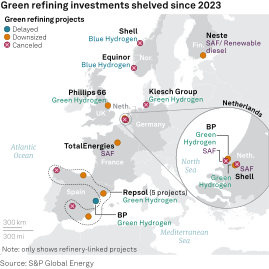
European carbon capture and storage investments should pay for themselves within 5-10 years, CERA analysis shows, but developments have stalled. As refiners mull their future, other marquee projects, including hydrogen and biofuels, have been sidelined.
For ExxonMobil, which recently dropped CCS plans for its Fawley refinery, timing is vital. "I think the government has realized that that is on the wrong pathway, the problem is that it is just slow, and it's taking far too long," Greenwood said.

Editor: