Refined Products, NGLs, LPG
December 22, 2025
COMMODITIES 2026: Canada eyes Asia for incremental LPG exports, race on to build new infrastructure
By Ashok Dutta and Benjamin Morse
HIGHLIGHTS
AltaGas to add 25,000 b/d of new export capacity at REEF
China emerging as lead destination after Japan, South Korea
Shipping time to Asia significantly less than US, Middle East
This is part of the COMMODITIES 2026 series, where our reporters bring you key themes that will drive commodities markets in 2026.
Canada has been behind the US in building new infrastructure for processing NGLs and exporting LPG to Asia. However, that scenario is changing rapidly with multiple projects underway along the Pacific Coast in British Columbia, which will position the nation as another reliable, long-term North American supplier, with the potential to offer competitive pricing, according to midstream players and industry stakeholders.
Canada produces around 500,000 b/d of LPG, of which nearly 50% is used domestically, and the balance gets exported to the US and Asia, AltaGas CEO Vern Yu said in late October on an earnings webcast, adding the US is already long on LPGs, so Canada needs to increase exports to Asia to maximize the value of its products.
Exporting to Asia via RIPET, or the Ridley Island Propane Export Terminal, located off the coast of northwestern British Columbia, offered a better netback of about $5/b than exporting to the US LPG hub in Conway, Kansas, the company said in a Dec. 2 investor presentation.
Propane exports out of the US Gulf have been supported by an FOB USGC-CFR North Asia spread that has averaged $145.59/metric ton over the last five years, according to Platts, part of S&P Global Energy.
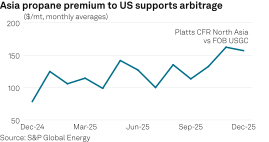
Aside from the price advantage, shipping from Canada's West Coast offers significant savings in shipping time.
From Ferndale, Washington or the RIPET terminal along the Canadian Pacific Coast, AltaGas estimates the travel time to be 10-11 days to China and Japan.
This is compared with the travel time from the USGC to China, which is more than double, or at least 25 days, as stated in the presentation.
Another logistical advantage to the West Coast exports is the ability to bypass the Panama Canal which has become increasingly congested and prone to delays. This situation was expected to potentially worsen as LNG exports increase and take priority in the canal over Very Large Gas Carriers.
Given these advantages, in May 2024, a partnership between AltaGas and Vopak announced that they were moving ahead with the Ridley Island Energy Export Facility, a purpose-built LPG and bulk liquids terminal featuring rail, logistics, and marine infrastructure on Ridley Island, British Columbia.
With a capacity of 55,000 b/d under the first phase of its development, a prime driver for the investment that would cost an estimated $970 million is incremental exports to the Asia market.
The facility is due to start up in late 2026. But in October, AltaGas unveiled Opti 1, which Yu termed as the first in a series of optimizations and expansions at REEF to add 25,000 b/d of throughput to the facility by mid-2027.
Strong demand for infrastructure
The AltaGas/Vopak partnership is also advancing engineering, permitting, and stakeholder work for REEF Opti 2 that could accommodate up to another 60,000 b/d of incremental throughput, he said.
"We've seen tremendous interest in tolling from our customers," Yu said. "We're right now moving as much LPG as we can to Asia, and that interest continues to grow. So, the optimization was very well received, commercially."
AltaGas is a leading exporter of LPG from the Pacific West Coast, sending out 133,000 b/d on 23 VLGCs in the third quarter.
The bulk of the exports went to Japan and South Korea, but this focus is shifting to China, particularly driven by rising demand for feedstocks for propane dehydrogenation plants.
In 2025, China started up 2.56 million mt/year of PDH plant capacity and is forecast to add another 1.9 million mt/year in 2026, with an additional 1.62 million mt/year slated for startup in 2027, according to S&P Global Energy CERA.
Tariffs imposed by the US on China are also impacting trade flows, creating an opportunity for Canada, said Bill Rawlusyk, a consulting director at CERA.
CERA expects Canadian propane exports to rise to 244,000 b/d in 2026 from 230,000 b/d in 2025, while butane exports are expected to reach 83,000 b/d in 2026 from 78,000 b/d in 2025.
"Today, Canadians take a haircut [in terms of pricing and competition from the US Gulf Coast and the Middle East]," Rob Booker, CEO of Trigon Pacific terminals, told Platts. "The competition for liquids in the US is about to go up significantly due to drilling in the Permian Basin, where producers have wells that have lots of NGL."
Trigon is collaborating with the Prince Rupert Port Authority to advance its planned 2.5 million mt/year LPG export terminal on the Pacific Coast.
"Demand in Asia will always price higher than what we can get in the US," Booker said.
Output to increase with LNG
Production growth in the Montney basin -- the prime source of Canadian NGLs -- has been restricted. However, that is changing fast with the startup of Shell Canada's two LNG trains and work underway on an additional 3.5 Bcf/d of feedgas demand from other such facilities.
NGL output is forecast to be 1.6 million b/d in 2025, up from 1.4 million b/d in 2019, Rawlusyk said, noting that with the planned LNG development, in particular the 12 million mt/year Ksi Lisims LNG development, output is forecast to grow further.
What had been widely rejected by the Canadian industry as a byproduct of crude oil or natural gas production, and occasionally sold at a negative price, is now profitable and attracting major investments. Once all the planned projects are done, Canada will become one of the world's largest LPG exporters behind the US and the Middle East.

Editor: