Natural Gas, Crude Oil, LNG
December 19, 2025
COMMODITIES 2026: Oil majors flock to Libya as sentiment improves

HIGHLIGHTS
NOC targeting 2 mil b/d crude output by 2028
BP, Shell, ExxonMobil all agree to return to Libya
Rising Libyan flows would hit Med refining margins
Libya is preparing for the return of international oil companies in 2026 as its state producer shrugs off over a decade of domestic volatility to target higher output.
This year, oil production in the North African country has repeatedly hit new 12-year highs as a period of perceived political stability and security has improved the operating environment. That has heralded the return of oil majors, eager to tap Libya's estimated 48 billion barrels of crude reserves.
After a decade and a half of instability, Libya watchers are wondering whether it can last. "The broad improvement in Libya's security situation since the 2020 ceasefire between the country's competing governments is undeniable," said Hamish Kinnear, senior MENA analyst at Verisk Maplecroft, a risk intelligence firm. "That said, the political situation remains fraught, with major implications for the oil and gas sector."
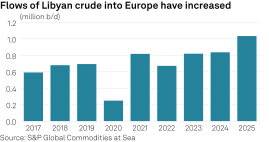
At stake is the flow of well over 1 million b/d of Libyan crude into the Mediterranean market -- where consumers are shifting away from Russian hydrocarbons.
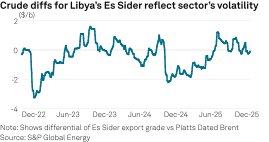
Platts, part of S&P Global Energy, assessed Libya's light sweet Es Sider export grade at $59.90/b, a 10 cents/b discount to Dated Brent on Dec. 17, after steadily strengthening since October 2024, when it was trading at a $2.20/b discount.
Production boost
Crude production has been volatile since the fall of Moammar Qadhafi in 2011. In 2018, Libya was split between rival governments in the west and east, resulting in a struggle for control of the National Oil Corp.
During the 2011 civil war, production slid from 1.58 million b/d to just 20,000 b/d, according to the Platts OPEC+ Survey from S&P Global Energy. Since then, it has seen frequent falls, most recently in September 2024, when a shutdown by the eastern faction -- dominated by warlord Khalifa Haftar -- slashed output to 580,000 b/d.
It has rallied this year, rising to 1.26 million b/d in September, according to the Platts Survey, the highest level since mid-2013.
According to remarks from NOC officials and statements from the state oil firm, the rise has been driven by satellite discoveries and well start-ups, reduced downtime at crude projects and heightened security around pipelines and installations. Recent highlights include small discoveries by NOC subsidiary Agoco and Algeria's Sonatrach in the Ghadames Basin and Austria's OMV in the Sirte Basin, underpinned by contracts signed over a decade ago.
Waha Oil, an NOC subsidiary, says it has hiked production by 20% since 2024 through maintenance programs, reopening shut-in wells and drilling new ones.
Libya has also launched its first post-revolution licensing round, which has received interest from 40 companies, NOC chairman Masoud Suleman told the ADIPEC conference in Abu Dhabi in early November.
In all, Libya is planning to hike output to 2 million b/d by 2028, according to the NOC's latest production goals.
That would have a knock-on effect in Europe's refining sector, where plant operators have long prized Libya's light sweet crude. Rebeka Foley, Senior Principal Analyst, Near-Term Oil Markets at S&P Global Energy CERA, said the increased supply of Libyan crude would hit refining margins.
"In the near-term, any influx of lighter/sweeter crudes will put further downward pressure on clean product cracks in Europe, which are already edging lower, as fundamentals weaken seasonally (softer gasoline demand, increasing refinery supply) and risk premiums fade (higher runs increasing output, diesel stocks ample)," Foley said.
"Greater supply in the next year will continue to support yields of lighter products, offsetting gains to margins from delayed refinery ramp-ups and resilient gasoline demand."
Forecasts from CERA analysts show ARA gasoline cracks softening to an average of $13/b in 2026, from $15/b in 2025, due to new capacity and strong refining runs.
Diesel is expected to average $18/b in 2026, down from $24/b, while jet cracks should fall by $3/b year over year to $19/b.
IOC influx
Improved sentiment in Libya's upstream sector has seen IOCs return after lengthy hiatuses.
In July, Shell and BP confirmed they had signed agreements with the NOC to assess Libyan exploration opportunities. One month later, US supermajor ExxonMobil inked a deal covering technical studies on a cluster of offshore blocks.
Eni, Repsol and TotalEnergies had already returned and boosted exploration activity, while Suleman told the Adipec conference in November that NOC had "something in the pipeline ... with Chevron." The US oil giant quit Libya in 2010.
"Improving security is the key factor behind the recent rise in interest from IOCs in the Libyan market," said Kinnear. "A new bidding round earlier this year and a willingness on the part of the NOC to consider fiscal terms more favorable to investors has also facilitated interest."
However, Tim Eaton, senior research fellow at Chatham House, said there is a "seeming paradox" between the IOC re-entries and the lack of concrete progress on the political and security front.
"For some, the lack of fighting in recent years indicates a return to stability, but the reality is otherwise," Eaton said in an interview with Platts. "Libya remains deeply divided."
Political risks
In Libya, the analysts said, political and security concerns are always front of mind for oil majors.
Local news reports of an assault on the NOC in late May -- which was quickly denied by the state oil firm -- triggered a threat from the east to shut down fields, while the killing of a prominent militia leader prompted some of Tripoli's worst fighting in years.
In June, payment issues related to the conclusion of a crude-for-fuel swap system sent gasoil/diesel imports to 32-month lows, according to S&P Global Commodities at Sea data and gasoil traders, as Platts reported at the time.
"A permanent political settlement that re-unifies Libya's competing governments is still a remote prospect given the entrenchment of two governing elites," said Kinnear. "However, as the recent rise in interest from IOCs shows, commercial operators with a high-risk appetite may accept a degree of political instability as the price of doing business."

Editor: