Crude Oil
November 13, 2025
India may boost Russian crude oil imports in Nov ahead of US sanctions deadline
HIGHLIGHTS
Festival demand, higher refinery throughput aid Oct purchases
Refiners rush to secure Russian cargoes ahead of Nov 21 deadline
Diversification to non-Russian suppliers expected from Dec
India's inflows of Russian crude oil could rise further in November as refiners expedite purchases ahead of the US deadline on sanctioned companies, after imports increased in October due to higher domestic demand during the festival season, according to industry sources and analysts.
The country's Russian-origin crude imports averaged 1.69 million b/d in October, edging up from 1.64 million b/d in September, the latest data from S&P Global Commodities at Sea show.
While December will be the first month to fully reflect the impact of US sanctions on Russian oil companies regarding crude flows into India, refiners have already begun securing import deals with suppliers from North America, Africa and South America -- viewed as potential alternative sources -- in addition to negotiating higher term volumes with traditional suppliers, according to the analysts.
"Russian flows to India in November could be even higher than in October, driven by the rush to secure barrels before sanctions on Rosneft and Lukoil take effect," said Premasish Das, executive director for oil analytics at S&P Global Energy.
"Future inflows will depend on how strictly the US enforces these sanctions and whether companies are willing to take any risks. Indian companies may still purchase from unsanctioned sources," Das said.
On Oct. 22, the US imposed sanctions on Rosneft and Lukoil, with the Office of Foreign Assets Control setting Nov. 21 as the deadline for companies to wind down transactions involving the newly sanctioned entities. The following day, the EU enacted comprehensive transaction bans on Rosneft and Gazprom Neft, along with sanctions targeting Lukoil’s subsidiary Litasco and Chinaoil, a Hong Kong-based trading division of China’s state-owned CNPC and Sinochem.
New Delhi has stated that it is examining the impact of US sanctions on Russian companies and will closely monitor the evolution of market dynamics in the global oil trade, noting that India's energy policy will be guided by the energy security needs of its population of 1.4 billion.
"Russian crude loadings have surged in response to reduced domestic refinery capacity caused by drone strikes," said Benjamin Tang, head of liquid bulk at CAS.
"Additionally, Indian refinery operations typically peak in the fourth quarter, heightening the demand for crude imports," Tang said. "There is also a pressing urgency to discharge Russian cargoes from Rosneft and Lukoil before the OFAC sanctions wind-down deadline on Nov. 21."
Top supplier
Russian-origin crude oil accounted for 36% of India's total imports from January to September, with about two-thirds of these volumes linked to Lukoil and Rosneft, according to CAS.
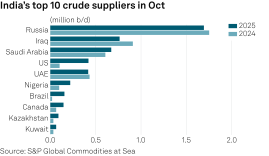
Indian refiners have adopted varied strategies as they seek to diversify their supplies. Indian Oil Corp. has stated that it will continue sourcing from non-sanctioned entities, while Nayara Energy has said it is awaiting government direction. HPCL-Mittal Energy has announced the suspension of Russian oil purchases pending government guidance.
"It is important to note that the purpose of the sanctions may be to force Russia to negotiate an end to the war in Ukraine, and not to shut down Russia's oil industry," Das said. "Still, these sanctions are potentially the most powerful oil sanctions yet deployed by the US and could substantially reduce the number of buyers of Russian oil."
Analysts said India's refinery throughput typically increases from September onward to meet the heightened demand during the festive season and winter months.
"As refiners pushed runs higher in October, they would draw more crude, including Russian grades," said Rajat Kapoor, managing director for oil and gas at Synergy Consulting. "While some refiners have cut down on Russian crude, they have been buying Urals grade via non-sanctioned traders or through sellers not on sanction lists; cargoes sold by such non-sanctioned entities continued to flow in October."
Since the US sanctions were announced in October, they are not expected to prevent cargoes already en route or those recently contracted from reaching their destinations, according to Kapoor.
"However, a decided pullback has occurred as no new orders have been placed by five major Indian refiners for December delivery, seen in light of US sanctions pressure and tariff threats," Kapoor said. "But we do not see a complete abdication of Russian crude by India."
Price impact
Kapoor said Indian refiners could take advantage of the widened discounts for Urals and ESPO crudes compared with Brent and Dubai benchmarks, allowing them to secure low-cost spot cargoes, especially from unsanctioned traders. "By all accounts, discounts on Urals could deepen further, but financing and compliance risks remain," he said. "Under such a scenario, we expect India's crude buying diversification to continue."
Platts, part of S&P Global Energy, assessed Urals crude on a DAP West Coast India basis at a discount of $2.95/b to front-month Dubai on Nov. 12.
Tushar Bansal, senior director at consulting agency Alvarez and Marsal, said the sanctions imposed on Nayara Energy's 400,000 b/d Vadinar refinery in July also disrupted its purchases from other suppliers.
Consequently, the refinery increased its procurement of Russian crude to maintain operational runs, which has been reflected in the overall rise of Russian crude inflows into India since then.
In the week to Nov. 2, Nayara Energy imported 420,000 b/d of Russian crude to the terminal that feeds its Vadinar refinery, more than double its import volumes before it was targeted by Brussels lawmakers, according to CAS.
"Also, a lot of Indian refineries [underwent] maintenance in August and September, coinciding with lean demand months, and have subsequently increased runs in October," Bansal said.
"Going forward, there could be an increase in November inflows prior to the US sanctions kicking in, and subsequently, increased non-Russian crude purchases by refiners could show up in December, January and February arrivals," he said.
